


Correlation between the Serum Platelet-Derived Growth Factor, Angiopoietin-1, and Severity of Coronary Heart Disease
- PMID: 32963822
- PMCID: PMC7501570
- DOI: 10.1155/2020/3602608
Correlation between the Serum Platelet-Derived Growth Factor, Angiopoietin-1, and Severity of Coronary Heart Disease
Abstract
Background: The expression of the platelet-derived growth factor (PDGF), angiopoietin-1 (Ang-1) in patients with coronary artery disease of different studies was inconsistent. This study was to investigate the expression of the PDGF and Ang-1 in peripheral blood and coronary artery in patients with acute coronary syndrome (ACS) and the relationship between the expression of the PDGF and Ang-1 and the severity of coronary artery disease.
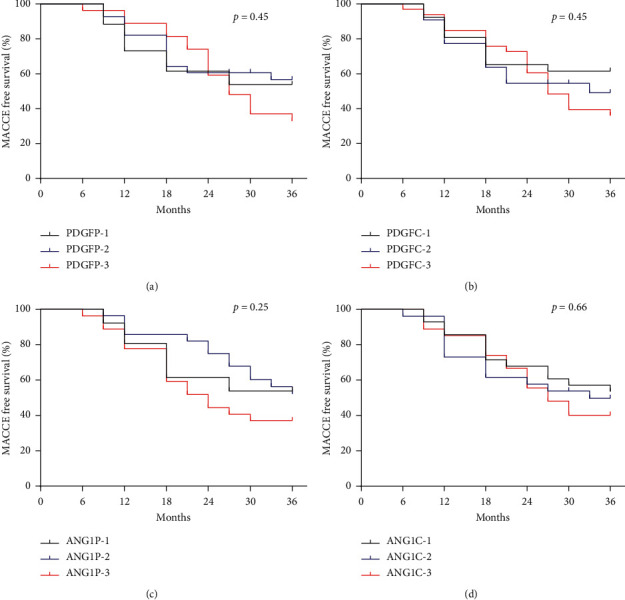
Methods: A total of 81 patients with acute coronary syndrome undergoing coronary angiography were enrolled from September 2012 to December 2013. Patients with ACS included 61 patients with acute myocardial infarction (AMI group) and 20 patients with unstable angina pectoris (UAP group). The 29 patients who were hospitalized for chest pain undergoing coronary angiography without stenosis and with TIMI level 3 blood flow were selected as the control group. During coronary arteriography (CAG) or percutaneous coronary intervention (PCI), blood in the peripheral artery and in the local coronary artery was collected from all the patients. Serum PDGF and Ang-1 levels were measured by ELISA. We calculated the Gensini score of each patient with CHD according to the result of CAG. Patients with ACS were followed up, and the major adverse cardiovascular and cerebrovascular adverse events were recorded.
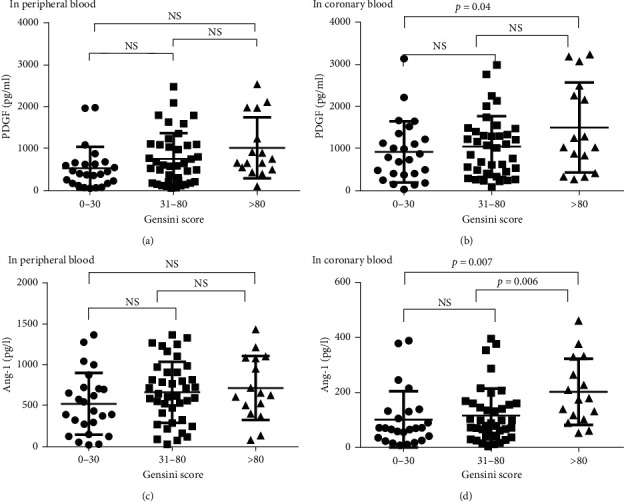
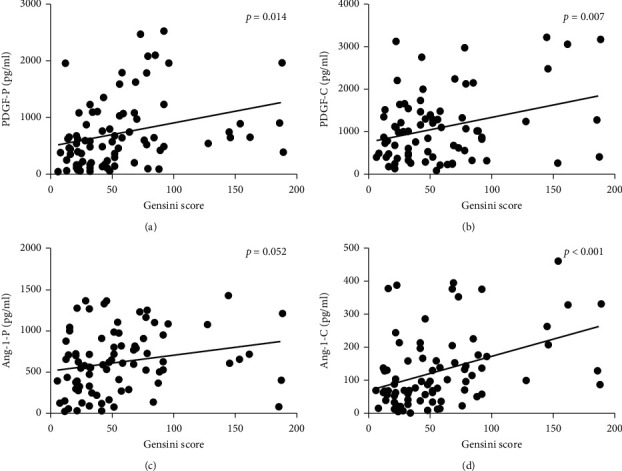
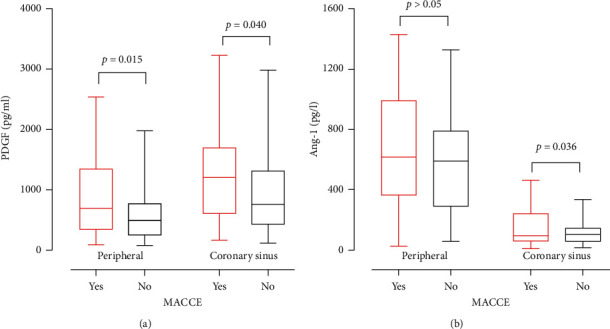
Results: In peripheral blood, the concentration of the PDGF was significantly elevated in the ACS group than that of the control group. The level of the PDGF in the AMI group was significantly higher than that in the UAP group. In coronary artery blood, the level of the PDGF in the ACS group was significantly higher than that of the UAP group. There was no significant difference in the concentration of Ang-1 in peripheral blood between patients with coronary heart disease and the control group. The concentration of Ang-1 in the coronary artery was significantly lower than that in peripheral blood. The coronary Ang-1 concentrations in the ACS group were significantly higher than those in the UAP group. The concentrations of the PDGF and Ang-1 in peripheral and coronary artery blood were positively correlated with the severity of coronary lesions. Patients with MACCE had higher PDGF and Ang-1 levels in the coronary sinus.
Conclusion: The serum PDGF concentration in patients with acute coronary syndrome was significantly increased, especially in the local coronary artery. The serum Ang-1 in the coronary artery was significantly increased in patients with acute myocardial infarction and was related to the degree of coronary artery stenosis. Coronary sinus PDGF and Ang-1 levels can reflect the severity of lesions in patients with acute coronary syndrome.
Copyright © 2020 Sisi Pang et al.
Conflict of interest statement
The authors declare that there are no potential conflicts of interest.
Figures
References
LinkOut - more resources
Full Text Sources
Miscellaneous