


Administration of all-trans retinoic acid after experimental traumatic brain injury is brain protective
- PMID: 32964418
- PMCID: PMC7588818
- DOI: 10.1111/bph.15259
Administration of all-trans retinoic acid after experimental traumatic brain injury is brain protective
Abstract
Background and purpose: All-trans retinoic acid (ATRA) is a vitamin A metabolite, important in the developing and mature brain. Pre-injury ATRA administration ameliorates ischaemic brain insults in rodents. This study examined the effects of post-traumatic ATRA treatment in experimental traumatic brain injury (TBI).
Experimental approach: Male adult mice were subjected to the controlled cortical impact model of TBI or sham procedure and killed at 7 or 30 days post-injury (dpi). ATRA (10 mg kg-1, i.p.) was given immediately after the injury and 1, 2 and 3 dpi. Neurological function and sensorimotor coordination were evaluated. Brains were processed for (immuno-) histological, mRNA and protein analyses (qPCR and western blot).
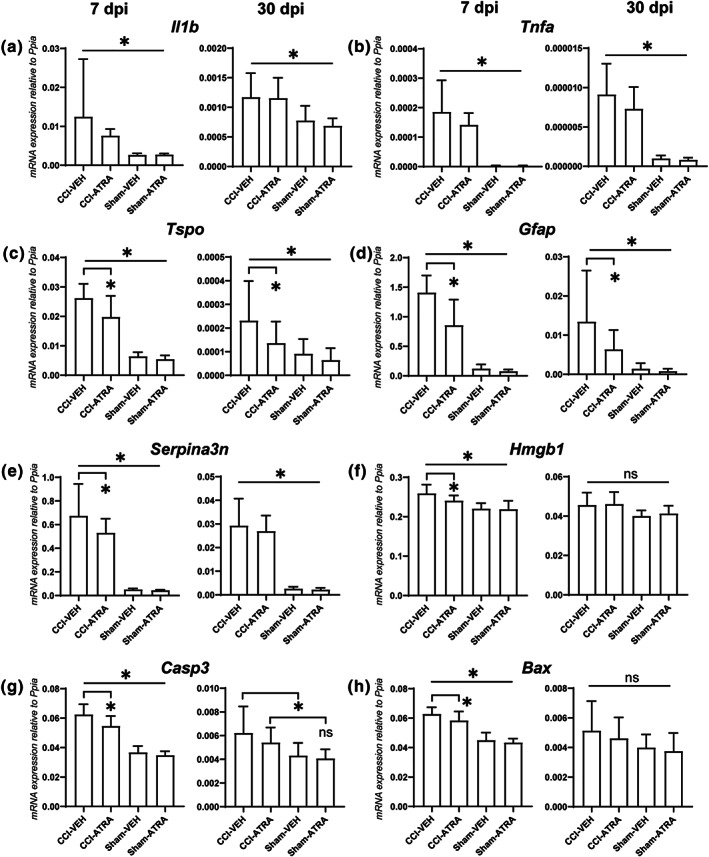
Key results: ATRA treatment reduced brain lesion size, reactive astrogliosis and axonal injury at 7 dpi, and hippocampal granule cell layer (GCL) integrity was protected at 7 and 30 dpi, independent of cell proliferation in neurogenic niches and blood-brain barrier damage. Neurological and motor deficits over time and the brain tissue loss at 30 dpi were not affected by ATRA treatment. ATRA decreased gene expression of markers for damage-associated molecular pattern (HMGB1), apoptosis (caspase-3 and Bax), activated microglia (TSPO), and reactive astrogliosis (GFAP, SerpinA3N) at 7 dpi and a subset of markers at 30 dpi (TSPO, GFAP).
Conclusion and implications: In experimental TBI, post-traumatic ATRA administration exerted brain protective effects, including long-term protection of GCL integrity, but did not affect neurological and motor deficits. Further investigations are required to optimize treatment regimens to enhance ATRA's brain protective effects and improve outcomes.
Keywords: all-trans retinoic acid; apoptosis; astrogliosis; axonal injury; hippocampus; neuroinflammation; traumatic brain injury.
© 2020. The British Pharmacological Society.
Conflict of interest statement
The authors declare no conflicts of interest.
Figures




References
-
- Alexander, S. P. H. , Roberts, R. E. , Broughton, B. R. S. , Sobey, C. G. , George, C. H. , Stanford, S. C. , … Ahluwalia, A. (2018). Goals and practicalities of immunoblotting and immunohistochemistry: A guide for submission to the British Journal of Pharmacology. British Journal of Pharmacology, 175(3), 407–411. 10.1111/bph.14112 - DOI - PMC - PubMed
-
- Beckers, L. , Ory, D. , Geric, I. , Declercq, L. , Koole, M. , Kassiou, M. , … Baes, M. (2018). Increased expression of translocator protein (TSPO) marks pro‐inflammatory microglia but does not predict neurodegeneration. Molecular Imaging and Biology: MIB: The Official Publication of the Academy of Molecular Imaging, 20, 94–102. 10.1007/s11307-017-1099-1 - DOI - PubMed
Publication types
MeSH terms
Substances
Grants and funding
LinkOut - more resources
Full Text Sources
Other Literature Sources
Medical
Research Materials
Miscellaneous
