


Potential Benefits and Risks Resulting From the Introduction of Health Apps and Wearables Into the German Statutory Health Care System: Scoping Review
- PMID: 32965231
- PMCID: PMC7542416
- DOI: 10.2196/16444
Potential Benefits and Risks Resulting From the Introduction of Health Apps and Wearables Into the German Statutory Health Care System: Scoping Review
Abstract
Background: Germany is the first country worldwide that has introduced a digital care act as an incentive system to enhance the use of digital health devices, namely health apps and wearables, among its population. The act allows physicians to prescribe statutory financed and previously certified health apps and wearables to patients. This initiative has the potential to improve treatment quality through better disease management and monitoring.
Objective: The aim of this paper was to outline the key concepts related to the potential risks and benefits discussed in the current literature about health apps and wearables. Furthermore, this study aimed to answer the research question: Which risks and benefits may result from the implementation of the digital care act in Germany?
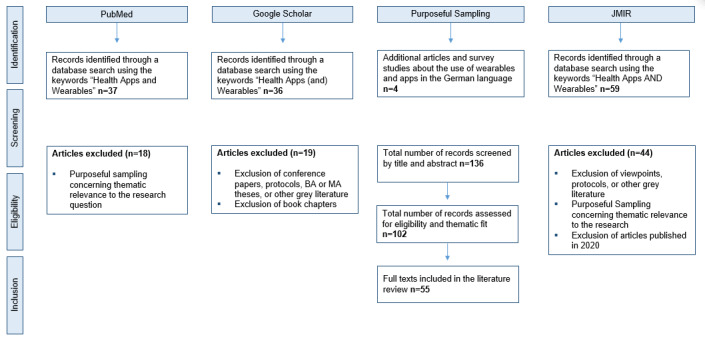
Methods: We conducted the scoping study by searching the databases PubMed, Google Scholar, and JMIR using the keywords health apps and wearables. We discussed 55 of 136 identified articles published in the English language from 2015 to March 2019 in this paper using a qualitative thematic analysis approach.
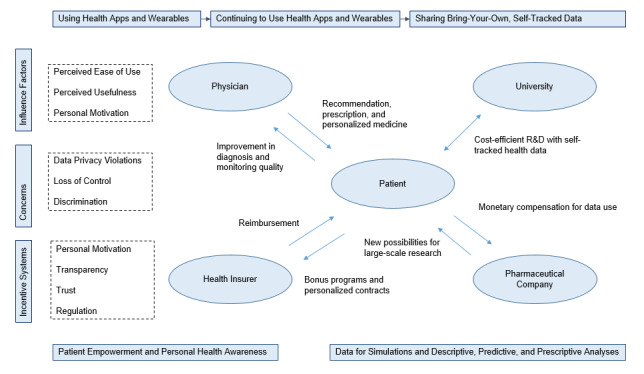
Results: We identified four key themes within the articles: Effectivity of health apps and wearables to improve health; users of health apps and wearables; the potential of bring-your-own, self-tracked data; and concerns and data privacy risks. Within these themes, we identified three main stages of benefits for the German health care system: Usage of health apps and wearables; continuing to use health apps and wearables; and sharing bring-your-own; self-tracked data with different agents in the health care sector.
Conclusions: The digital care act could lead to an improvement in treatment quality through better patient monitoring, disease management, personalized therapy, and better health education. However, physicians should play an active role in recommending and supervising health app use to reach digital-illiterate or health-illiterate people. Age must not be an exclusion criterion. Yet, concerns about data privacy and security are very strong in Germany. Transparency about data processing should be provided at all times for continuing success of the digital care act in Germany.
Keywords: digital health application; health apps; mHealth; wearables.
©Alexandra Heidel, Christian Hagist. Originally published in JMIR mHealth and uHealth (http://mhealth.jmir.org), 23.09.2020.
Conflict of interest statement
Conflicts of Interest: None declared.
Figures
References
-
- Lobelo F, Kelli HM, Tejedor SC, Pratt M, McConnell MV, Martin SS, Welk GJ. The Wild Wild West: A Framework to Integrate mHealth Software Applications and Wearables to Support Physical Activity Assessment, Counseling and Interventions for Cardiovascular Disease Risk Reduction. Prog Cardiovasc Dis. 2016 May;58(6):584–94. doi: 10.1016/j.pcad.2016.02.007. http://europepmc.org/abstract/MED/26923067 - DOI - PMC - PubMed
-
- Kotlikoff L, Hagist C. Who's Going Broke? Comparing Growth in Healthcare Costs in Ten OECD Countries. NBER Working Paper No. w11833. 2005 Dec;188(1) doi: 10.3386/w11833. https://ssrn.com/abstract=875666 - DOI
-
- Der Bundestag Bundesgesetzblatt Teil I Nr. 49. Gesetz für eine bessere Versorgung durch Digitalisierung und Innovation (Digitale Versorgung Gesetz) 2019. Jul 22, [2020-09-12]. www.bgbl.de.
-
- Zeit Online Jens Spahn: Krankenkassen Sollen Für Gesundheitsapps Zahlen. Die Zeit. 2019. May 15, [2020-09-12]. www.zeit.de/digital.
-
- Bundesinstitut für Arzneimittel und Medizinprodukte Das Fast-Track-Verfahren Für Digitale Gesundheitsanwendungen (DiGA) Nach § 139e SGB V. DIGA Leitfaden. 2020. [2020-09-12]. www.bfarm.de/SharedDocs.
Publication types
MeSH terms
LinkOut - more resources
Full Text Sources
