


Overview of Current Drug Delivery Methods Across the Blood-Brain Barrier for the Treatment of Primary Brain Tumors
- PMID: 32965590
- PMCID: PMC7658069
- DOI: 10.1007/s40263-020-00766-w
Overview of Current Drug Delivery Methods Across the Blood-Brain Barrier for the Treatment of Primary Brain Tumors
Abstract
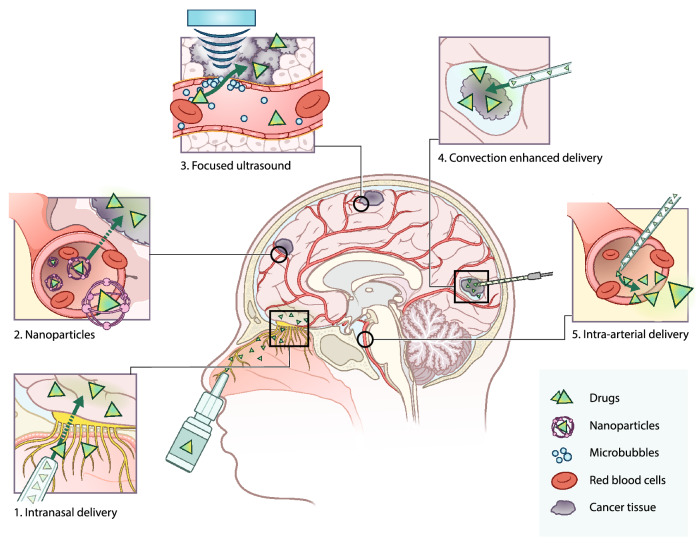
Existing drug delivery methods have not led to a significant increase in survival for patients with malignant primary brain tumors. While the combination of conventional therapies consisting of surgery, radiotherapy, and chemotherapy has improved survival for some types of brain tumors (e.g., WNT medulloblastoma), other types of brain tumors (e.g., glioblastoma and diffuse midline glioma) still have a poor prognosis. The reason for the differences in response can be largely attributed to the blood-brain barrier (BBB), a specialized structure at the microvasculature level that regulates the transport of molecules across the blood vessels into the brain parenchyma. This structure hampers the delivery of most chemotherapeutic agents for the treatment of primary brain tumors. Several drug delivery methods such as nanoparticles, convection enhanced delivery, focused ultrasound, intranasal delivery, and intra-arterial delivery have been developed to overcome the BBB in primary brain tumors. However, prognosis of most primary brain tumors still remains poor. The heterogeneity of the BBB in primary brain tumors and the distinct vasculature of tumors make it difficult to design a drug delivery method that targets the entire tumor. Drug delivery methods that combine strategies such as focused ultrasound and nanoparticles might be a more successful approach. However, more research is needed to optimize and develop new drug delivery techniques to improve survival of patients with primary brain tumors.
Conflict of interest statement
Rianne Haumann, Jessica Carvalho Videira, Gertjan J.L. Kaspers, Dannis G. van Vuurden, and Esther Hulleman declare that they have no conflicts of interest that might be relevant to the contents of this manuscript.
Figures
References
-
- Howlader NNA, Krapcho M, Miller D, Brest A, Yu M, Ruhl J, et al. SEER cancer statistics review 1975–2016. National Cancer Institute.
-
- Allemani C, Matsuda T, Di Carlo V, Harewood R, Matz M, Nikšić M, et al. Global surveillance of trends in cancer survival 2000–14 (CONCORD-3): analysis of individual records for 37 513 025 patients diagnosed with one of 18 cancers from 322 population-based registries in 71 countries. Lancet. 2018;391(10125):1023–1075. - PMC - PubMed
-
- Wells EM, Packer RJ. Pediatric brain tumors. Continuum. 2015;21(2):373–396. - PubMed
-
- Patel MM, Patel BM. Crossing the blood–brain barrier: recent advances in drug delivery to the brain. CNS Drugs. 2017;31(2):109–133. - PubMed
Publication types
MeSH terms
Substances
LinkOut - more resources
Full Text Sources
Medical
