


From statistical regularities in multisensory inputs to peripersonal space representation and body ownership: Insights from a neural network model
- PMID: 32965729
- PMCID: PMC7894138
- DOI: 10.1111/ejn.14981
From statistical regularities in multisensory inputs to peripersonal space representation and body ownership: Insights from a neural network model
Abstract
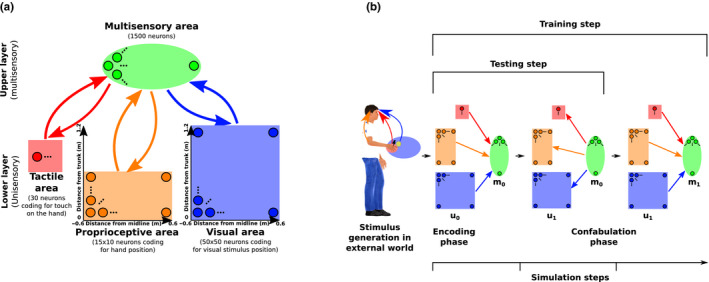
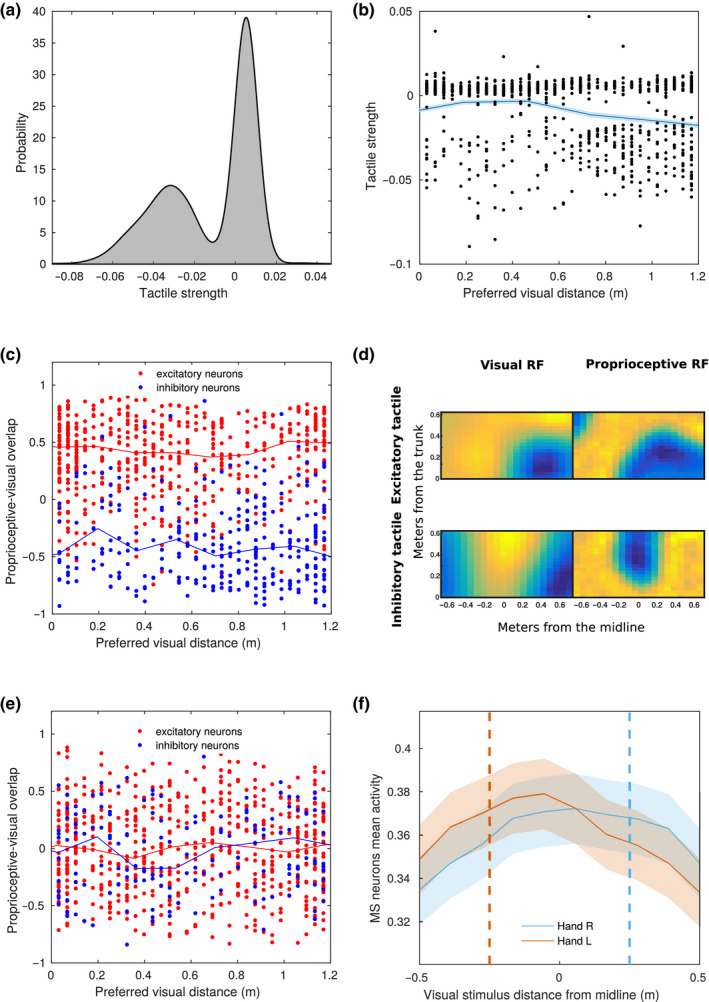
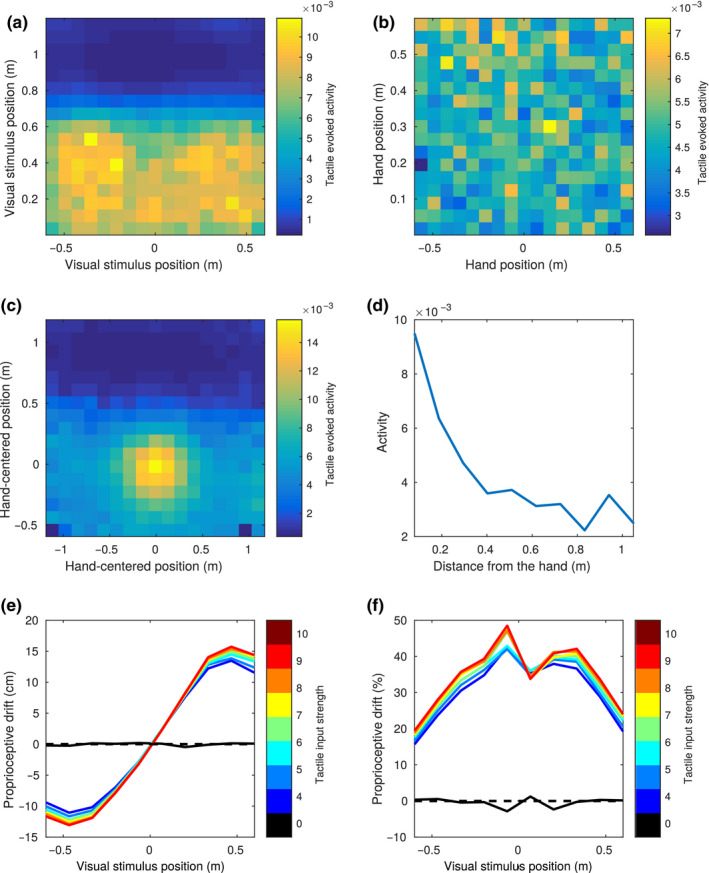
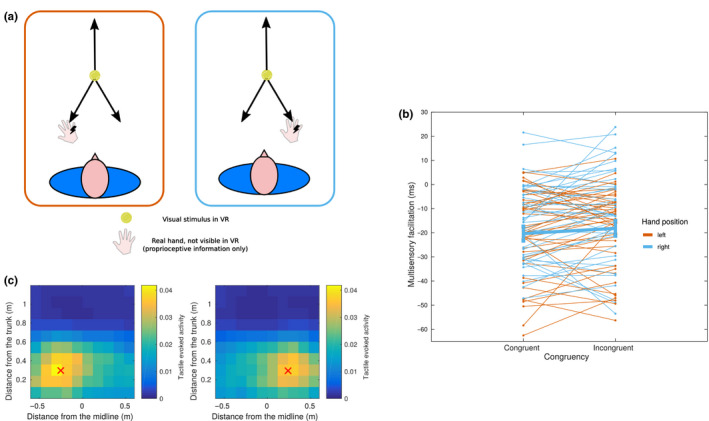
Peripersonal space (PPS), the interface between the self and the environment, is represented by a network of multisensory neurons with visual (or auditory) receptive fields anchored to specific body parts, and tactile receptive fields covering the same body parts. Neurophysiological and behavioural features of hand PPS representation have been previously modelled through a neural network constituted by one multisensory population integrating tactile inputs with visual/auditory external stimuli. Reference frame transformations were not explicitly modelled, as stimuli were encoded in pre-computed hand-centred coordinates. Here we present a novel model, aiming to overcome this limitation by including a proprioceptive population encoding hand position. We confirmed behaviourally the plausibility of the proposed architecture, showing that visuo-proprioceptive information is integrated to enhance tactile processing on the hand. Moreover, the network's connectivity was spontaneously tuned through a Hebbian-like mechanism, under two minimal assumptions. First, the plasticity rule was designed to learn the statistical regularities of visual, proprioceptive and tactile inputs. Second, such statistical regularities were simply those imposed by the body structure. The network learned to integrate proprioceptive and visual stimuli, and to compute their hand-centred coordinates to predict tactile stimulation. Through the same mechanism, the network reproduced behavioural correlates of manipulations implicated in subjective body ownership: the invisible and the rubber hand illusion. We thus propose that PPS representation and body ownership may emerge through a unified neurocomputational process; the integration of multisensory information consistently with a model of the body in the environment, learned from the natural statistics of sensory inputs.
Keywords: Hebbian learning; bodily self-consciousness; body representation; reference frame transformations; statistical inference.
© 2020 The Authors. European Journal of Neuroscience published by Federation of European Neuroscience Societies and John Wiley & Sons Ltd.
Conflict of interest statement
The authors declare no conflict of interest.
Figures
References
-
- Alais, D. , & Burr, D. (2004). The ventriloquist effect results from near‐optimal bimodal integration. Current Biology, 14, 257–262. - PubMed
-
- Avillac, M. , Denève, S. , Olivier, E. , Pouget, A. , & Duhamel, J.‐R. (2005). Reference frames for representing visual and tactile locations in parietal cortex. Nature Neuroscience, 8, 941–949. - PubMed
-
- Barlow, H. B. (1961). Possible principles underlying the transformation of sensory messages. Sensory Communication, 217–234.
-
- Bernasconi, F. , Noel, J. , Park, H. D. , Faivre, N. , Seeck, M. , Spinelli, L. , Schaller, K. , Blanke, O. , & Serino, A. (2018). Audio‐tactile and peripersonal space processing around the trunk in human parietal and temporal cortex: An intracranial EEG study. Cerebral Cortex, 28, 3385–3397. 10.1093/cercor/bhy156 - DOI - PMC - PubMed
Publication types
MeSH terms
LinkOut - more resources
Full Text Sources
