


Quantification of an Adverse Outcome Pathway Network by Bayesian Regression and Bayesian Network Modeling
- PMID: 32965776
- PMCID: PMC7820971
- DOI: 10.1002/ieam.4348
Quantification of an Adverse Outcome Pathway Network by Bayesian Regression and Bayesian Network Modeling
Abstract
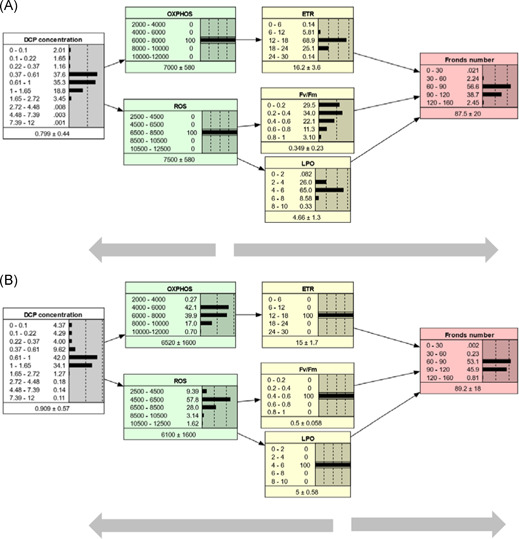
The adverse outcome pathway (AOP) framework has gained international recognition as a systematic approach linking mechanistic processes to toxicity endpoints. Nevertheless, successful implementation into risk assessments is still limited by the lack of quantitative AOP models (qAOPs) and assessment of uncertainties. The few published qAOP models so far are typically based on data-demanding systems biology models. Here, we propose a less data-demanding approach for quantification of AOPs and AOP networks, based on regression modeling and Bayesian networks (BNs). We demonstrate this approach with the proposed AOP #245, "Uncoupling of photophosphorylation leading to reduced ATP production associated growth inhibition," using a small experimental data set from exposure of Lemna minor to the pesticide 3,5-dichlorophenol. The AOP-BN reflects the network structure of AOP #245 containing 2 molecular initiating events (MIEs), 3 key events (KEs), and 1 adverse outcome (AO). First, for each dose-response and response-response (KE) relationship, we quantify the causal relationship by Bayesian regression modeling. The regression models correspond to dose-response functions commonly applied in ecotoxicology. Secondly, we apply the fitted regression models with associated uncertainty to simulate 10 000 response values along the predictor gradient. Thirdly, we use the simulated values to parameterize the conditional probability tables of the BN model. The quantified AOP-BN model can be run in several directions: 1) prognostic inference, run forward from the stressor node to predict the AO level; 2) diagnostic inference, run backward from the AO node; and 3) omnidirectionally, run from the intermediate MIEs and/or KEs. Internal validation shows that the AOP-BN can obtain a high accuracy rate, when run is from intermediate nodes and when a low resolution is acceptable for the AO. Although the performance of this AOP-BN is limited by the small data set, our study demonstrates a proof-of-concept: the combined use of Bayesian regression modeling and Bayesian network modeling for quantifying AOPs. Integr Environ Assess Manag 2021;17:147-164. © 2020 The Authors. Integrated Environmental Assessment and Management published by Wiley Periodicals LLC on behalf of Society of Environmental Toxicology & Chemistry (SETAC).
Keywords: Conditional probability tables; Dose-response curve; Key event relationships; Quantitative AOP; Uncertainty.
© 2020 The Authors. Integrated Environmental Assessment and Management published by Wiley Periodicals LLC on behalf of Society of Environmental Toxicology & Chemistry (SETAC).
Figures


References
-
- Ananthasubramaniam B, McCauley E, Gust KA, Kennedy AJ, Muller EB, Perkins EJ, Nisbet RM. 2015. Relating suborganismal processes to ecotoxicological and population level endpoints using a bioenergetic model. Ecol Appl 25(6):1691–1710. - PubMed
-
- Ankley GT, Bennett RS, Erickson RJ, Hoff DJ, Hornung MW, Johnson RD, Mount DR, Nichols JW, Russom CL, Schmieder PK et al. 2010. Adverse outcome pathways: A conceptual framework to support ecotoxicology research and risk assessment. Environ Toxicol Chem 29(3):730–741. - PubMed
-
- Baldwin SA, Larson MJ. 2017. An introduction to using Bayesian linear regression with clinical data. Behav Res Ther 98:58–75. - PubMed
-
- Battistoni M, Di Renzo F, Menegola E, Bois FY. 2019. Quantitative AOP based teratogenicity prediction for mixtures of azole fungicides. Comput Toxicol 11:72–81.
-
- Becker RA, Ankley GT, Edwards SW, Kennedy SW, Linkov I, Meek B, Sachana M, Segner H, Van Der Burg B, Villeneuve DL et al. 2015. Increasing scientific confidence in adverse outcome pathways: Application of tailored Bradford‐Hill considerations for evaluating weight of evidence. Regul Toxicol Pharmacol 72(3):514–537. - PubMed
MeSH terms
LinkOut - more resources
Full Text Sources
