


Beers with Peers: Childhood ADHD and Risk for Correlated Change in Perceived Peer and Personal Alcohol Use Across Young Adulthood
- PMID: 32966613
- PMCID: PMC7680395
- DOI: 10.1111/acer.14467
Beers with Peers: Childhood ADHD and Risk for Correlated Change in Perceived Peer and Personal Alcohol Use Across Young Adulthood
Abstract
Background: ADHD poses risk for problematic alcohol use through adulthood. Perceived peer alcohol use, one of the strongest correlates of individuals' own alcohol use, is especially salient for adolescents with ADHD. The extent to which this risk extends into young adulthood is unknown, as well as how change in these constructs is associated throughout young adulthood.
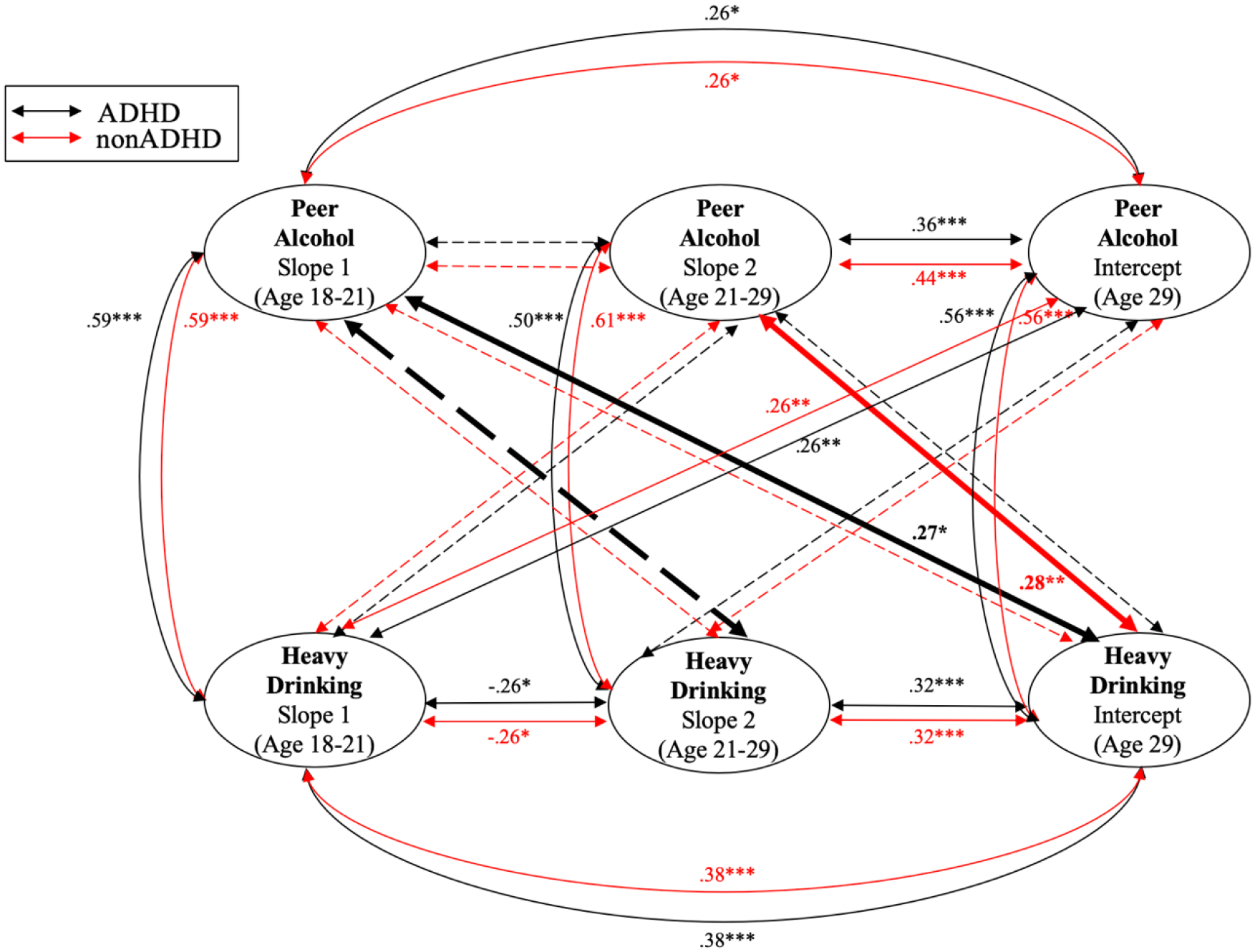
Methods: In the Pittsburgh ADHD Longitudinal Study, 358 individuals with childhood-diagnosed ADHD and 239 without were prospectively followed from ages 18 to 29. Piecewise, bivariate longitudinal growth modeling was used to examine the change in both peer alcohol use and individuals' heavy drinking (binge-drinking frequency), their between-person associations, and differences by ADHD group. The addition of structured residuals probed within-person year-to-year change in peer and personal alcohol use and their prospective associations.
Results: Perceived peer alcohol use and individuals' heavy drinking frequencies changed together over time concurrently-from ages 18 to 21 (piece 1) and 21 to 29 (piece 2). Prospectively, individuals who increased the most in heavy drinking from ages 18 to 21 reported more friends using alcohol at age 29, regardless of ADHD history. Within-person increases in personal alcohol use likewise predicted increased perceived peer use the subsequent year within each age group (piece), regardless of ADHD history. However, while decreasing perceived peer use from ages 21 to 29 was related to more frequent heavy drinking at age 29 for those without ADHD, increasing perceived peer use from ages 18 to 21 predicted more frequent heavy drinking at age 29 for those with ADHD.
Conclusions: Young adult heavy drinking changes in tandem with perceived peer alcohol use across individuals and predicts selection of alcohol-using peers from year to year within individuals, further into adulthood than previously documented. Findings suggest the centrality of relationships with alcohol-consuming friends in relation to one's heavy drinking, especially for young adults with ADHD histories, through the twenties.
Keywords: Alcohol; Attention-Deficit/Hyperactivity Disorder; Longitudinal; Peers; Young Adulthood.
© 2020 by the Research Society on Alcoholism.
Figures

References
-
- Andrews JA, Tildesley E, Hops H, Li F (2002) The influence of peers on young adult substance use. Health Psychology 21:349–357. - PubMed
-
- Barkley RA (2015) Educational, occupational, dating and marital, and financial impairments in adults with ADHD, in Attention-Deficit Hyperactivity Disorder: A Handbook for Diagnosis & Treatment, 4th Edition (Barkley RA eds), pp 314–342. Guilford: New York.
Publication types
MeSH terms
Grants and funding
LinkOut - more resources
Full Text Sources
Medical
