Review
. 2020 Sep 21;10(9):1348.
doi: 10.3390/biom10091348.

Current Understanding of the Relationship of HDL Composition, Structure and Function to Their Cardioprotective Properties in Chronic Kidney Disease

Affiliations
Review

Current Understanding of the Relationship of HDL Composition, Structure and Function to Their Cardioprotective Properties in Chronic Kidney Disease

Gunther Marsche et al. Biomolecules. .

Abstract

In the general population, the ability of high-density lipoproteins (HDLs) to promote cholesterol efflux is a predictor of cardiovascular events, independently of HDL cholesterol levels. Although patients with chronic kidney disease (CKD) have a high burden of cardiovascular morbidity and mortality, neither serum levels of HDL cholesterol, nor cholesterol efflux capacity associate with cardiovascular events. Important for the following discussion on the role of HDL in CKD is the notion that traditional atherosclerotic cardiovascular risk factors only partially account for this increased incidence of cardiovascular disease in CKD. As a potential explanation, across the spectrum of cardiovascular disease, the relative contribution of atherosclerotic cardiovascular disease becomes less important with advanced CKD. Impaired renal function directly affects the metabolism, composition and functionality of HDL particles. HDLs themselves are a heterogeneous population of particles with distinct sizes and protein composition, all of them affecting the functionality of HDL. Therefore, a more specific approach investigating the functional and compositional features of HDL subclasses might be a valuable strategy to decipher the potential link between HDL, cardiovascular disease and CKD. This review summarizes the current understanding of the relationship of HDL composition, metabolism and function to their cardio-protective properties in CKD, with a focus on CKD-induced changes in the HDL proteome and reverse cholesterol transport capacity. We also will highlight the gaps in the current knowledge regarding important aspects of HDL biology.

Keywords: HDL cholesterol efflux capacity; HDL proteome; kidney failure.


Conflict of interest statement

The authors declare no conflict of interest.

Figures

Figure 1
Figure 1
Principle of the cholesterol efflux assay. J774 macrophages are cultivated in multiwell plates to form a monolayer. The cells are then treated for 24 h with an ACAT (acyl coenzyme A: cholesterol acyltransferase) inhibitor and radiolabeled cholesterol ([3H]-cholesterol). The ACAT inhibitor prevents cholesterol esterification and the added cholesterol remains cell-associated as free cholesterol. On the following day, the cells are treated with cyclic adenosine monophosphate (cAMP) for 16 h to stimulate the expression of the cholesterol exporter ABCA1. The cholesterol efflux in unstimulated macrophages is mediated to 15% by ABCA1, 25% by SR-BI and 55% by passive diffusion (includes ABCG1-mediated efflux). By cAMP treatment, the ABCA1-dependent cholesterol efflux triples to about 40%, while passive diffusion accounts for 50% and SR-BI-mediated efflux for 10% [125]. Human serum shows a depletion of lipoproteins containing apoB100 (mainly VLDL, LDL) using polyethylene glycol. After extensive rinsing of the cells, apoB-depleted serum (containing all HDL subclasses) is added to the [3H]-cholesterol-labeled macrophages at a concentration of 2.8%. After 4 h, the [3H]-cholesterol that has passed from the cells into the supernatant is quantified by liquid scintillation counting.
Figure 2
Figure 2
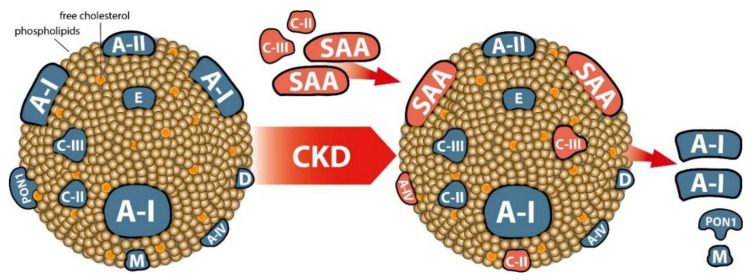
Most frequently identified changes in the proteome of HDL in CKD patients. Approximately 70% of the HDL protein mass is comprised of apoA-I (A-I), while apoA-II(A-II) comprises about 15–20% [50]. The remaining 10–15% of protein mass is composed of less abundant proteins, including apoC-III, apoC-II, apoE, apoD, apoM, apoA-IV, as well as enzymes such as paraoxonase 1 (PON1) and lipid transfer proteins, including lecithin:cholesterol acyl transferase and cholesteryl ester transfer protein [50]. To simplify the illustration only the major constituents of HDL are shown. In CKD, a specific remodeling of the HDL particle occurs depending on the stage of CKD and the vintage of dialysis treatment. The most noticeable change in the composition of HDL in CKD is the accumulation of serum amyloid a (SAA), especially SAA1, together with the enrichment in apoC-II and apoC-III. The accumulation of these proteins is accompanied by a loss of apoA-I, apoA-II, apoM and a decrease in the mass and enzymatic activity of paraoxonase 1 (PON1).

References

    1. Rader D.J., Hovingh G.K. HDL and cardiovascular disease. Lancet. 2014;384:618–625. doi: 10.1016/S0140-6736(14)61217-4. - DOI - PubMed
    1. Rader D.J., Alexander E.T., Weibel G.L., Billheimer J., Rothblat G.H. The role of reverse cholesterol transport in animals and humans and relationship to atherosclerosis. J. Lipid Res. 2009;50:S189–S194. doi: 10.1194/jlr.R800088-JLR200. - DOI - PMC - PubMed
    1. Heine G.H., Eller K., Stadler J.T., Rogacev K.S., Marsche G. Lipid-modifying therapy in chronic kidney disease: Pathophysiological and clinical considerations. Pharm. Ther. 2020;207:107459. doi: 10.1016/j.pharmthera.2019.107459. - DOI - PubMed
    1. Moradi H., Streja E., Vaziri N.D. ESRD-induced dyslipidemia-Should management of lipid disorders differ in dialysis patients? Semin. Dial. 2018;31:398–405. doi: 10.1111/sdi.12706. - DOI - PMC - PubMed
    1. Annema W., von Eckardstein A. High-density lipoproteins. Multifunctional but vulnerable protections from atherosclerosis. Circ. J. 2013;77:2432–2448. doi: 10.1253/circj.CJ-13-1025. - DOI - PubMed

Publication types

MeSH terms