


Conspiracy theories as barriers to controlling the spread of COVID-19 in the U.S
- PMID: 32967786
- PMCID: PMC7502362
- DOI: 10.1016/j.socscimed.2020.113356
Conspiracy theories as barriers to controlling the spread of COVID-19 in the U.S
Abstract
Rationale: The COVID-19 pandemic poses extraordinary challenges to public health.
Objective: Because the novel coronavirus is highly contagious, the widespread use of preventive measures such as masking, physical distancing, and eventually vaccination is needed to bring it under control. We hypothesized that accepting conspiracy theories that were circulating in mainstream and social media early in the COVID-19 pandemic in the US would be negatively related to the uptake of preventive behaviors and also of vaccination when a vaccine becomes available.
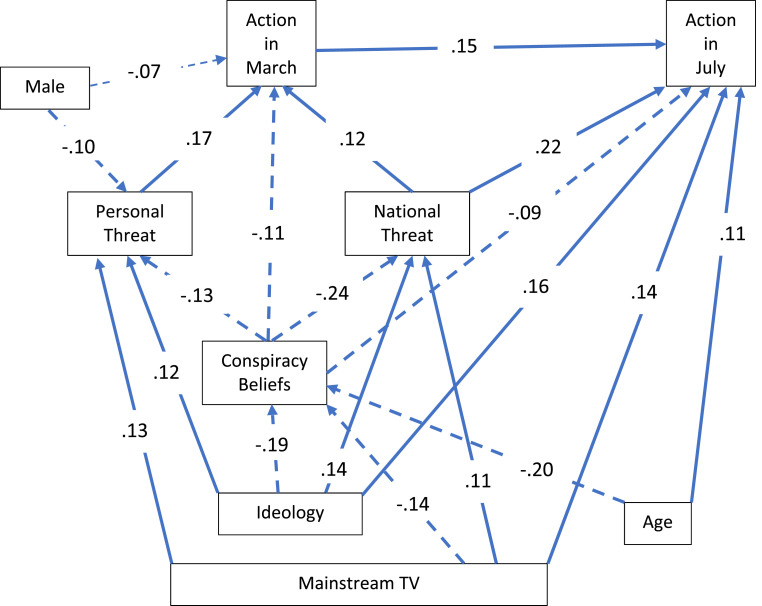
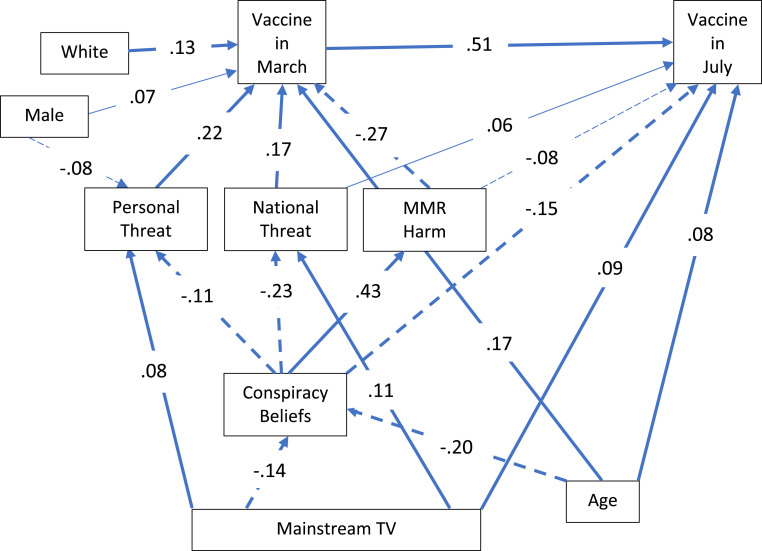
Method: A national probability survey of US adults (N = 1050) was conducted in the latter half of March 2020 and a follow-up with 840 of the same individuals in July 2020. The surveys assessed adoption of preventive measures recommended by public health authorities, vaccination intentions, conspiracy beliefs, perceptions of threat, belief about the safety of vaccines, political ideology, and media exposure patterns.
Results: Belief in three COVID-19-related conspiracy theories was highly stable across the two periods and inversely related to the (a) perceived threat of the pandemic, (b) taking of preventive actions, including wearing a face mask, (c) perceived safety of vaccination, and (d) intention to be vaccinated against COVID-19. Conspiracy beliefs in March predicted subsequent mask-wearing and vaccination intentions in July even after controlling for action taken and intentions in March. Although adopting preventive behaviors was predicted by political ideology and conservative media reliance, vaccination intentions were less related to political ideology. Mainstream television news use predicted adopting both preventive actions and vaccination.
Conclusions: Because belief in COVID-related conspiracy theories predicts resistance to both preventive behaviors and future vaccination for the virus, it will be critical to confront both conspiracy theories and vaccination misinformation to prevent further spread of the virus in the US. Reducing those barriers will require continued messaging by public health authorities on mainstream media and in particular on politically conservative outlets that have supported COVID-related conspiracy theories.
Keywords: COVID-19; Conspiracy theories; Media use; Political ideology; Prevention; Vaccination; Vaccination misinformation.
Copyright © 2020 The Author(s). Published by Elsevier Ltd.. All rights reserved.
Figures
References
-
- Bollen K.A., Davis W.R. Causal indicator models: identification, estimation, and testing. Struct. Equ. Model. 2009;16:498–522.
-
- CDC . 2020. Recommendation regarding the use of cloth face coverings, especially in areas of significant community transmission.
-
- CDC . Centers for Disease Control and Prevention; Atlanta, GA: 2020. Among Adults, the Risk for Severe Illness from COVID-19 Increases with Age, with Older Adults at Highest Risk.
Publication types
MeSH terms
Substances
LinkOut - more resources
Full Text Sources
