Setting the standard: multidisciplinary hallmarks for structural, equitable and tracked antibiotic policy
- PMID: 32967980
- PMCID: PMC7513567
- DOI: 10.1136/bmjgh-2020-003091
Setting the standard: multidisciplinary hallmarks for structural, equitable and tracked antibiotic policy
Abstract
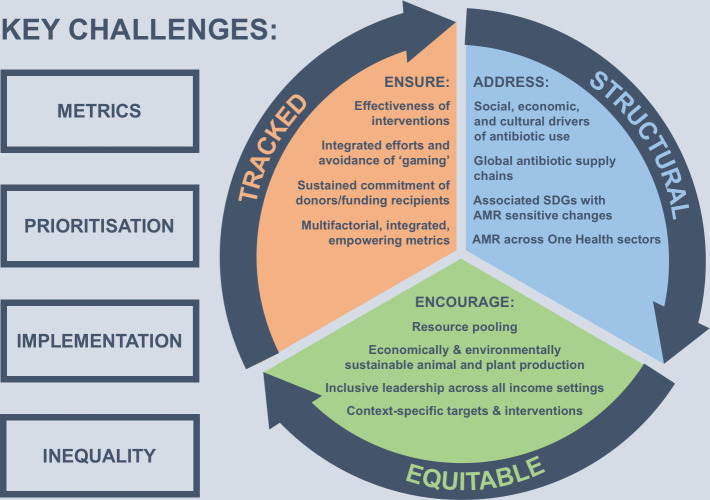
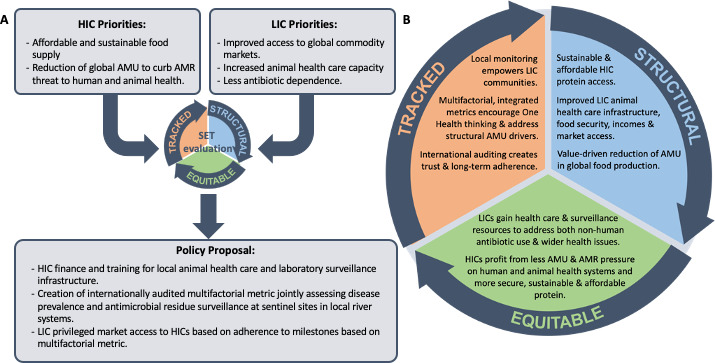
There is increasing concern globally about the enormity of the threats posed by antimicrobial resistance (AMR) to human, animal, plant and environmental health. A proliferation of international, national and institutional reports on the problems posed by AMR and the need for antibiotic stewardship have galvanised attention on the global stage. However, the AMR community increasingly laments a lack of action, often identified as an 'implementation gap'. At a policy level, the design of internationally salient solutions that are able to address AMR's interconnected biological and social (historical, political, economic and cultural) dimensions is not straightforward. This multidisciplinary paper responds by asking two basic questions: (A) Is a universal approach to AMR policy and antibiotic stewardship possible? (B) If yes, what hallmarks characterise 'good' antibiotic policy? Our multistage analysis revealed four central challenges facing current international antibiotic policy: metrics, prioritisation, implementation and inequality. In response to this diagnosis, we propose three hallmarks that can support robust international antibiotic policy. Emerging hallmarks for good antibiotic policies are: Structural, Equitable and Tracked. We describe these hallmarks and propose their consideration should aid the design and evaluation of international antibiotic policies with maximal benefit at both local and international scales.
Keywords: diseases; disorders; health policies and all other topics; infections; injuries; public health.
© Author(s) (or their employer(s)) 2020. Re-use permitted under CC BY. Published by BMJ.
Conflict of interest statement
Competing interests: SH is Scientific Director of CIHR’s Institute of Population and Public Health and CIHR’s Scientific Co-Lead for Antimicrobial Resistance. He is Director of the WHO Collaborating Centre on Global Governance of Antimicrobial Resistance. KO in principal investigator of CARB-X, a project at Boston University (my employer), funded by three governments (US, UK and Germany) and two charitable foundations (Wellcome Trust and the Bill & Melinda Gates Foundation). CARB-X is a non-profit, making grants for preclinical antibacterial research. I do not view this as a conflict, but disclose in an abundance of caution. APR is the co-ordinator of the JPIAMR funded Network NEAR-AMR. ADS reports grants from ReAct-Action on Antibiotic Resistance and from Open Society Foundation during the conduct of the study. He served as Co-Convener of the UN Interagency Coordination Group on Antimicrobial Resistance (2018–2019), as a member of the Expert Commission on Addressing the Livestock Contribution to the Antibiotic Resistance Crisis (2016–2017), as a commissioned author to the UK Commission on AMR on 'A Framework for Costing the Lowering of Antimicrobial Use in Food Animal Production' (2016), as Head of the Secretariat of the Antibiotic Resistance Coalition, and as a Member of the Working Group on Antibiotic Resistance for the President’s Council of Advisors on Science and Technology (2013–2014).
Figures
References
-
- Chandler CIR, Hutchinson E, Hutchison C. Addressing antimicrobial resistance through social theory. An Anthropologically oriented report. London: London School of Hygiene & Tropical Medicine, 2016.
-
- Laxminarayan R, Malani A. Extending the cure: policy responses to the growing threat of antibiotic resistance: Earthscan, 2007.
Publication types
MeSH terms
Substances
Grants and funding
LinkOut - more resources
Full Text Sources
Medical
Miscellaneous