


Distinct hypertrophic cardiomyopathy genotypes result in convergent sarcomeric proteoform profiles revealed by top-down proteomics
- PMID: 32968017
- PMCID: PMC7547245
- DOI: 10.1073/pnas.2006764117
Distinct hypertrophic cardiomyopathy genotypes result in convergent sarcomeric proteoform profiles revealed by top-down proteomics
Abstract
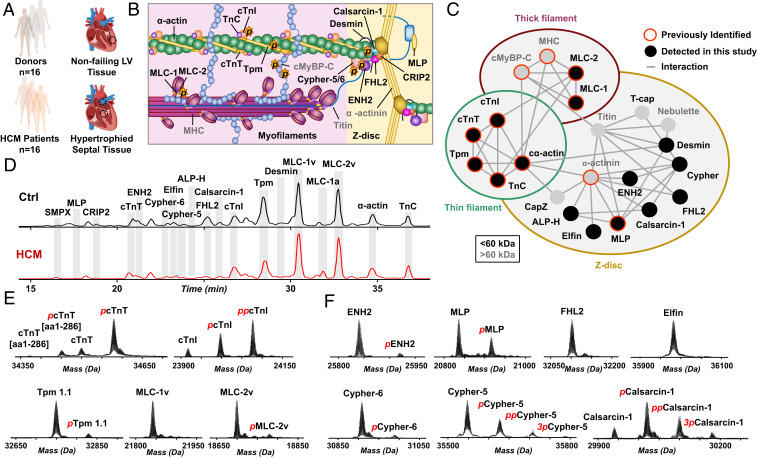
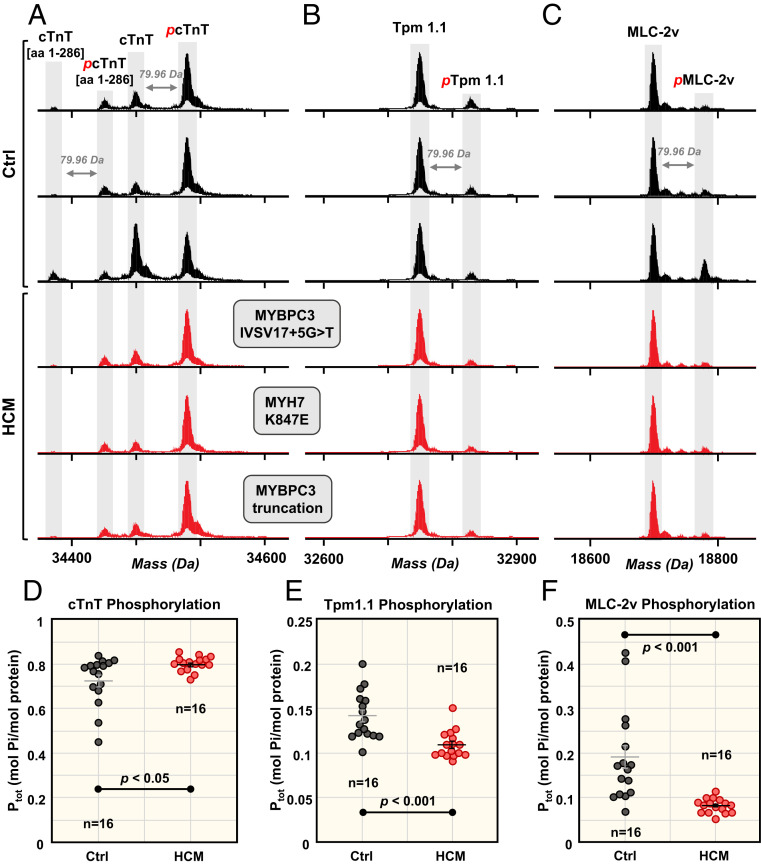
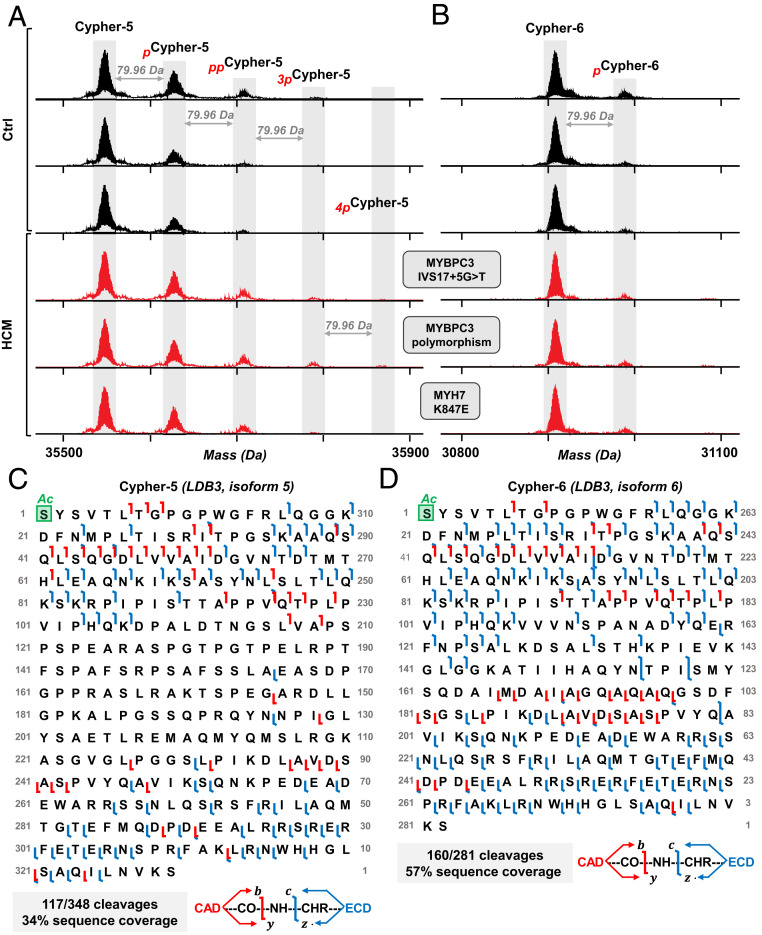
Hypertrophic cardiomyopathy (HCM) is the most common heritable heart disease. Although the genetic cause of HCM has been linked to mutations in genes encoding sarcomeric proteins, the ability to predict clinical outcomes based on specific mutations in HCM patients is limited. Moreover, how mutations in different sarcomeric proteins can result in highly similar clinical phenotypes remains unknown. Posttranslational modifications (PTMs) and alternative splicing regulate the function of sarcomeric proteins; hence, it is critical to study HCM at the level of proteoforms to gain insights into the mechanisms underlying HCM. Herein, we employed high-resolution mass spectrometry-based top-down proteomics to comprehensively characterize sarcomeric proteoforms in septal myectomy tissues from HCM patients exhibiting severe outflow track obstruction (n = 16) compared to nonfailing donor hearts (n = 16). We observed a complex landscape of sarcomeric proteoforms arising from combinatorial PTMs, alternative splicing, and genetic variation in HCM. A coordinated decrease of phosphorylation in important myofilament and Z-disk proteins with a linear correlation suggests PTM cross-talk in the sarcomere and dysregulation of protein kinase A pathways in HCM. Strikingly, we discovered that the sarcomeric proteoform alterations in the myocardium of HCM patients undergoing septal myectomy were remarkably consistent, regardless of the underlying HCM-causing mutations. This study suggests that the manifestation of severe HCM coalesces at the proteoform level despite distinct genotype, which underscores the importance of molecular characterization of HCM phenotype and presents an opportunity to identify broad-spectrum treatments to mitigate the most severe manifestations of this genetically heterogenous disease.
Keywords: hypertrophic cardiomyopathy; phosphorylation; posttranslational modifications; proteoform; top-down proteomics.
Copyright © 2020 the Author(s). Published by PNAS.
Conflict of interest statement
Competing interest statement: T.J.K. is a consultant for Fujifilm Cellular Dynamics Incorporated.
Figures


References
-
- Maron B. J.; Clinical Course and Management of Hypertrophic Cardiomyopathy , Clinical course and management of hypertrophic cardiomyopathy. N. Engl. J. Med. 379, 655–668 (2018). - PubMed
-
- Yotti R., Seidman C. E., Seidman J. G., Advances in the genetic basis and pathogenesis of sarcomere cardiomyopathies. Annu. Rev. Genomics Hum. Genet. 20, 129–153 (2019). - PubMed
-
- Frey N., Luedde M., Katus H. A., Mechanisms of disease: Hypertrophic cardiomyopathy. Nat. Rev. Cardiol. 9, 91–100 (2011). - PubMed
Publication types
MeSH terms
Substances
Grants and funding
- T32 GM008505/GM/NIGMS NIH HHS/United States
- R01 GM117058/GM/NIGMS NIH HHS/United States
- U01 HL134764/HL/NHLBI NIH HHS/United States
- RG/11/20/29266/BHF_/British Heart Foundation/United Kingdom
- R01 HL109810/HL/NHLBI NIH HHS/United States
- R01 HL139883/HL/NHLBI NIH HHS/United States
- R01 HL096971/HL/NHLBI NIH HHS/United States
- R01 GM125085/GM/NIGMS NIH HHS/United States
- PG/17/5/32705/BHF_/British Heart Foundation/United Kingdom
- S10 OD018475/OD/NIH HHS/United States
- R01 HL129798/HL/NHLBI NIH HHS/United States
- T32 HL007936/HL/NHLBI NIH HHS/United States
- T32 GM008688/GM/NIGMS NIH HHS/United States
LinkOut - more resources
Full Text Sources
Miscellaneous
