


Nutrition transition and double burden of malnutrition in Africa: A case study of four selected countries with different social economic development
- PMID: 32968668
- PMCID: PMC7505783
- DOI: 10.3934/publichealth.2020035
Nutrition transition and double burden of malnutrition in Africa: A case study of four selected countries with different social economic development
Abstract
Background: Disease and lifestyle patterns have been changing rapidly especially in Africa due to transformation in economic development and urbanization. Research on the magnitude and consequences of these transformations in Africa is limited. This study investigates the shifts in nutritional status in children and adults in four selected low-, middle- and high-income countries in Africa, identifies factors associated with the shifts, and provides recommendations for future studies.
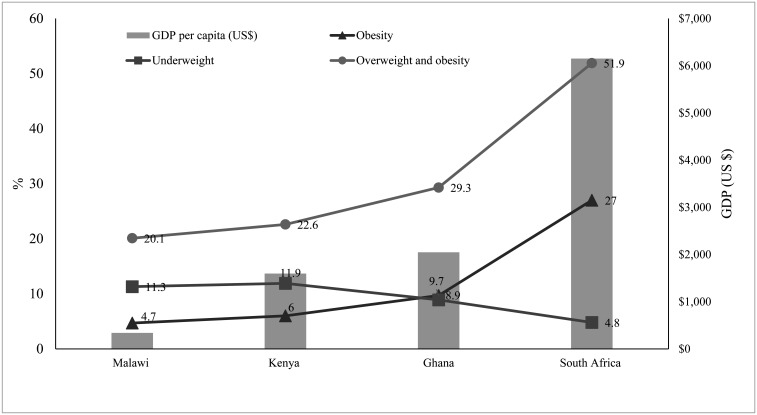
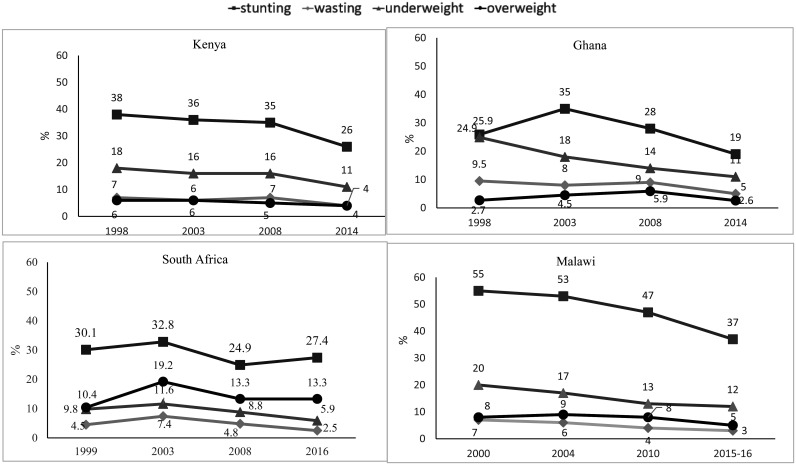
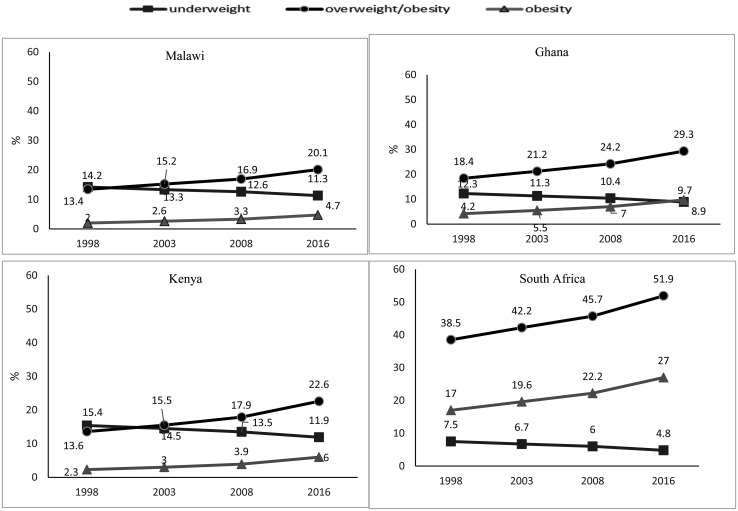
Methods: Malawi, Kenya, Ghana, and South Africa were selected based on their Gross Domestic Product (GDP). Nationally representative data were obtained from the 2017 Global Nutrition Report, Demographic Health Surveys (DHSs), and the World Health Organization (WHO) database. Prevalence of underweight, overweight, and obesity were assessed and compared across the countries, gender, residence, and over time. Results: South Africa had the highest GDP and largest prevalence of overweight and obesity rates in children < 5 years old and adults > 18 (13.3% and 51.9%, respectively). Malawi, with the lowest GDP, had the highest stunting rate (37.0%). In all 4 countries, but most notably in South Africa, trends indicated that the increasing prevalence of overweight and obesity was much greater than the declining rate of underweight. Malawi, Kenya, and Ghana had a slight decline in overweight prevalence in children under 5 years.
Conclusions: Nutritional shifts are occurring in Africa and seem to be heavily influenced by economic development. The double-burden of malnutrition presents prioritization challenges for policymakers. Attention needs to be shifted towards prevention of obesity, at least in the higher income countries in Africa.
Keywords: Africa; malnutrition; obesity; overweight; social economic status.
© 2020 the Author(s), licensee AIMS Press.
Conflict of interest statement
Conflicts of interest: All authors did not have any conflict of interest to report.
Figures
References
-
- Wang Y, Mi J, Shan XY, et al. Is China facing an obesity epidemic and the consequences? The trends in obesity and chronic disease in China. Int J Obes (Lond) 2007;31:177–188. - PubMed
-
- Wang Y, Chen HJ, Shaikh S, et al. Is obesity becoming a public health problem in India? Examine the shift from under- to overnutrition problems over time. Obes Rev. 2009;10:456–474. - PubMed
-
- Wang Y, Lobstein T. Worldwide trends in childhood overweight and obesity. Int J Pediatr Obes. 2006;1:11–25. - PubMed
-
- Steyn NP, McHiza ZJ. Obesity and the nutrition transition in Sub-Saharan Africa. Ann N Y Acad Sci. 2014;1311:88–101. - PubMed
LinkOut - more resources
Full Text Sources