


Comparability of Emotion Dynamics Derived From Ecological Momentary Assessments, Daily Diaries, and the Day Reconstruction Method: Observational Study
- PMID: 32969835
- PMCID: PMC7545330
- DOI: 10.2196/19201
Comparability of Emotion Dynamics Derived From Ecological Momentary Assessments, Daily Diaries, and the Day Reconstruction Method: Observational Study
Abstract
Background: Interest in the measurement of the temporal dynamics of people's emotional lives has risen substantially in psychological and medical research. Emotions fluctuate and change over time, and measuring the ebb and flow of people's affective experiences promises enhanced insights into people's health and functioning. Researchers have used a variety of intensive longitudinal assessment (ILA) methods to create measures of emotion dynamics, including ecological momentary assessments (EMAs), end-of-day (EOD) diaries, and the day reconstruction method (DRM). To date, it is unclear whether they can be used interchangeably or whether ostensibly similar emotion dynamics captured by the methods differ in meaningful ways.
Objective: This study aims to examine the extent to which different ILA methods yield comparable measures of intraindividual emotion dynamics.
Methods: Data from 90 participants aged 50 years or older were collected in a probability-based internet panel, the Understanding America Study, and analyzed. Participants provided positive and negative affect ratings using 3 ILA methods: (1) smartphone-based EMA, administered 6 times per day over 1 week, (2) web-based EOD diaries, administered daily over the same week, and (3) web-based DRM, administered once during that week. We calculated 11 measures of emotion dynamics (addressing mean levels, variability, instability, and inertia separately for positive and negative affect, as well as emotion network density, mixed emotions, and emotional dialecticism) from each ILA method. The analyses examined mean differences and correlations of scores addressing the same emotion dynamic across the ILA methods. We also compared the patterns of intercorrelations among the emotion dynamics and their relationships with health outcomes (general health, pain, and fatigue) across ILA methods.
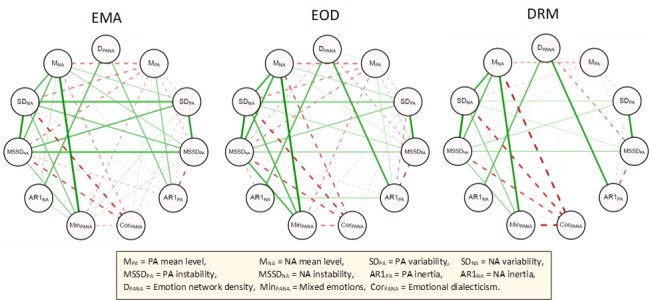
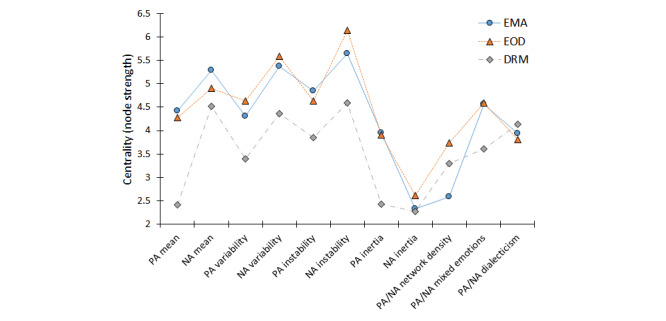
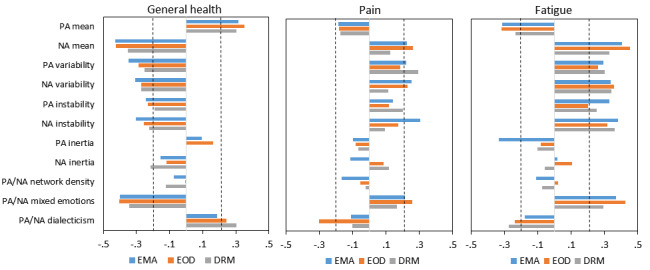
Results: Emotion dynamics derived from EMAs and EOD diaries demonstrated moderate-to-high correspondence for measures of mean emotion levels (ρ≥0.95), variability (ρ≥0.68), instability (ρ≥0.51), mixed emotions (ρ=0.92), and emotional dialecticism (ρ=0.57), and low correspondence for measures of inertia (ρ≥0.17) and emotion network density (ρ=0.36). DRM-derived measures showed correlations with EMAs and EOD diaries that were high for mean emotion levels and mixed emotions (ρ≥0.74), moderate for variability (ρ=0.38-.054), and low to moderate for other measures (ρ=0.03-0.41). Intercorrelations among the emotion dynamics showed high convergence across EMAs and EOD diaries, and moderate convergence between the DRM and EMAs as well as EOD diaries. Emotion dynamics from all 3 ILA methods produced very similar patterns of relationships with health outcomes.
Conclusions: EMAs and EOD diaries provide corresponding information about individual differences in various emotion dynamics, whereas the DRM provides corresponding information about emotion levels and (to a lesser extent) variability, but not about more complex emotion dynamics. Our results caution researchers against viewing these ILA methods as universally interchangeable.
Keywords: daily diaries; day reconstruction method; ecological momentary assessment; emotion dynamics; emotion variability; mobile phone.
©Stefan Schneider, Doerte U Junghaenel, Tania Gutsche, Hio Wa Mak, Arthur A Stone. Originally published in the Journal of Medical Internet Research (http://www.jmir.org), 24.09.2020.
Conflict of interest statement
Conflicts of Interest: AS is a senior scientist with the Gallup Organization and a consultant with Adelphi Values. All other authors declare no conflicts of interest.
Figures
References
-
- Schneider S, Stone AA. Ambulatory and diary methods can facilitate the measurement of patient-reported outcomes. Qual Life Res. 2016 Mar;25(3):497–506. doi: 10.1007/s11136-015-1054-z. http://europepmc.org/abstract/MED/26101141 - DOI - PMC - PubMed
-
- Fisher AJ, Medaglia JD, Jeronimus BF. Lack of group-to-individual generalizability is a threat to human subjects research. Proc Natl Acad Sci U S A. 2018 Jul 3;115(27):E6106–15. doi: 10.1073/pnas.1711978115. http://www.pnas.org/cgi/pmidlookup?view=long&pmid=29915059 - DOI - PMC - PubMed
Publication types
MeSH terms
Grants and funding
LinkOut - more resources
Full Text Sources
Research Materials
