


The allocation of USdollar;105 billion in global funding from G20 countries for infectious disease research between 2000 and 2017: a content analysis of investments
- PMID: 32971052
- PMCID: PMC7505652
- DOI: 10.1016/S2214-109X(20)30357-0
The allocation of USdollar;105 billion in global funding from G20 countries for infectious disease research between 2000 and 2017: a content analysis of investments
Abstract
Background: Each year, billions of US$ are spent globally on infectious disease research and development. However, there is little systematic tracking of global research and development. We present research on investments into infectious diseases research from funders in the G20 countries across an 18-year time period spanning 2000-17, comparing amounts invested for different conditions and considering the global burden of disease to identify potential areas of relative underfunding.
Methods: The study examined research awards made between 2000 and 2017 for infectious disease research from G20-based public and philanthropic funders. We searched research databases using a range of keywords, and open access data were extracted from funder websites. Awards were categorised by type of science, specialty, and disease or pathogen. Data collected included study title, abstract, award amount, funder, and year. We used descriptive statistics and Spearman's correlation coefficient to investigate the association between research investment and disease burden, using Global Burden of Disease 2017 study data.
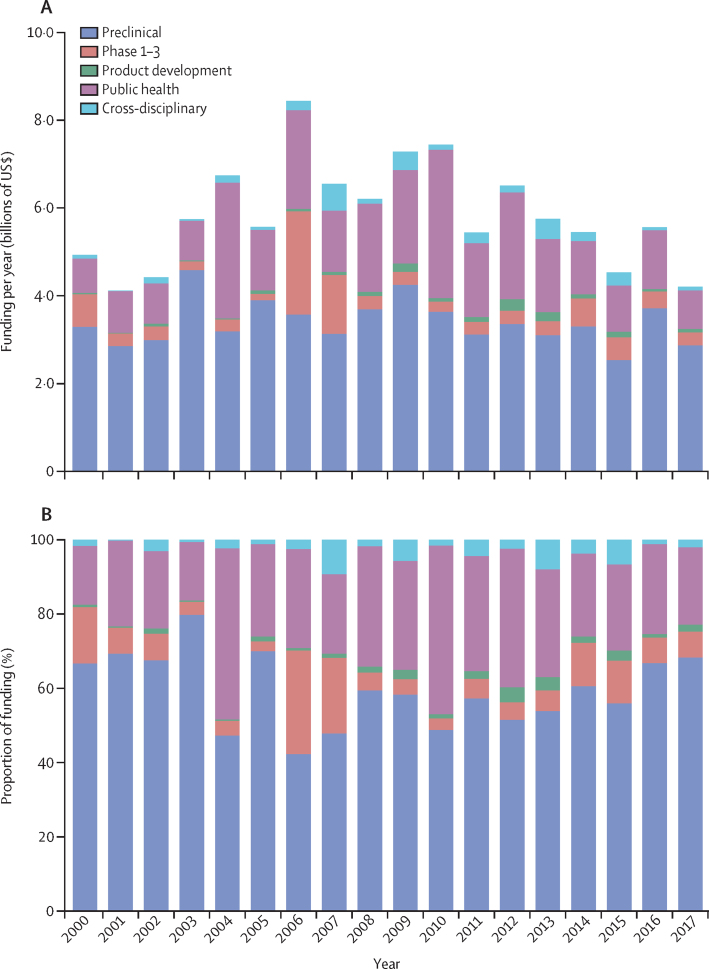
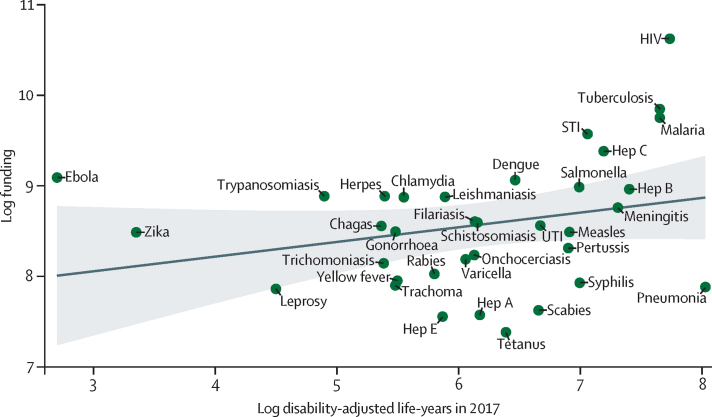
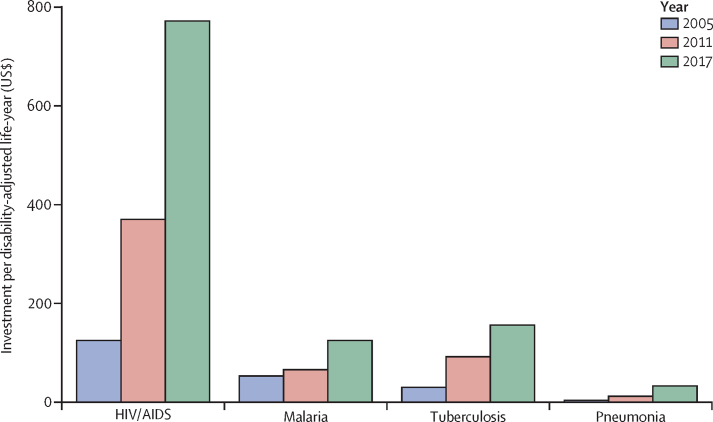
Findings: The final 2000-17 dataset included 94 074 awards for infectious disease research, with a sum investment of $104·9 billion (annual range 4·1 billion to 8·4 billion) and a median award size of $257 176 (IQR 62 562-770 661). Pre-clinical research received $61·1 billion (58·2%) across 70 337 (74·8%) awards and public health research received $29·5 billion (28·1%) from 19 197 (20·4%) awards. HIV/AIDS received $42·1 billion (40·1%), tuberculosis received $7·0 billion (6·7%), malaria received $5·6 billion (5·3%), and pneumonia received $3·5 billion (3·3%). Funding for Ebola virus ($1·2 billion), Zika virus ($0·3 billion), influenza ($4·4 billion), and coronavirus ($0·5 billion) was typically highest soon after a high-profile outbreak. There was a general increase in year-on-year investment in infectious disease research between 2000 and 2006, with a decline between 2007 and 2017. Funders based in the USA provided $81·6 billion (77·8%). Based on funding per 2017 disability-adjusted life years (DALYs), HIV/AIDS received the greatest relative investment ($772 per DALY), compared with tuberculosis ($156 per DALY), malaria ($125 per DALY), and pneumonia ($33 per DALY). Syphilis and scabies received the least relative investment (both $9 per DALY). We observed weak positive correlation (r=0·30) between investment and 2017 disease burden.
Interpretation: HIV research received the highest amount of investment relative to DALY burden. Scabies and syphilis received the lowest relative funding. Investments for high-threat pathogens (eg, Ebola virus and coronavirus) were often reactive and followed outbreaks. We found little evidence that funding is proactively guided by global burden or pandemic risk. Our findings show how research investments are allocated and how this relates to disease burden and diseases with pandemic potential.
Funding: Bill & Melinda Gates Foundation.
Copyright © 2020 The Author(s). Published by Elsevier Ltd. This is an Open Access article under the CC BY 4.0 license. Published by Elsevier Ltd.. All rights reserved.
Figures
References
-
- World Bank Money and microbes: strengthening research capacity to prevent epidemics. May 18, 2018. http://www.worldbank.org/en/topic/pandemics/publication/money-and-microb...
-
- Wellcome Trust How we've defined what success looks like for Wellcome's work. April 10, 2018. https://wellcome.ac.uk/news/how-weve-defined-what-success-looks-wellcome...
-
- Bill & Melinda Gates Foundation Global health strategy overview. 2010. https://docs.gatesfoundation.org/documents/global-health-strategy-overvi...
-
- Brown RJ, Head MG. Sizing up pneumonia investment. April 16, 2018. https://figshare.com/articles/Sizing_Up_Pneumonia_Investment/6143060/1
Publication types
MeSH terms
Grants and funding
LinkOut - more resources
Full Text Sources
Medical
