Review
. 2020 Sep 22;8(9):1448.
doi: 10.3390/microorganisms8091448.

Francisella tularensis Subspecies holarctica and Tularemia in Germany

Affiliations
Review

Francisella tularensis Subspecies holarctica and Tularemia in Germany

Sandra Appelt et al. Microorganisms. .

Abstract

Tularemia is a zoonotic disease caused by Francisella tularensis a small, pleomorphic, facultative intracellular bacterium. In Europe, infections in animals and humans are caused mainly by Francisella tularensis subspecies holarctica. Humans can be exposed to the pathogen directly and indirectly through contact with sick animals, carcasses, mosquitoes and ticks, environmental sources such as contaminated water or soil, and food. So far, F. tularensis subsp. holarctica is the only Francisella species known to cause tularemia in Germany. On the basis of surveillance data, outbreak investigations, and literature, we review herein the epidemiological situation-noteworthy clinical cases next to genetic diversity of F. tularensis subsp. holarctica strains isolated from patients. In the last 15 years, the yearly number of notified cases of tularemia has increased steadily in Germany, suggesting that the disease is re-emerging. By sequencing F. tularensis subsp. holarctica genomes, knowledge has been added to recent findings, completing the picture of genotypic diversity and geographical segregation of Francisella clades in Germany. Here, we also shortly summarize the current knowledge about a new Francisella species (Francisella sp. strain W12-1067) that has been recently identified in Germany. This species is the second Francisella species discovered in Germany.

Keywords: Francisella tularensis subspecies holarctica; Germany; W12-1067; rabbit fever; tularemia; zoonotic disease.


Conflict of interest statement

The authors declare no conflict of interest.

Figures
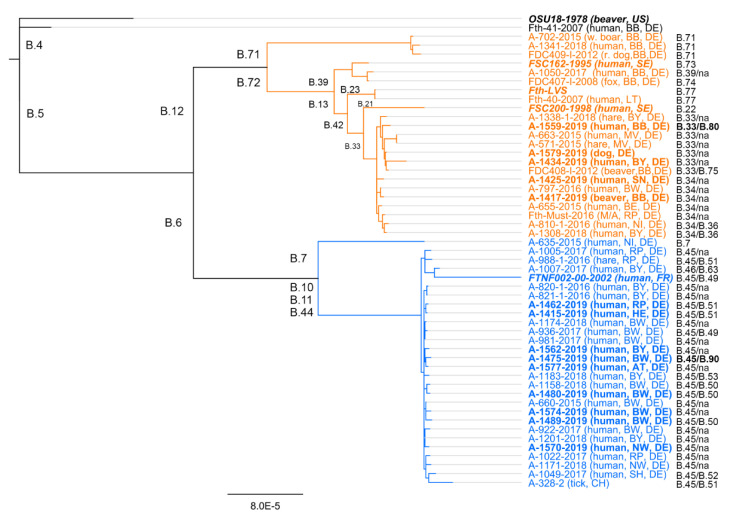
Figure 1
Figure 1
Phylogenetic relationship of Francisella tularensis subsp. holarctica isolates from 2007–2019 in Germany. The analysis was based on a Mauve alignment for collinear genomes. Genomes were generated by DNA sequencing and mapping of obtained DNA reads to the genome of F. tularensis subsp. holarctica (Fth) live vaccine strain (LVS) (for details, see [17]). For the clustering, the neighbor joining bootstrap method was chosen, with F. tularensis subsp. holarctica strain OSU18 as an out-group. Outlined for each genome are the identifier of the isolate and the year of sampling, the host organism, and the sampling spot (Germany’s federal state). In addition, the respective Francisella clade and final subclade (na = not determined) for each genome is given. The sequences obtained from isolates in 2019 (not published elsewhere yet) and some reference genomes included in the analysis are given in bold. Abbreviations: Austria (AT), France (FR), Lithuania (LT), United States (US), Sweden (SE) and Switzerland (CH). Germanys federal states: BB: Brandenburg; BE: Berlin; BW: Baden-Württemberg, BY: Bavaria; HE: Hesse, MV: Mecklenburg-Western Pomerania; NI: Lower Saxony; NW: North Rhine-Westphalia; RP: Rhineland-Palatinate; SH: Schleswig-Holstein; SN: Saxony; TH: Thuringia.
Figure 2
Figure 2
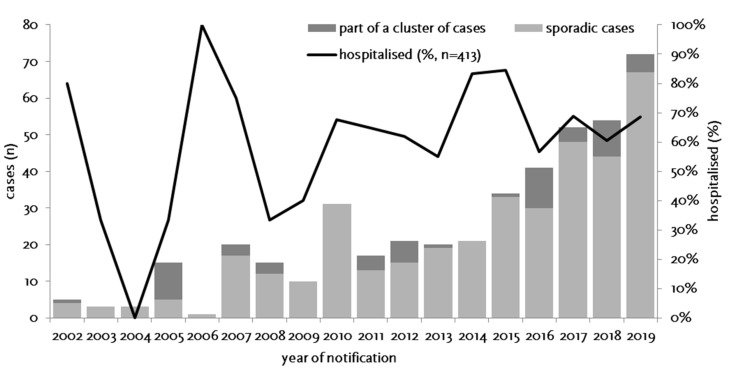
Notified cases of tularemia (sporadic and part of a cluster of cases, stacked bars) and proportion of hospitalized cases (line, second y-axis) by year of notification, Germany, 2002–2019.
Figure 3
Figure 3
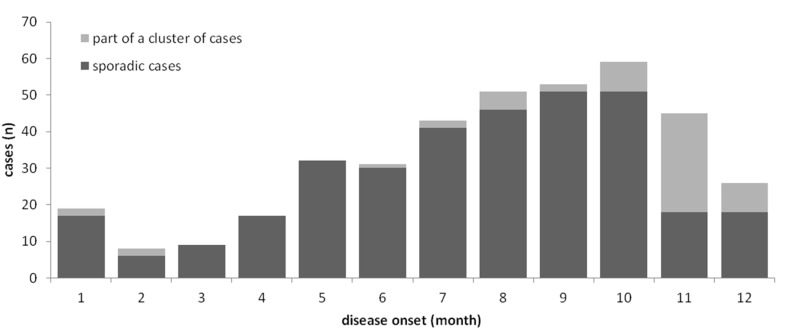
Notified cases of tularemia (sporadic and part of a cluster of cases, stacked bars) by month of notification, Germany, 2002–2019.
Figure 4
Figure 4
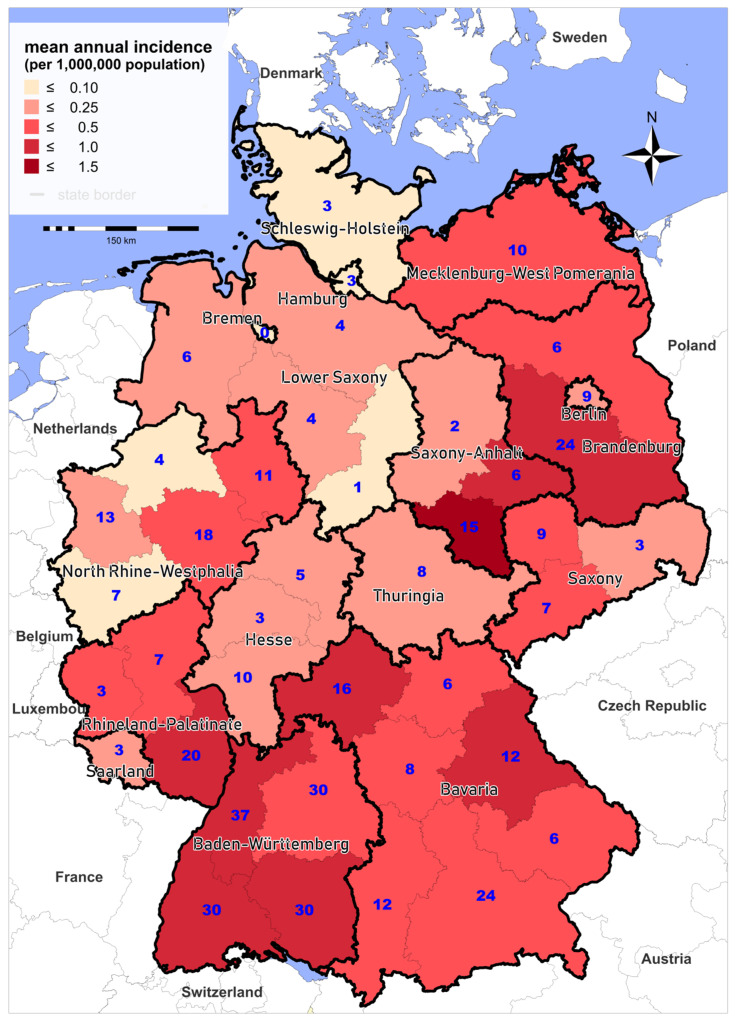
Mean annual incidence (per 1,000,000 population, shading) and total number of notified cases of tularemia (blue digits), Germany, 2002–2019.

References

    1. Moreau G.B., Mann B.J. Adherence and uptake ofFrancisellainto host cells. Virulence. 2013;4:826–832. doi: 10.4161/viru.25629. - DOI - PMC - PubMed
    1. Clemens D.L., Lee B.-Y., Horwitz M.A. Francisella tularensis Enters Macrophages via a Novel Process Involving Pseudopod Loops. Infect. Immun. 2005;73:5892–5902. doi: 10.1128/IAI.73.9.5892-5902.2005. - DOI - PMC - PubMed
    1. Santic M., Molmeret M., Klose K.E., Abu Kwaik Y. Francisella tularensis travels a novel, twisted road within macrophages. Trends Microbiol. 2006;14:37–44. doi: 10.1016/j.tim.2005.11.008. - DOI - PubMed
    1. Ellis J., Oyston P.C.F., Green M., Titball R.W. Tularemia. Clin. Microbiol. Rev. 2002;15:631–646. doi: 10.1128/CMR.15.4.631-646.2002. - DOI - PMC - PubMed
    1. Maurin M., Gyuranecz M. Tularaemia: Clinical aspects in Europe. Lancet Infect. Dis. 2016;16:113–124. doi: 10.1016/S1473-3099(15)00355-2. - DOI - PubMed

LinkOut - more resources