


An Unconventional Flavivirus and Other RNA Viruses in the Sea Cucumber (Holothuroidea; Echinodermata) Virome
- PMID: 32972018
- PMCID: PMC7551563
- DOI: 10.3390/v12091057
An Unconventional Flavivirus and Other RNA Viruses in the Sea Cucumber (Holothuroidea; Echinodermata) Virome
Abstract
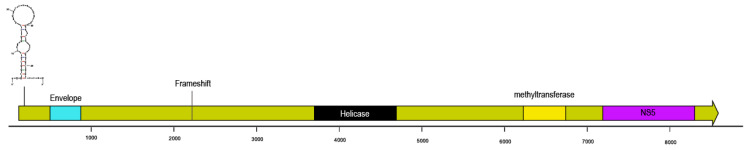
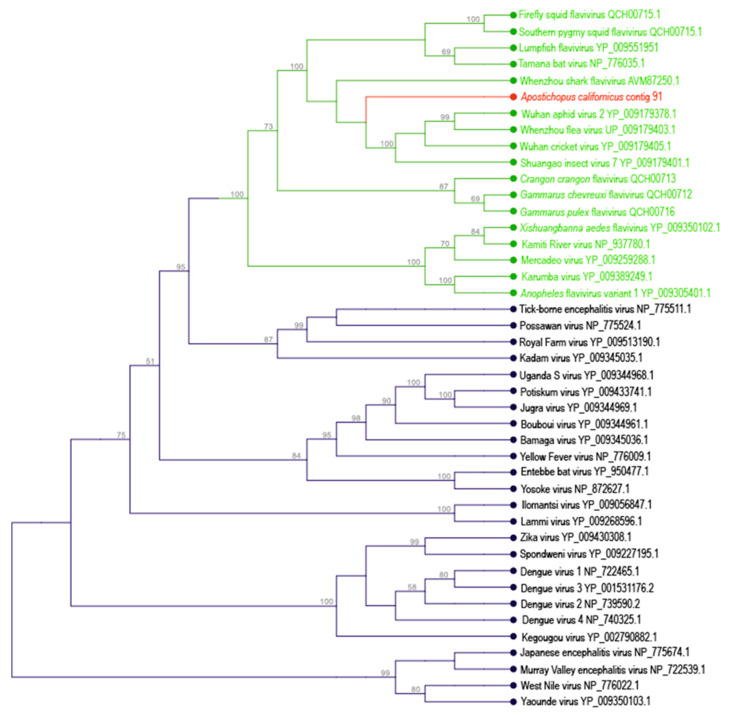
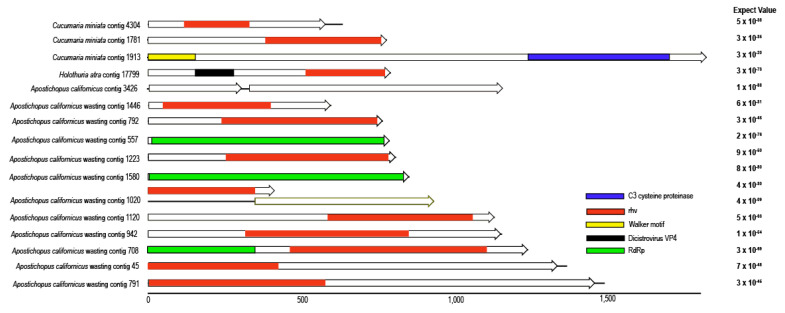
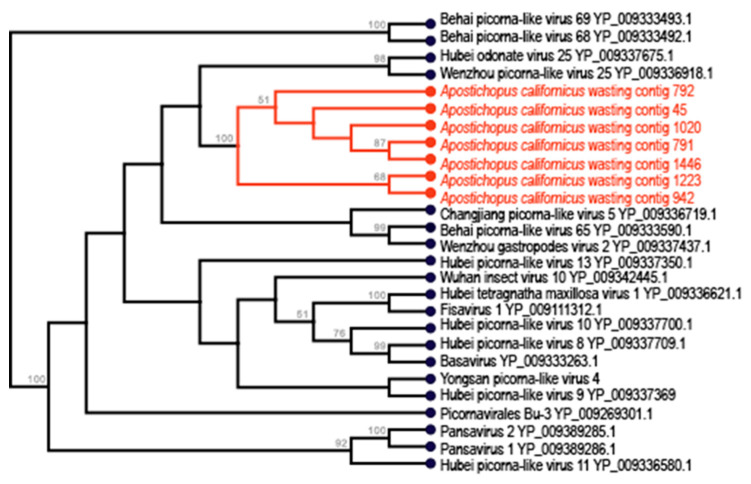
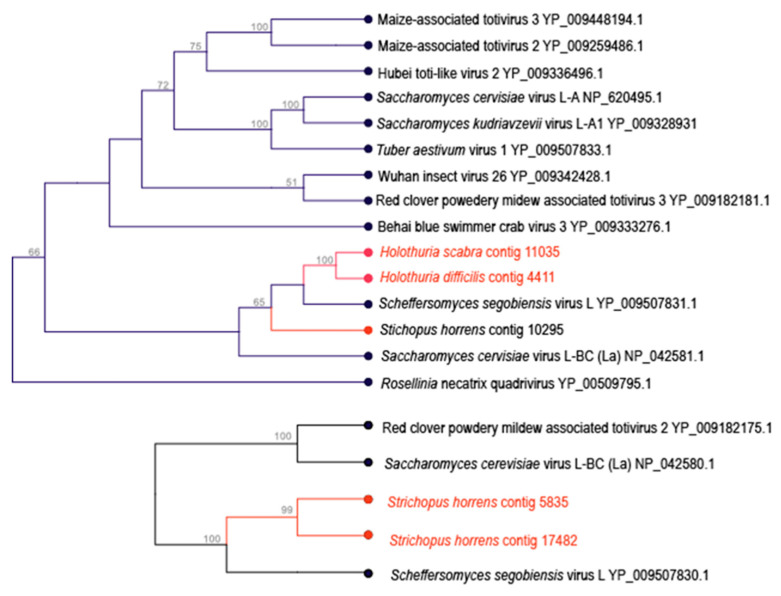
Sea cucumbers (Holothuroidea; Echinodermata) are ecologically significant constituents of benthic marine habitats. We surveilled RNA viruses inhabiting eight species (representing four families) of holothurian collected from four geographically distinct locations by viral metagenomics, including a single specimen of Apostichopus californicus affected by a hitherto undocumented wasting disease. The RNA virome comprised genome fragments of both single-stranded positive sense and double stranded RNA viruses, including those assigned to the Picornavirales, Ghabrivirales, and Amarillovirales. We discovered an unconventional flavivirus genome fragment which was most similar to a shark virus. Ghabivirales-like genome fragments were most similar to fungal totiviruses in both genome architecture and homology and had likely infected mycobiome constituents. Picornavirales, which are commonly retrieved in host-associated viral metagenomes, were similar to invertebrate transcriptome-derived picorna-like viruses. The greatest number of viral genome fragments was recovered from the wasting A. californicus library compared to the asymptomatic A. californicus library. However, reads from the asymptomatic library recruited to nearly all recovered wasting genome fragments, suggesting that they were present but not well represented in the grossly normal specimen. These results expand the known host range of flaviviruses and suggest that fungi and their viruses may play a role in holothurian ecology.
Keywords: Apostichopus; flavivirus; holothurian; totivirus; virus; wasting.
Conflict of interest statement
The authors declare no conflict of interest.
Figures

Similar articles
-
Virome Variation during Sea Star Wasting Disease Progression in Pisaster ochraceus (Asteroidea, Echinodermata).Viruses. 2020 Nov 20;12(11):1332. doi: 10.3390/v12111332. Viruses. 2020. PMID: 33233680 Free PMC article.
-
West African Anopheles gambiae mosquitoes harbor a taxonomically diverse virome including new insect-specific flaviviruses, mononegaviruses, and totiviruses.Virology. 2016 Nov;498:288-299. doi: 10.1016/j.virol.2016.07.031. Epub 2016 Sep 15. Virology. 2016. PMID: 27639161
-
Novel Circular Single-Stranded DNA Viruses among an Asteroid, Echinoid and Holothurian (Phylum: Echinodermata).PLoS One. 2016 Nov 17;11(11):e0166093. doi: 10.1371/journal.pone.0166093. eCollection 2016. PLoS One. 2016. PMID: 27855181 Free PMC article.
-
Metagenomic characterization of viral communities in corals: mining biological signal from methodological noise.Environ Microbiol. 2015 Oct;17(10):3440-9. doi: 10.1111/1462-2920.12803. Epub 2015 Mar 27. Environ Microbiol. 2015. PMID: 25708646 Review.
-
RNA Viruses in Aquatic Unicellular Eukaryotes.Viruses. 2021 Feb 25;13(3):362. doi: 10.3390/v13030362. Viruses. 2021. PMID: 33668994 Free PMC article. Review.
Cited by
-
Virome Variation during Sea Star Wasting Disease Progression in Pisaster ochraceus (Asteroidea, Echinodermata).Viruses. 2020 Nov 20;12(11):1332. doi: 10.3390/v12111332. Viruses. 2020. PMID: 33233680 Free PMC article.
-
Surveillance of densoviruses and mesomycetozoans inhabiting grossly normal tissues of three Aotearoa New Zealand asteroid species.PLoS One. 2021 Apr 22;16(4):e0241026. doi: 10.1371/journal.pone.0241026. eCollection 2021. PLoS One. 2021. PMID: 33886557 Free PMC article.
-
Aquatic Flaviviruses.J Virol. 2022 Sep 14;96(17):e0043922. doi: 10.1128/jvi.00439-22. Epub 2022 Aug 17. J Virol. 2022. PMID: 35975997 Free PMC article. Review.
-
Unraveling the viral dark matter through viral metagenomics.Front Immunol. 2022 Sep 16;13:1005107. doi: 10.3389/fimmu.2022.1005107. eCollection 2022. Front Immunol. 2022. PMID: 36189246 Free PMC article. Review.
-
Heat stress does not induce wasting symptoms in the giant California sea cucumber (Apostichopus californicus).PeerJ. 2023 Feb 7;11:e14548. doi: 10.7717/peerj.14548. eCollection 2023. PeerJ. 2023. PMID: 36778149 Free PMC article.
References
-
- Thurber R.L.V., Barott K.L., Hall D., Liu H., Rodriguez-Mueller B., Desnues C., Edwards R.A., Haynes M., Angly F.E., Wegley L., et al. Metagenomic analysis indicates that stressors induce production of herpes-like viruses in the coral Porites compressa. Proc. Natl. Acad. Sci. USA. 2008;105:18413–18418. doi: 10.1073/pnas.0808985105. - DOI - PMC - PubMed
-
- van Oppen M.J.H., Leong J.A., Gates R.D. Coral-virus interactions: A double-edged sword? Symbiosis. 2009;47:1–8. doi: 10.1007/BF03179964. - DOI
-
- Thurber R.L.V., Correa A.M.S. Viruses of reef-building scleractinian corals. J. Exp. Mar. Biol. Ecol. 2011;408:102–113. doi: 10.1016/j.jembe.2011.07.030. - DOI
Publication types
MeSH terms
LinkOut - more resources
Full Text Sources
Molecular Biology Databases
Miscellaneous
