


Expanding outcomes when considering the relative effectiveness of two evidence-based outpatient treatment programs for adolescents
- PMID: 32972649
- PMCID: PMC7519172
- DOI: 10.1016/j.jsat.2020.108075
Expanding outcomes when considering the relative effectiveness of two evidence-based outpatient treatment programs for adolescents
Erratum in
-
Corrigendum to "Expanding outcomes when considering the relative effectiveness of two evidence-based outpatient treatment programs for adolescents" [J. Subst. Abuse Treat. 118 (2020) 108075].J Subst Abuse Treat. 2020 Nov;118:108126. doi: 10.1016/j.jsat.2020.108126. Epub 2020 Sep 3. J Subst Abuse Treat. 2020. PMID: 32985983 Free PMC article. No abstract available.
Abstract
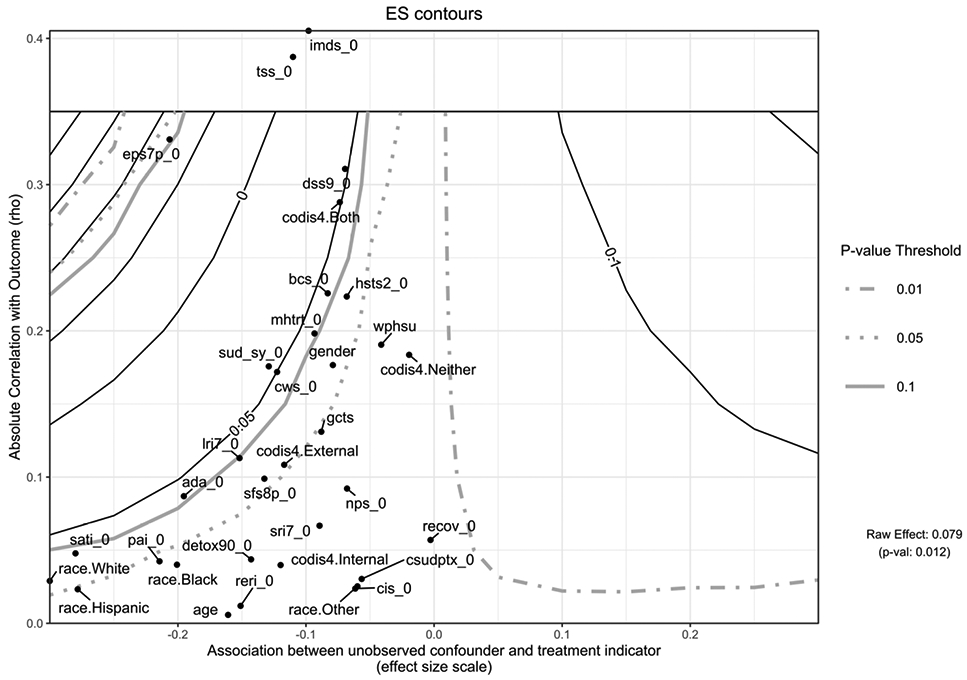
The current study seeks to advance understanding about how to address substance use and co-occurring mental health problems in adolescents. Specifically, we compared the effectiveness of two evidence-based treatment programs (Motivational Enhancement Treatment/Cognitive Behavior Therapy, 5 Sessions [MET/CBT5] and Adolescent Community Reinforcement Approach [A-CRA]) for both substance use and mental health outcomes (i.e., crossover effects). We used statistical methods designed to approximate randomized controlled trials when comparing nonequivalent groups using observational study data. Our methods also included an assessment of the potential impact of omitted variables. We found that after applying balancing weighting to ensure similarity of the baseline samples (given the nonrandomized study design), both groups significantly improved on the two substance use outcomes (days abstinent and percent of youth in recovery) and on the two mental health outcomes (post-traumatic stress disorder (PTSD) symptoms and general emotional problems). Youth in A-CRA were significantly more likely to be in recovery at the 3-month follow-up compared to youth in MET/CBT5, but the size of this effect was very small. Youth receiving MET/CBT5 appeared to show significantly more improvement in the two mental health measures compared to youth in A-CRA, though these effect sizes were also very small. The findings indicate that adolescents with co-occurring substance use and mental health problems improve on both substance use and mental health outcomes with both treatments even though they are not specifically targeting mental health problems.
Keywords: Adolescent; Causal inference; Mental health; Omitted variable; Substance use treatment.
Copyright © 2020 Elsevier Inc. All rights reserved.
Figures


References
-
- Agrawal A, Grant JD, Waldron M, Duncan AE, Scherrer JF, Lynskey MT, Madden PA, Bucholz KK, & Heath AC (2006). Risk for initiation of substance use as a function of age of onset of cigarette, alcohol and cannabis use: findings in a Midwestern female twin cohort. Preventive Medicine, 43(2), 125–128. - PubMed
-
- American Psychiatric Association. (2013). Diagnostic and statistical manual of mental disorders, fifth edition. American Psychiatric Association.
-
- Azrin N, Sisson R, Meyers R, & Godley M (1982). Outpatient alcoholism treatment by community reinforcement and disulfiram therapy. Journal of Behavior Therapy Experimental Psychiatry, 13, 105–112. - PubMed
-
- Bisson JI, Ehlers A, Matthews R, Pilling S, Richards D, & Turner S (2007). Psychological treatments for chronic post-traumatic stress disorder: Systematic review and meta-analysis. The British Journal of Psychiatry, 190(2), 97–104. - PubMed
Publication types
MeSH terms
Grants and funding
LinkOut - more resources
Full Text Sources
Medical
Miscellaneous
