


Stat2 stability regulation: an intersection between immunity and carcinogenesis
- PMID: 32973222
- PMCID: PMC8080578
- DOI: 10.1038/s12276-020-00506-6
Stat2 stability regulation: an intersection between immunity and carcinogenesis
Abstract
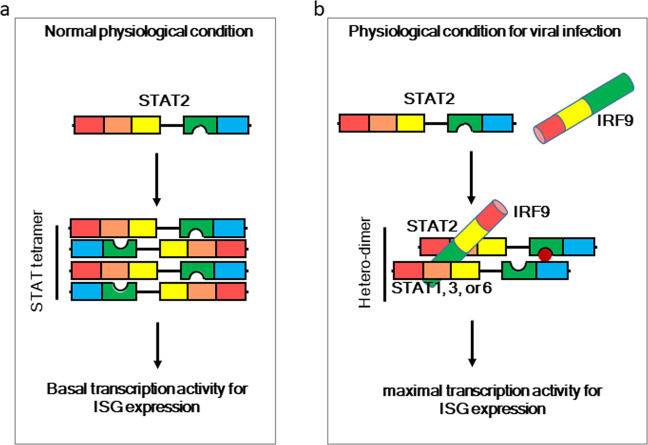
Signal transducer and activator of transcription (STAT2) is a member of the STAT family that plays an essential role in immune responses to extracellular and intracellular stimuli, including inflammatory reactions, invasion of foreign materials, and cancer initiation. Although the majority of STAT2 studies in the last few decades have focused on interferon (IFN)-α/β (IFNα/β) signaling pathway-mediated host defense against viral infections, recent studies have revealed that STAT2 also plays an important role in human cancer development. Notably, strategic research on STAT2 function has provided evidence that transient regulatory activity by homo- or heterodimerization induces its nuclear localization where it to forms a ternary IFN-stimulated gene factor 3 (ISGF3) complex, which is composed of STAT1 and/or STAT2 and IFN regulatory factor 9 (IEF9). The molecular mechanisms of ISGF3-mediated ISG gene expression provide the basic foundation for the regulation of STAT2 protein activity but not protein quality control. Recently, previously unknown molecular mechanisms of STAT2-mediated cell proliferation via STAT2 protein quality control were elucidated. In this review, we briefly summarize the role of STAT2 in immune responses and carcinogenesis with respect to the molecular mechanisms of STAT2 stability regulation via the proteasomal degradation pathway.
Conflict of interest statement
The authors declare that they have no conflict of interest.
Figures



References
-
- Tanaka T, Soriano MA, Grusby MJ. SLIM is a nuclear ubiquitin E3 ligase that negatively regulates STAT signaling. Immunity. 2005;22:729–736. - PubMed
-
- Ulane CM, Horvath CM. Paramyxoviruses SV5 and HPIV2 assemble STAT protein ubiquitin ligase complexes from cellular components. Virology. 2002;304:160–166. - PubMed
-
- Garcin D, Marq JB, Strahle L, le Mercier P, Kolakofsky D. All four Sendai Virus C proteins bind Stat1, but only the larger forms also induce its mono-ubiquitination and degradation. Virology. 2002;295:256–265. - PubMed
Publication types
MeSH terms
Substances
LinkOut - more resources
Full Text Sources
Research Materials
Miscellaneous
