


Shedding Light on "the Hole": A Systematic Review and Meta-Analysis on Adverse Psychological Effects and Mortality Following Solitary Confinement in Correctional Settings
- PMID: 32973582
- PMCID: PMC7468496
- DOI: 10.3389/fpsyt.2020.00840
Shedding Light on "the Hole": A Systematic Review and Meta-Analysis on Adverse Psychological Effects and Mortality Following Solitary Confinement in Correctional Settings
Abstract
Objectives: To systematically review and meta-analyze the psychological effects and mortality rate in inmates having been exposed to solitary confinement in correctional settings.
Methods: PubMed, PsycINFO, Web of Science, and Google Scholar were searched using keywords describing solitary confinement in combination with keywords for psychological or mortality outcomes. Eligible case-control studies for the systematic review met an operational definition for solitary confinement and evaluated outcomes after exposure to such confinement. Studies presenting statistical data which allowed to compute standardized mean differences for symptom scales or odds ratio for mortality were further meta-analyzed using random-effects models.
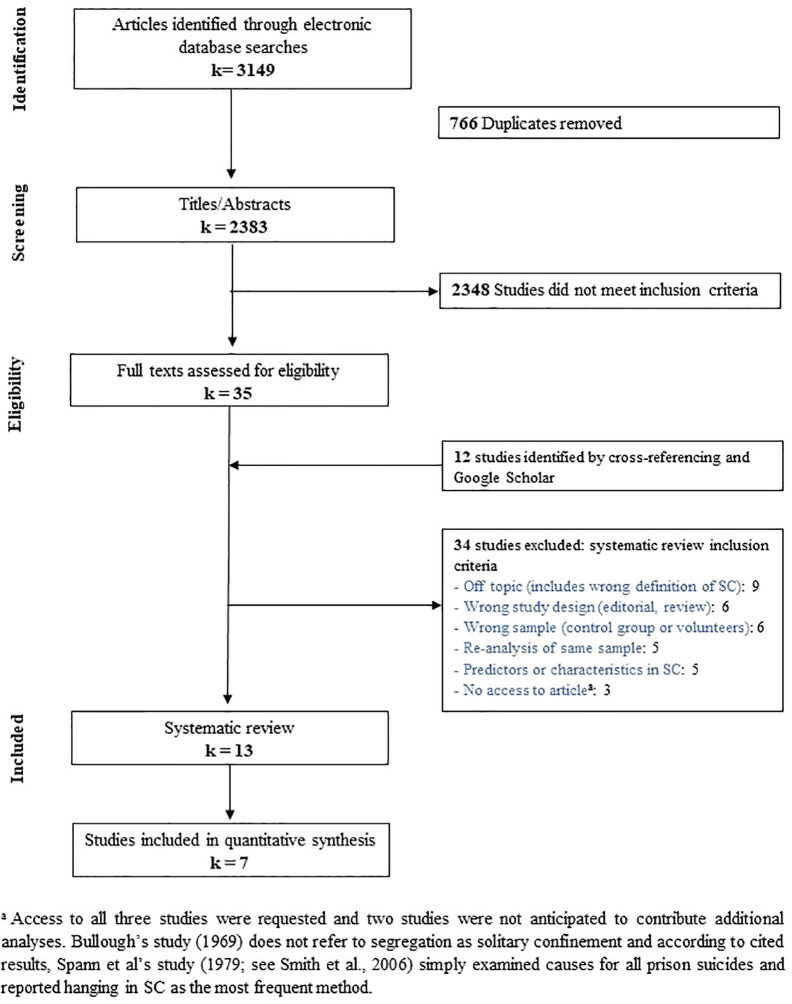
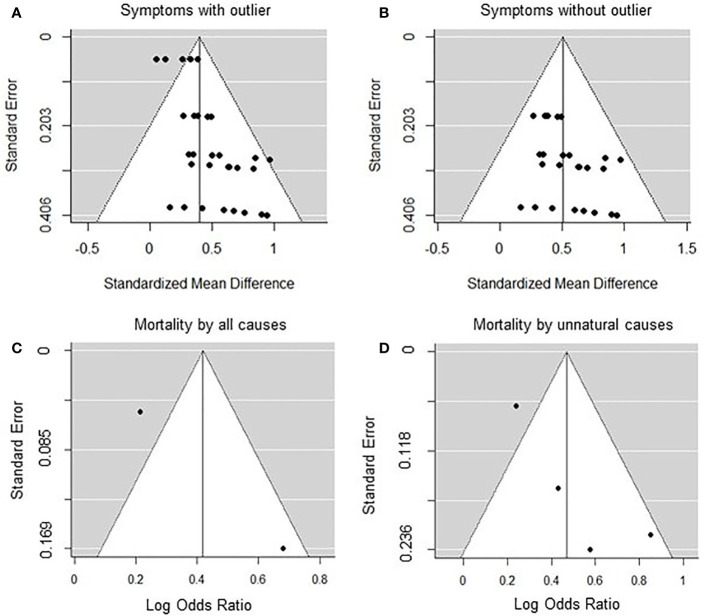
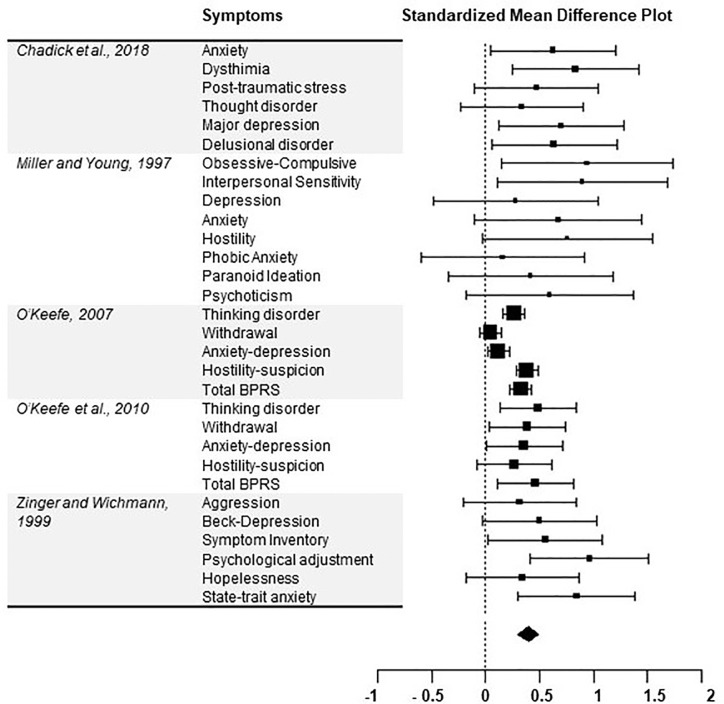
Results: Systematic review identified 13 studies for inclusion, with a total sample of 382,440 inmates (23% having been exposed to solitary confinement). Higher quality evidence showed solitary confinement was associated with an increase in adverse psychological effects, self-harm, and mortality, especially by suicide. Meta-analysis of five studies (n = 4,517) showed a standardized mean difference of 0.45 for general psychological symptomatology, which increased to 0.51 upon outlier exclusion. Small to moderate significant effects were observed for mood, psychotic, and hostility symptoms specifically. In addition, meta-analysis of two mortality studies (n = 243,050) showed a trend for a moderate effect for mortality by any or unnatural causes (i.e., suicide, homicide, overdose, and accidents).
Conclusions: Analyses showed that solitary confinement is associated with the psychological deterioration of inmates. This effect appears to be beyond that of general incarceration or presence of prior mental illness. Thus, solitary confinement may pose significant harm for inmates. Still, further studies are required to show that exposure to SC can increase risk of post-release death. Finally, add-on treatments and alternatives to solitary confinement that could alleviate the associated psychological harm are discussed.
Keywords: inmates; mental health; meta-analysis; mortality; segregation; solitary confinement; symptom; systematic review.
Copyright © 2020 Luigi, Dellazizzo, Giguère, Goulet and Dumais.
Figures
References
-
- Shames A, Wilcox J, Subramanian R. Solitary Confinement: Common Misconceptions and Emerging Safe Alternatives. VERA Institute of Justice: New York: (2015).
-
- Beck AJ. Use of Restrictive Housing in U.S. Prisons and Jails, 2011-12. Washington, DC: Bureau of Justice Statistics, U.S Department of Justice; (2015).
-
- Morris RG. Exploring the effect of exposure to short-term solitary confinement among violent prison inmates. J Quantitative Criminol (2016) 32(1):1–22. 10.1007/s10940-015-9250-0 - DOI
-
- Lynch LE, Mason KV, Rodriguez N. Restrictive housing in the U.S. : Issues, challenges, and future directions. In: . Washington, DC: U.S. Department of Justice, Office of Justice Programs; (2016).
-
- Butler HD, Johnson WW, Griffin OH. The treatment of the mentally ill in supermax facilities: An evaluation of state supermax policies. Crim Justice Behav (2014) 41(11):1338–53. 10.1177/0093854814535082 - DOI
Publication types
Associated data
LinkOut - more resources
Full Text Sources
Miscellaneous
