


Medication Overuse Withdrawal in Children and Adolescents Does Not Always Improve Headache: A Cross-Sectional Study
- PMID: 32973650
- PMCID: PMC7466727
- DOI: 10.3389/fneur.2020.00823
Medication Overuse Withdrawal in Children and Adolescents Does Not Always Improve Headache: A Cross-Sectional Study
Abstract
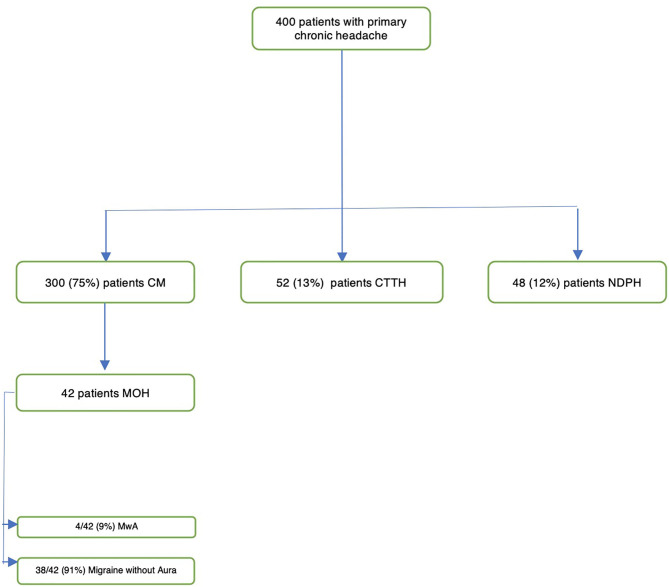
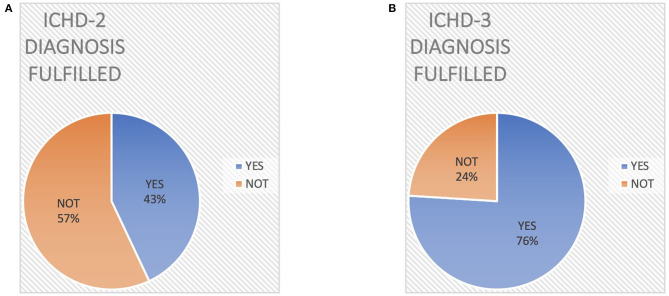
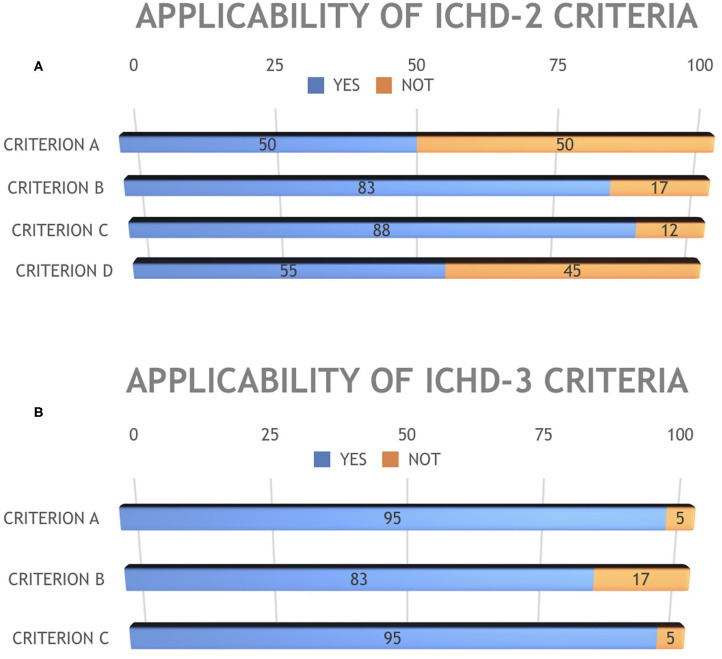
Background: MOH can be diagnosed in subjects with headache occurring 15 days/month in association with a regular medication overuse, but its existence is not universally accepted. ICHD-3 redefined criteria for MOH, removing the criterion associating drug suspension with headache course. The aim of our study was to compare the rate of patients diagnosed with medication overuse headache (MOH) according to ICHD-2 and ICHD-3 criteria, to verify the degree of concordance. The secondary aim was to verify if drug withdrawal was really associated with pain relief. Methods: In this cross-sectional study, we retrospectively analyzed a sample of 400 patients followed for primary chronic headache at the Headache Center of Bambino Gesù Children's Hospital. We then selected those presenting with a history of medication overuse, and we applied both ICHD-2 and ICHD-3 criteria to verify in which patients the criteria would identify a clinical diagnosis of MOH. Results: We identified 42 subjects (10.5%) with MOH; 23 of them (55%) presented a relief of headache withdrawing drug overuse. Regarding the applicability of the ICHD-2 criteria, 43% of patients (18/42) fulfilled all criteria, while all ICHD-3 diagnostic criteria were satisfied in 76% of patients (32/42). Eighteen patients (43%) satisfied both ICHD-2 and ICHD-3 criteria, while 10 patients (24%) did not satisfy either diagnostic criterion. Conclusions: Our study suggests that in children and adolescents, withdrawing medication overuse is not always associated with a clinical benefit. Therefore, though allowing a MOH diagnosis in a higher rate of patients as compared to ICHD-2, the application of ICHD-3 criteria does not guarantee a true a causal relationship between medication overuse and headache worsening.
Keywords: ICHD-3 criteria; children; chronic migraine; medication overuse headache; secondary headache; treatment.
Copyright © 2020 Moavero, Stornelli, Papetti, Ursitti, Ferilli, Balestri, Sforza, Tarantino, Vigevano and Valeriani.
Figures
References
LinkOut - more resources
Full Text Sources
