. 2020;34(Suppl):s57-s72.
doi: 10.11607/ofph.2582.

Attributes Germane to Temporomandibular Disorders and Their Associations with Five Chronic Overlapping Pain Conditions

Attributes Germane to Temporomandibular Disorders and Their Associations with Five Chronic Overlapping Pain Conditions

Sonia Sharma et al. J Oral Facial Pain Headache. 2020.

Abstract

Aims: To investigate whether TMD-related characteristics are indeed specific to TMD or whether they are also associated with other chronic overlapping pain conditions (COPCs).

Methods: In this cross-sectional study, 22 characteristics related broadly to TMD (eg, jaw kinesiophobia, overuse behaviors, and functional limitation) were measured in 178 painful TMD cases who were also classified according to four COPCs: headache, low back pain, irritable bowel syndrome, and fibromyalgia. Differences in mean subscale scores were compared according to individual chronic pain conditions and according to number of COPCs.

Results: Headache, low back pain, irritable bowel syndrome, and fibromyalgia were each associated (P < .05) with higher values of at least one TMD-relevant characteristic. In the multivariable analysis, TMD was independently associated with 20 of the 22 characteristics (P < .01), and other COPCs were associated variably. A critical threshold existed between the number of COPCs and TMD characteristics: all characteristics were elevated for subjects with ≥ 3 COPCs (P ≤ .01).

Conclusion: The overlap between COPCs and characteristics typically regarded as specific to painful TMD has implications for treatment targeted at both the local TMD condition and the broader pain disorder underlying the COPC(s). In TMD patients, the overall burden of pain from COPCs may create a shift in the pain-processing systems that underlie these TMD-relevant characteristics.


Figures

Fig 1
Fig 1
Beta coefficient and standard error (SE) for the linear relationship of each measure with the number of COPCs. The orange panel is a heat map depicting standardized odds ratios (SORs) (reported in Table 2) that quantify the strength of association between measures germane to TMD and each individual COPC. The blue panel is a heat map depicting TMD measure z-score differences according to each COPC (data presented in Appendix 3). For example, the top row depicts the mean pain-free jaw opening z-score difference between cases and controls for each COPC. HA = headache; FM = fibromyalgia; (r) = reverse scoring (negative z scores used for SORs represent increase in odds of being a case associated with reduction of 1 SD in the value of the variable); MM = masticatory muscle; TMQ = Temporomandibular Questionnaire; JFLS = Jaw Functional Limitation Scale; V&E = verbal and emotional expression subscale; TSK = Tampa Scale for Kinesiophobia (activity and somatic subscales); OBC = Oral Behaviors Checklist.
Fig 2
Fig 2
Relationships between number of pain conditions and measures germane to TMD in the OPPERA-2 study (n = 655 participants). (a) Pain-free opening. (b) Jaw muscle pain on palpation. (c) Neck muscle pain on palpation. (d) Nonspecific jaw symptoms. (e) Jaw Functional Limitation Scale global score. (f) Oral Behaviors Checklist. Each TMD measure was the dependent variable in separate linear regression models that used weighted estimates from generalized estimating equations with robust error variance calculation and adjustments for study site, age, gender, and race. Each plot summarizes three separate regression models for the same dependent variable. (1) The number of COPCs was modeled as a dummy predictor. Vertical axis plots estimated the mean value of the selected TMD variable (transformed to a z-score) as the dependent variable and the dummy variable for the number of COPCs (5 degrees of freedom) as a categorical predictor. The model was adjusted for study site, age, gender, and race. Whiskers signify ± 1 standard error (SE). (2) Beta (β) estimate (SE) represents the amount of change in the same dependent variable as in (1) for each increase in the number of COPCs, modeled as a continuous variable. The model was adjusted for study site, age, gender, and race. aP < .05 for the test of the null hypothesis that β = 0. (3) Each COPC was modeled as an independent binary predictor to show independent associations of each COPC. The numbers in the tables are parameter estimates for the corresponding dummy variables for the COPCs, denoted as T = temporomandibular disorder, H = headache, I = IBS, B = low back pain, and F = fibromyalgia. The model adjusted for study site, age, gender, and race. bP < .05 for the null hypothesis that the parameter estimate for the dummy variable = 0.
Fig 3
Fig 3
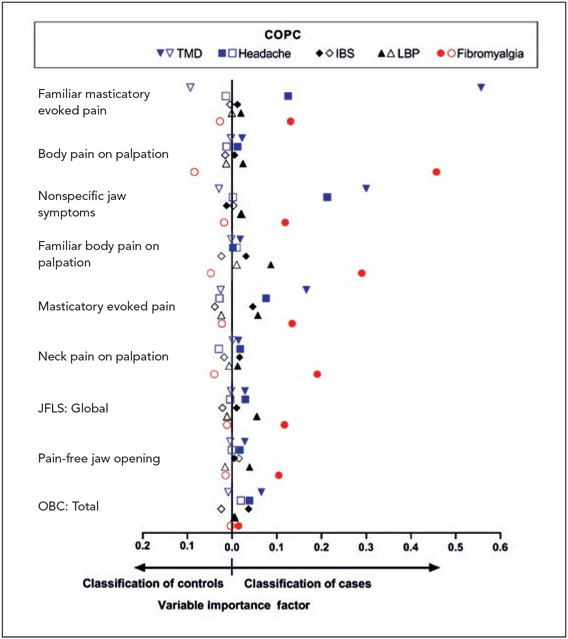
Multivariable associations of TMD measures with pain conditions in OPPERA-2 (n = 655 participants). Random forest modeling explored the multivariable associations of all TMD measures with each binary COPC case classification, with study site, age, gender, and race also included as covariates. Associations of individual variables in the random forest models were quantified using variable importance scores, which estimate the relative association of each predictor to the model’s classification of true positives and true negatives. Other measures germane to TMD were included in the models but are excluded from the figure due to negligible variable importance scores. The threshold for exclusion from the figure was set to 0.0004 in order to ensure a clear, concise plot. A variable importance score < 0.0004 means that in the presence of all of the other measures included in the random forest model, these TMD measures improved the misclassification error rate by less than 0.04 percentage points. Filled symbols = COPC cases; open symbols = controls; JFLS = Jaw Functional Limitation Scale; OBC = Oral Behaviors Checklist.

Comment in

References

    1. Diatchenko L, Nackley AG, Slade GD, Fillingim RB, Maixner W. Idiopathic pain disorders—Pathways of vulnerability. Pain 2006;123:226–230. - PubMed
    1. Maixner W, Fillingim RB, Williams DA, Smith SB, Slade GD. Overlapping chronic pain conditions: Implications for diagnosis and classification. J Pain 2016;17(9 suppl):T93–T107. - PMC - PubMed
    1. Yunus MB. Fibromyalgia and overlapping disorders: The unifying concept of central sensitivity syndromes. Semin Arthritis Rheum 2007;36:339–356. - PubMed
    1. Functional pain disorders: Time for a paradigm shift. In: Mayer EA, Bushnell MC (eds). Functional Pain Syndromes: Presentation and Pathophysiology. Seattle: IASP, 2009:531–565.
    1. Headache Classification Committee of the International Headache Society (IHS). The International Classification of Headache Disorders, ed 3. Cephalalgia 2018;38:1–211. - PubMed