


Influence of altitude on cerebral and splanchnic oxygen saturation in critically ill children during air ambulance transport
- PMID: 32976507
- PMCID: PMC7518599
- DOI: 10.1371/journal.pone.0239272
Influence of altitude on cerebral and splanchnic oxygen saturation in critically ill children during air ambulance transport
Abstract
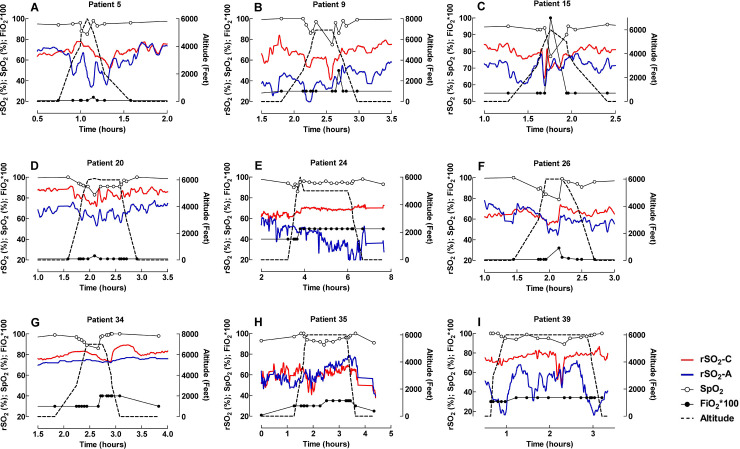
Objective: The aim of the current study was to investigate how cerebral and splanchnic oxygen saturation (rSO2-C and rSO2-A) in critically ill children transported in air ambulance was affected by flight with cabin pressurization corresponding to ≥ 5000 feet. A second aim was to investigate any differences between cyanotic and non-cyanotic children in relation to cerebral and splanchnic oxygen saturation during flight ≥ 5000 feet. The variability of the cerebral and splanchnic Near Infrared Spectroscopy (NIRS) sensors was evaluated.
Design: NIRS was used to measure rSO2-C and rSO2-A during transport of critically ill children in air ambulance. rSO2 data was collected and stored by the NIRS monitor and extracted and analyzed off-line after the transport. Prior to evaluation of the NIRS signals all zero and floor-effect values were removed.
Setting: The Pediatric Intensive Care Unit (PICU) at Astrid Lindgren Children's Hospital, Karolinska University Hospital in Stockholm, Sweden.
Patients: In total, 44 critically ill children scheduled for inter-hospital transport by a specialized pediatric transport team were included in the study between January 2014 and January 2019 (convenience sampling).
Intervention: No interventions were conducted.
Measurements: All study patients were monitored with a cerebral NIRS-sensor placed over the forehead and an abdominal NIRS-sensor placed in the infra-umbilical area for cerebral and splanchnic regional oxygen saturation monitoring, rSO2-C and rSO2-A, respectively.
Main results: Complete rSO2-C and rSO2-A data was obtained in 39 patients. Median age was 12 days. Cyanotic congenital heart malformations were present in 9 patients (23%). In 22 patients (56%) rSO2-C decreased at altitude ≥ 5000 feet and in 24 patients (61%) rSO2-A decreased at altitude ≥ 5000 feet compared to baseline (p<0.0001). In 25 patients (64%) the rSO2-C/rSO2-A ratio was greater at altitude ≥ 5000 feet than at baseline. A ratio ≥ 1 was seen in 77% of patients at altitude ≥ 5000 feet compared to in 67% of patients at baseline.
Conclusion: Both cerebral and splanchnic oxygen saturation decreased at altitude ≥ 5000 feet compared to baseline. In most patients, both cyanotic and non-cyanotic, cerebral oxygen saturation was preserved more than splanchnic oxygen saturation.
Conflict of interest statement
The authors have declared that no competing interests exist.
Figures



References
-
- Ramnarayan P, Thiru K, Parslow RC, Harrison DA, Draper ES, Rowan KM. Effect of specialist retrieval teams on outcomes in children admitted to paediatric intensive care units in England and Wales: a retrospective cohort study. Lancet. 2010; 376(9742):698–704. 10.1016/S0140-6736(10)61113-0 - DOI - PubMed
Publication types
MeSH terms
Substances
LinkOut - more resources
Full Text Sources
Medical
