


Angelman syndrome and melatonin: What can they teach us about sleep regulation
- PMID: 32976638
- PMCID: PMC7577950
- DOI: 10.1111/jpi.12697
Angelman syndrome and melatonin: What can they teach us about sleep regulation
Abstract
In 1965, Dr Harry Angelman reported a neurodevelopmental disorder affecting three unrelated children who had similar symptoms: brachycephaly, mental retardation, ataxia, seizures, protruding tongues, and remarkable paroxysms of laughter. Over the past 50 years, the disorder became Angelman's namesake and symptomology was expanded to include hyper-activity, stereotypies, and severe sleep disturbances. The sleep disorders in many Angelman syndrome (AS) patients are broadly characterized by difficulty falling and staying asleep at night. Some of these patients sleep less than 4 hours a night and, in most cases, do not make up this lost sleep during the day-leading to the speculation that AS patients may "need" less sleep. Most AS patients also have severely reduced levels of melatonin, a hormone produced by the pineal gland exclusively at night. This nightly pattern of melatonin production is thought to help synchronize internal circadian rhythms and promote nighttime sleep in humans and other diurnal species. It has been proposed that reduced melatonin levels contribute to the sleep problems in AS patients. Indeed, emerging evidence suggests melatonin replacement therapy can improve sleep in many AS patients. However, AS mice show sleep problems that are arguably similar to those in humans despite being on genetic backgrounds that do not make melatonin. This suggests the hypothesis that the change in nighttime melatonin may be a secondary factor rather than the root cause of the sleeping disorder. The goals of this review article are to revisit the sleep and melatonin findings in both AS patients and animal models of AS and discuss what AS may tell us about the underlying mechanisms of, and interplay between, melatonin and sleep.
Keywords: Ube3a; Angelman syndrome; melatonin; sleep.
© 2020 John Wiley & Sons A/S. Published by John Wiley & Sons Ltd.
Figures
References
-
- Boivin DB, Czeisler CA, Dijk DJ, et al. Complex interaction of the sleep-wake cycle and circadian phase modulates mood in healthy subjects. Arch Gen Psychiatry. 1997;54(2):145–152. - PubMed
-
- Achermann P, Dijk DJ, Brunner DP, Borbely AA. A model of human sleep homeostasis based on EEG slow-wave activity: quantitative comparison of data and simulations. Brain Res Bull. 1993;31(1–2):97–113. - PubMed
-
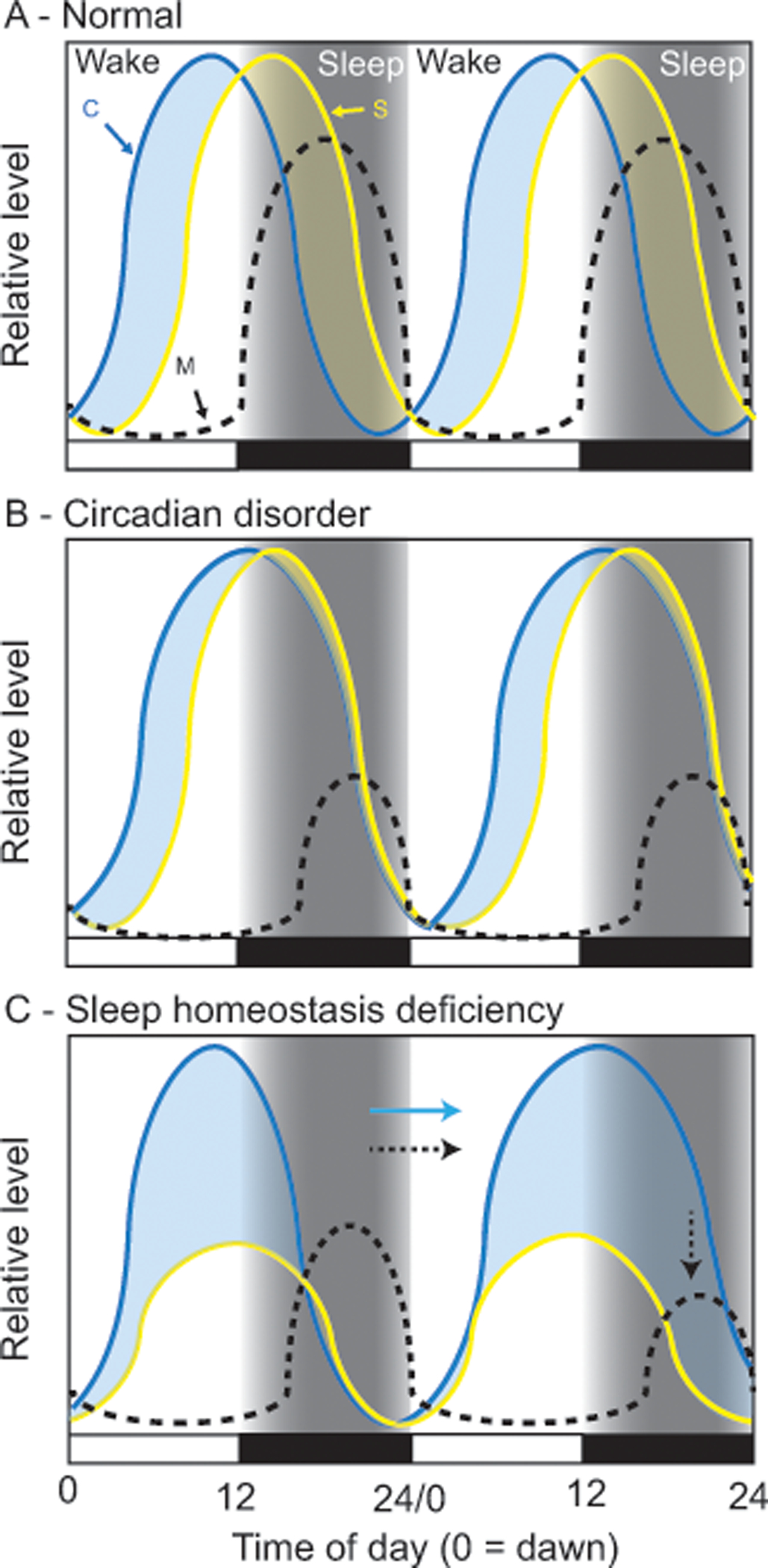
- Borbely AA, Daan S, Wirz-Justice A, Deboer T. The two-process model of sleep regulation: a reappraisal. J Sleep Res. 2016;25(2):131–143. - PubMed
Publication types
MeSH terms
Substances
Grants and funding
- U54 NS083932/NS/NINDS NIH HHS/United States
- R35 GM127044/GM/NIGMS NIH HHS/United States
- NS083932/NS/NINDS NIH HHS/United States
- R25 GM058268/GM/NIGMS NIH HHS/United States
- U24 MD015970/MD/NIMHD NIH HHS/United States
- 1832069/Division of Integrative Organismal Systems
- U54 MD007602/MD/NIMHD NIH HHS/United States
- GM109861/GM/NIGMS NIH HHS/United States
- SC1 GM127260/GM/NIGMS NIH HHS/United States
- GM127044/GM/NIGMS NIH HHS/United States
- U54MD007602/MD/NIMHD NIH HHS/United States
- GM127260/GM/NIGMS NIH HHS/United States
- SC1 GM109861/GM/NIGMS NIH HHS/United States
LinkOut - more resources
Full Text Sources
Medical
Research Materials
Miscellaneous
