


Good to Excellent Functional Short-Term Outcome and Low Revision Rates Following Primary Anterior Cruciate Ligament Repair Using Suture Augmentation
- PMID: 32977649
- PMCID: PMC7598184
- DOI: 10.3390/jcm9103068
Good to Excellent Functional Short-Term Outcome and Low Revision Rates Following Primary Anterior Cruciate Ligament Repair Using Suture Augmentation
Abstract
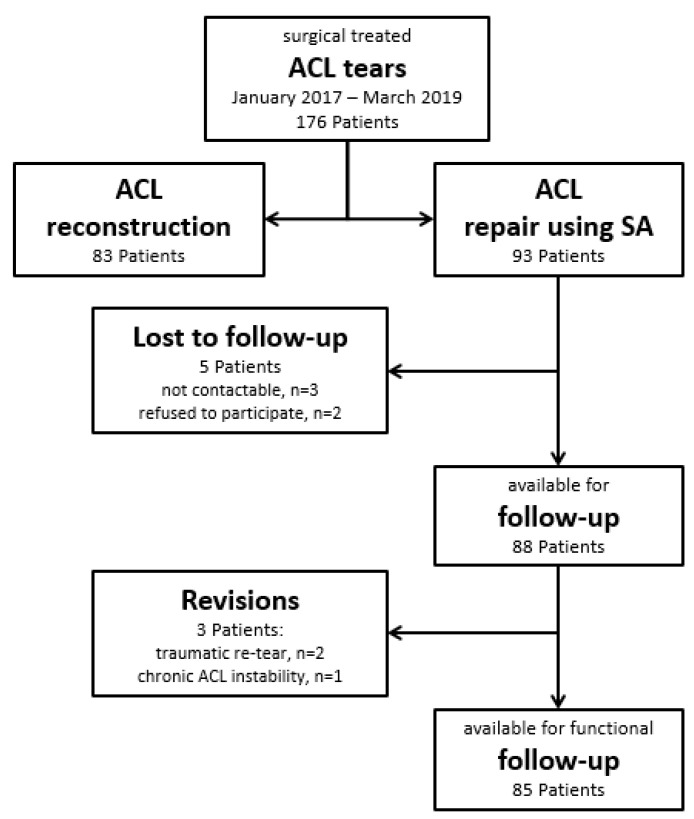
The aim of this study was to evaluate the functional outcome of primary anterior cruciate ligament (ACL) repair using suture augmentation (SA) in 93 consecutive patients (67 female) with a minimum follow-up of 12 months. Patients' outcomes were determined using International Knee Documentation Committee (IKDC) score, Lysholm score (LS) and Tegner score (TS). Knee-laxity was assessed using the KT-1000 arthrometer. Eighty-eight patients (67 female, mean age 42 years ± standard deviation (SD) 13) were available for follow-up after a mean time of 21 months (range 12-39). Three patients (3%) underwent revision surgery and were excluded from functional analysis. The mean IKDC score was 87.4 ± 11, mean LS was 92.6 ± 11, mean pre-traumatic TS was 6 ± 2 and mean postoperative TS was 6 ± 2, with a mean difference (TSDiff) of 1 ± 1. The interval from injury to surgery had no significant impact on the postoperative IKDC (p = 0.228), LS (p = 0.377) and TSDiff (p = 0.572). Patients' age (>40 years), BMI (>30) and coexisting ligament or meniscal injuries did not seem to influence postoperative functional results. Primary ACL repair using SA provides good to excellent functional outcomes with a low probability of revision surgery at a minimum of 12 months.
Keywords: ACL; anterior cruciate ligament; injury; internal brace; repair; rupture; suture augmentation; tear.
Conflict of interest statement
B.S. has given paid lectures for Mathys AG, is a paid consultant for KLS Martin and has received research funding from Arthrex GmbH and Mathys AG—all outside the submitted work All other authors declare no conflict of interest.
Figures
References
-
- Aglietti P., Giron F., Buzzi R., Biddau F., Sasso F. Anterior cruciate ligament reconstruction: Bone-patellar tendon-bone compared with double semitendinosus and gracilis tendon grafts. A prospective, randomized clinical trial. J. Bone Joint Surg. Am. 2004;86-A:2143–2155. doi: 10.2106/00004623-200410000-00004. - DOI - PubMed
LinkOut - more resources
Full Text Sources
Medical
