


Treg Enhancing Therapies to Treat Autoimmune Diseases
- PMID: 32977677
- PMCID: PMC7582931
- DOI: 10.3390/ijms21197015
Treg Enhancing Therapies to Treat Autoimmune Diseases
Abstract
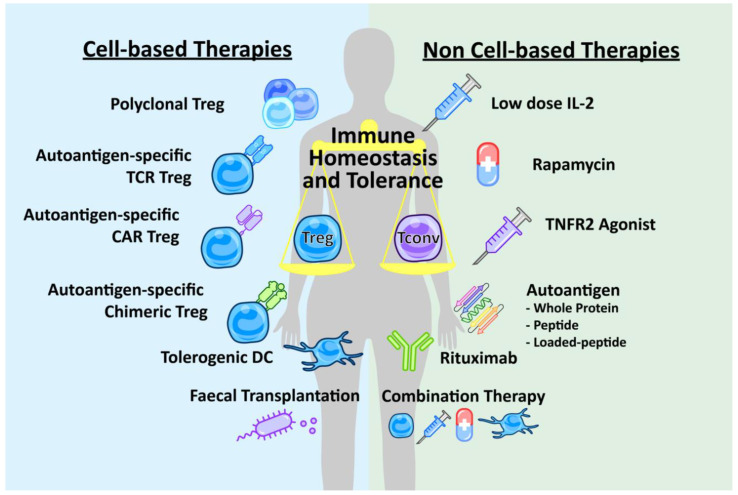
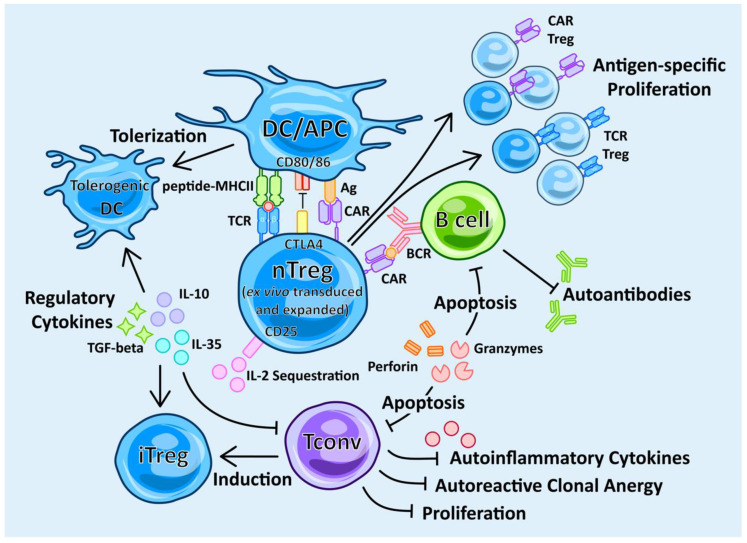
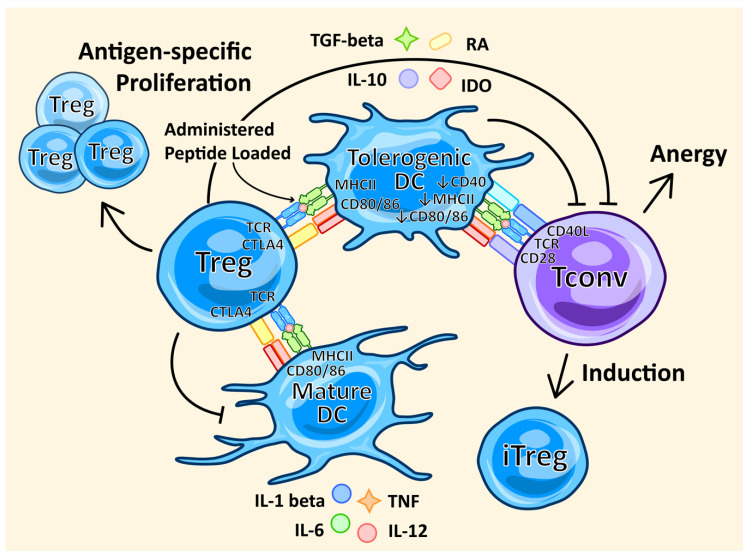
Regulatory T cells (Tregs) are a small yet critical subset of CD4+ T cells, which have the role of maintaining immune homeostasis by, for example, regulating self-tolerance, tumor immunity, anti-microbial resistance, allergy and transplantation rejection. The suppressive mechanisms by which Tregs function are varied and pleiotropic. The ability of Tregs to maintain self-tolerance means they are critical for the control and prevention of autoimmune diseases. Irregularities in Treg function and number can result in loss of tolerance and autoimmune disease. Restoring immune homeostasis and tolerance through the promotion, activation or delivery of Tregs has emerged as a focus for therapies aimed at curing or controlling autoimmune diseases. Such therapies have focused on the Treg cell subset by using drugs to suppress T effector cells and promote Tregs. Other approaches have trialed inducing tolerance by administering the autoantigen via direct administration, by transient expression using a DNA vector, or by antigen-specific nanoparticles. More recently, cell-based therapies have been developed as an approach to directly or indirectly enhance Treg cell specificity, function and number. This can be achieved indirectly by transfer of tolerogenic dendritic cells, which have the potential to expand antigen-specific Treg cells. Treg cells can be directly administered to treat autoimmune disease by way of polyclonal Tregs or Tregs transduced with a receptor with high affinity for the target autoantigen, such as a high affinity T cell receptor (TCR) or a chimeric antigen receptor (CAR). This review will discuss the strategies being developed to redirect autoimmune responses to a state of immune tolerance, with the aim of the prevention or amelioration of autoimmune disease.
Keywords: Treg; Treg therapy; autoimmune disease; autoimmunity; cell-based therapy.
Conflict of interest statement
The funders had no role in the design of the review; in the writing of the manuscript, or in the decision to publish the results. Joshua D. Ooi and Peter J. Eggenhuizen are inventors on Australian Provisional Patent Application number 2020900864.
Figures
References
-
- Shimizu J., Yamazaki S., Sakaguchi S. Induction of tumor immunity by removing CD25+CD4+ T cells: A common basis between tumor immunity and autoimmunity. J. Immunol. 1999;163:5211–5218. - PubMed
-
- Sutmuller R.P., van Duivenvoorde L.M., van Elsas A., Schumacher T.N., Wildenberg M.E., Allison J.P., Toes R.E., Offringa R., Melief C.J. Synergism of cytotoxic T lymphocyte-associated antigen 4 blockade and depletion of CD25(+) regulatory T cells in antitumor therapy reveals alternative pathways for suppression of autoreactive cytotoxic T lymphocyte responses. J. Exp. Med. 2001;194:823–832. doi: 10.1084/jem.194.6.823. - DOI - PMC - PubMed
-
- Sakaguchi S., Sakaguchi N., Asano M., Itoh M., Toda M. Immunologic self-tolerance maintained by activated T cells expressing IL-2 receptor alpha-chains (CD25). Breakdown of a single mechanism of self-tolerance causes various autoimmune diseases. J. Immunol. 1995;155:1151–1164. - PubMed
Publication types
MeSH terms
Substances
Grants and funding
LinkOut - more resources
Full Text Sources
Other Literature Sources
Medical
Research Materials
