. 2020 Dec 10;533(3):467-473.
doi: 10.1016/j.bbrc.2020.08.086. Epub 2020 Aug 25.

Andrographolide and its fluorescent derivative inhibit the main proteases of 2019-nCoV and SARS-CoV through covalent linkage

Affiliations

Andrographolide and its fluorescent derivative inhibit the main proteases of 2019-nCoV and SARS-CoV through covalent linkage

Tzu-Hau Shi et al. Biochem Biophys Res Commun. .

Abstract

The coronavirus disease 2019 (COVID-19) pandemic caused by 2019 novel coronavirus (2019-nCoV) has been a crisis of global health, whereas the effective vaccines against 2019-nCoV are still under development. Alternatively, utilization of old drugs or available medicine that can suppress the viral activity or replication may provide an urgent solution to suppress the rapid spread of 2019-nCoV. Andrographolide is a highly abundant natural product of the medicinal plant, Andrographis paniculata, which has been clinically used for inflammatory diseases and anti-viral therapy. We herein demonstrate that both andrographolide and its fluorescent derivative, the nitrobenzoxadiazole-conjugated andrographolide (Andro- NBD), suppressed the main protease (Mpro) activities of 2019-nCoV and severe acute respiratory syndrome coronavirus (SARS-CoV). Moreover, Andro-NBD was shown to covalently link its fluorescence to these proteases. Further mass spectrometry (MS) analysis suggests that andrographolide formed a covalent bond with the active site Cys145 of either 2019-nCoV Mpro or SARS-CoV Mpro. Consistently, molecular modeling analysis supported the docking of andrographolide within the catalytic pockets of both viral Mpros. Considering that andrographolide is used in clinical practice with acceptable safety and its diverse pharmacological activities that could be beneficial for attenuating COVID-19 symptoms, extensive investigation of andrographolide on the suppression of 2019-nCoV as well as its application in COVID-19 therapy is suggested.

Keywords: 2019-nCoV; Andrographolide; Main protease; SARS-CoV.


Conflict of interest statement

Declaration of competing interest The authors declare no conflicts of interest.

Figures
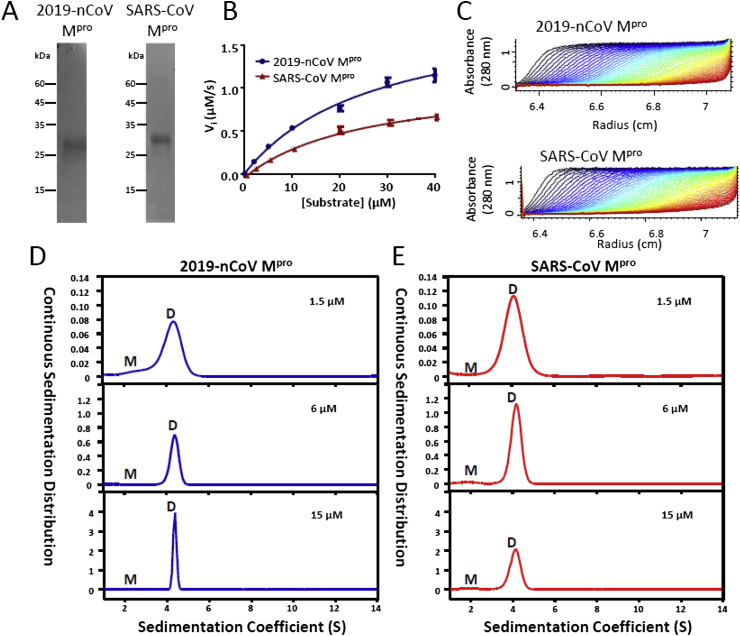
Fig. 1
Fig. 1
Enzymatic activities and quaternary structure analyses of the 2019-nCoV Mpro and SARS-CoV Mpro. (A) Expression and purification of 2019-nCoV Mpro and SARS-CoV Mpro. (B) Enzyme activities of 2019-nCoV Mpro and SARS-CoV Mpro were measured using a proteolytic activity assay. (C) Absorbance patterns acquired during the sedimentation velocity experiment. (D) Profiles of 2019-nCoV Mpro quaternary structures at various protein concentration. M as monomer and D as Dimer. (E) Profiles of SARS-CoV Mpro quaternary structures at various protein concentration.
Fig. 2
Fig. 2
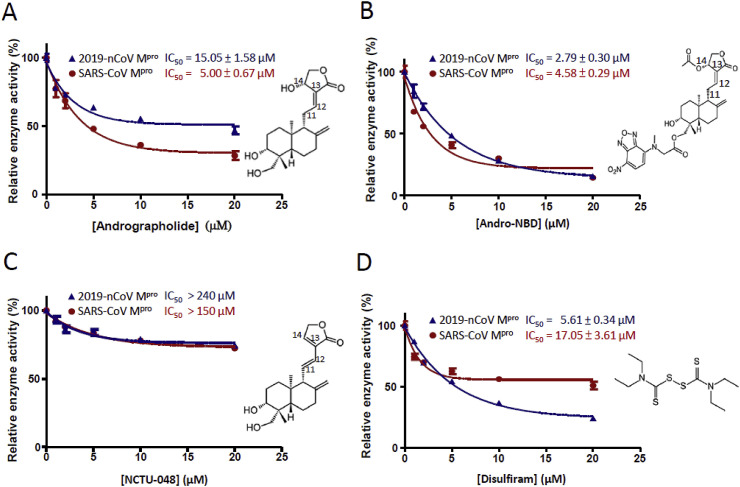
Inhibition of 2019-nCoV Mpro activity by andrographolide and its derivatives. Protease activities of 2019-nCoV Mpro or SARS-CoV Mpro in the presence of inhibitors at five different concentrations was measured. IC50 of (A) andrographolide (B) Andro-NBD (C) NCTU-048 and (D) disulfiram were determined and shown respectively. All the experiments were independently carried out in triplicates.
Fig. 3
Fig. 3
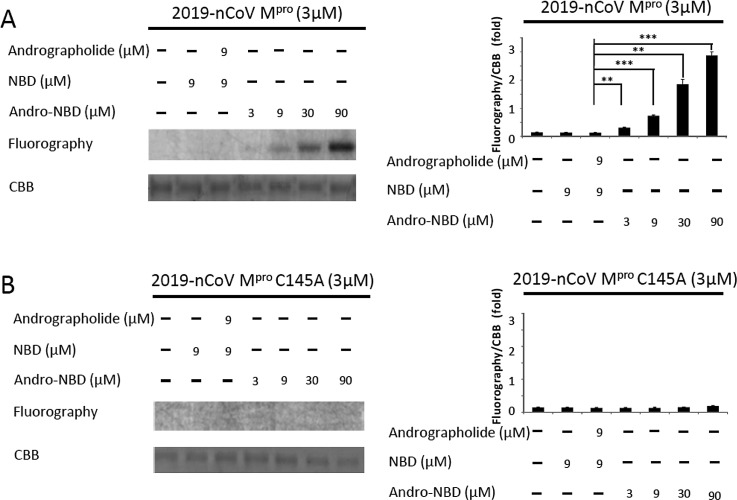
Andro-NBD formed covalent linkage with Cys145 of 2019-nCoV Mpro. (A) 2019-nCoV Mpro was incubated with various concentration of Andro-NBD at 25 °C for 1 h and subsequently analyzed by SDS-PAGE. Gel fluorescence was detected and scanned for image. Quantitative data were shown as mean ± SD from three independent experiments. ∗∗ represents p-value <0.01 and ∗∗∗ represents p-value <0.001. (B) The C145A mutant 2019-nCoV Mpro was also incubated with various concentration of Andro-NBD at 25 °C for 1 h and subsequently analyzed by SDS-PAGE. No gel fluorescence was detected.
Fig. 4
Fig. 4
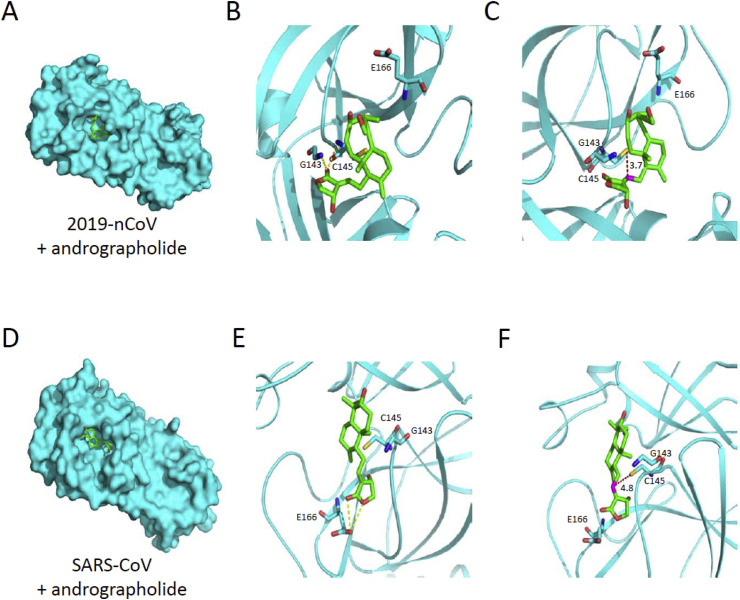
Prediction of the putative binding site for andrographolide in 2019-nCoV Mpro and SARS-CoV Mpro. (A) Overall predicted surface model for the complex of 2019-nCoV Mpro (cyan) and andrographolide (green) was established. (B) Amplified region of catalytic pocket highlighting the hydrogen bonds (yellow dot line) between Mpro residues and andrographolide. (C) The distance (red dot line) between Mpro Cys145 (yellow) and Michael acceptor carbon (magenta) of andrographolide is shown. (D) Overall predicted surface model for the complex of SARS-CoV Mpro (cyan) and andrographolide (green) was established. (E, F) Amplified regions of catalytic pocket for complex in (D). (For interpretation of the references to colour in this figure legend, the reader is referred to the Web version of this article.)

References

    1. Li G., De Clercq E. Therapeutic options for the 2019 novel coronavirus (2019-nCoV) Nat. Rev. Drug Discov. 2020;19:149–150. - PubMed
    1. Pillaiyar T., Manickam M., Namasivayam V., Hayashi Y., Jung S.H. An overview of severe acute respiratory syndrome-coronavirus (SARS-CoV) 3CL protease inhibitors: Peptidomimetics and small molecule chemotherapy. J. Med. Chem. 2016;59:6595–6628. - PMC - PubMed
    1. Morse J.S., Lalonde T., Xu S., Liu W.R. Learning from the Past: Possible urgent prevention and treatment options for severe acute respiratory infections caused by 2019-nCoV. Chembiochem. 2020;21:730–738. - PMC - PubMed
    1. Jin Z., Du X., Xu Y., Deng Y., Liu M., Zhao Y., Zhang B., Li X., Zhang L., Peng C., Duan Y., Yu J., Wang L., Yang K., Liu F., Jiang R., Yang X., You T., Liu X., Yang X., Bai F., Liu H., Liu X., Guddat L.W., Xu W., Xiao G., Qin C., Shi Z., Jiang H., Rao Z., Yang H. Structure of M(pro) from COVID-19 virus and discovery of its inhibitors. Nature. 2020 - PubMed
    1. Ul Qamar M.T., Alqahtani S.M., Alamri M.A., Chen L.L. Structural basis of SARS-CoV-2 3CL(pro) and anti-COVID-19 drug discovery from medicinal plants. J Pharm Anal. 2020 - PMC - PubMed

MeSH terms