Model uncertainty, political contestation, and public trust in science: Evidence from the COVID-19 pandemic
- PMID: 32978142
- PMCID: PMC7577608
- DOI: 10.1126/sciadv.abd4563
Model uncertainty, political contestation, and public trust in science: Evidence from the COVID-19 pandemic
Abstract
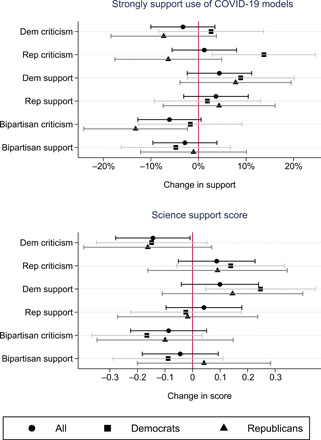
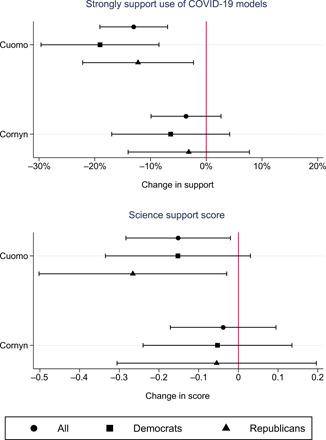
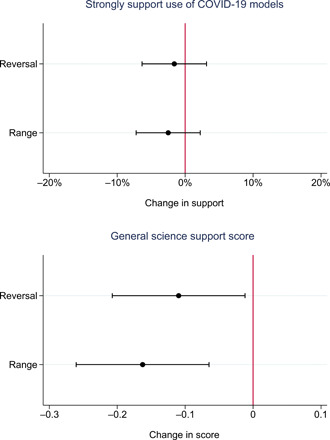
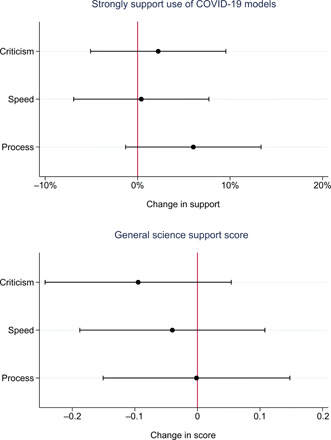
While scientific uncertainty always invites the risk of politicization and raises questions of how to communicate about science, this risk is magnified for COVID-19. The limited data and accelerated research timelines mean that some prominent models or findings inevitably will be overturned or retracted. In this research, we examine the attitudes of more than 6000 Americans across five different survey experiments to understand how the cue giver and cue given about scientific uncertainty regarding COVID-19 affect public trust in science and support for science-based policy. Criticism from Democratic political elites undermines trust more than criticism from Republicans. Emphasizing uncertainty in projections can erode public trust in some contexts. Downplaying uncertainty can raise support in the short term, but reversals in projections may temper these effects or even reduce scientific trust. Careful science communication is critical to maintaining public support for science-based policies as the scientific consensus shifts over time.
Copyright © 2020 The Authors, some rights reserved; exclusive licensee American Association for the Advancement of Science. No claim to original U.S. Government Works. Distributed under a Creative Commons Attribution NonCommercial License 4.0 (CC BY-NC).
Figures

References
-
- N. Ferguson, D. Laydon, G. Nedjati-Gilani, N. Imai, K. Ainslie, M. Baguelin, S. Bhatia, A. Boonyasiri, Z. Cucunubá, G. Cuomo-Dannenburg, A. Dighe, Report 9—Impact of non-pharmaceutical interventions (NPIs) to reduce COVID-19 mortality and healthcare demand (Imperial College London, 2020); https://dsprdpub.cc.ic.ac.uk:8443/handle/10044/1/77482.
-
- S. Begley, “Influential Covid-19 model uses flawed methods and shouldn’t guide U.S. policies, critics say,” Stat, 17 April 2020.
-
- D. Siders, M. Ward, “A fight over data infiltrates Trumpworld’s response to coronavirus,” Politico, 10 April 2020.
-
- Druckman J. N., The crisis of politicization within and beyond science. Nat. Hum. Behav. 1, 615–617 (2017). - PubMed
-
- Uusitalo L., Lehikoinen A., Helle I., Myrberg K., An overview of methods to evaluate uncertainty of deterministic models in decision support. Environ. Model. Software 63, 24–31 (2015).
Publication types
MeSH terms
LinkOut - more resources
Full Text Sources