


Incidence of chronic wounds in Singapore, a multiethnic Asian country, between 2000 and 2017: a retrospective cohort study using a nationwide claims database
- PMID: 32978205
- PMCID: PMC7520842
- DOI: 10.1136/bmjopen-2020-039411
Incidence of chronic wounds in Singapore, a multiethnic Asian country, between 2000 and 2017: a retrospective cohort study using a nationwide claims database
Abstract
Objectives: Chronic wounds are common, costly and impair quality of life, yet epidemiological data are scarce. We aimed to estimate the incidence trend of a multiethnic Asian population.
Design: Retrospective cohort study.
Setting: Singapore's nationwide claims database.
Participants: Singaporeans and permanent residents.
Outcomes: Patients were identified by International Classification of Disease, Ninth Revision, Australian Modification (ICD-9-AM) and ICD-10-AM codes from all admissions between 2000 and 2017, and categorised according to aetiology: venous, arterial, diabetic and pressure. Comorbidities were extracted from a national database of Charlson Comorbidity Index scores.
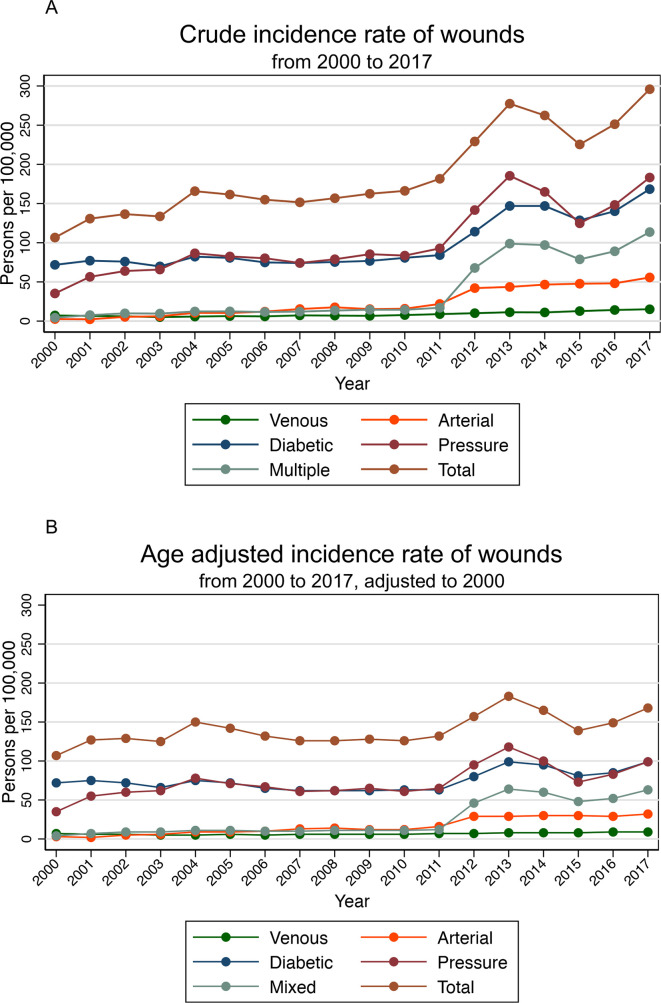
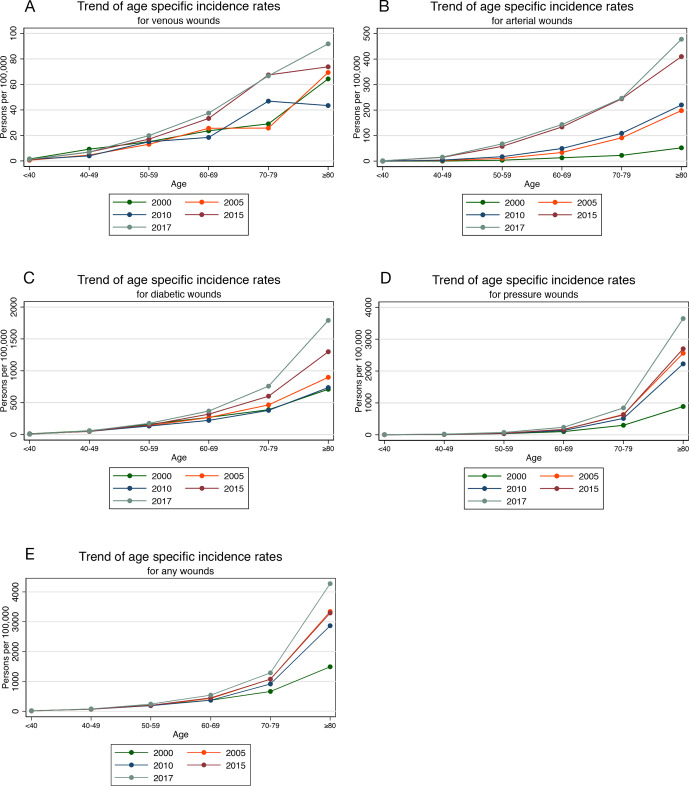
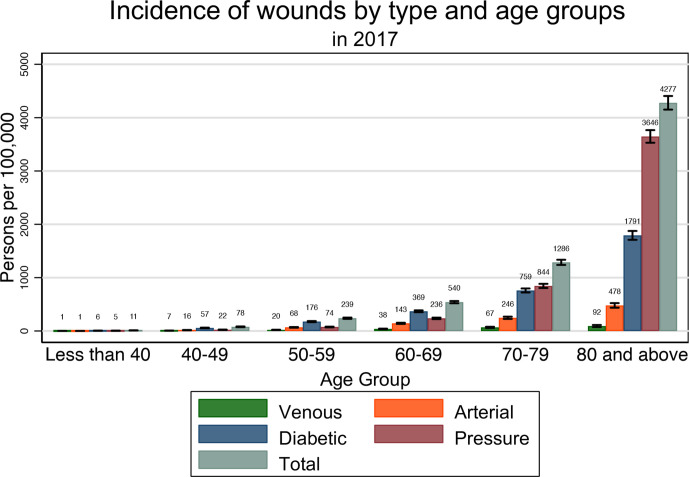
Results: Between 2000 and 2017, 124 023 wound-related claims among 86 631 patients were identified. Age-specific rate (ASR) and age-adjusted incidence rates of all wounds increased over 18 years, with greatest increases among those aged ≥80. In 2017, the median age of patients was 74 (IQR 63-84). Half were male (51%). 70% were ethnic Chinese, 15% Malay and 9% Indian. In 2017, the crude incidence rate (CIR) was 15 per 100 000 persons (95% CI 14 to 16) for venous wounds, 56 (95% CI 53 to 58) for arterial, 168 (95% CI 164 to 173) for diabetic and 183 (95% CI 179 to 188) for pressure wounds. The CIR of any chronic wound was 296 (95% CI 291 to 301). ASRs were greatest in patients aged ≥80: 92 (95% CI 74 to 112) for venous, 478 (95% CI 436 to 522) for arterial, 1791 (95% CI 1710 to 1876) for diabetic, 3647 (95% CI 3530 to 3766) for pressure and 4277 (95% CI 4151 to 4407) for any wound. Compared with the Chinese, Indians had thrice the ASRs of venous and arterial wounds and double the ASR of diabetic wounds. Malays had double the ASRs of arterial and diabetic wounds.
Conclusions: Chronic wounds are common in the elderly with significant ethnic disparities in this Asian cohort. With the incidence expected to rise with ageing populations, it is crucial to address health disparities and evaluate utilisation and cost to inform clinical practice and health policy.
Keywords: health economics; health services administration & management; internal medicine; wound management.
© Author(s) (or their employer(s)) 2020. Re-use permitted under CC BY-NC. No commercial re-use. See rights and permissions. Published by BMJ.
Conflict of interest statement
Competing interests: None declared.
Figures
References
MeSH terms
LinkOut - more resources
Full Text Sources
Medical
