


When Does Physician Use of AI Increase Liability?
- PMID: 32978285
- PMCID: PMC8679587
- DOI: 10.2967/jnumed.120.256032
When Does Physician Use of AI Increase Liability?
Abstract
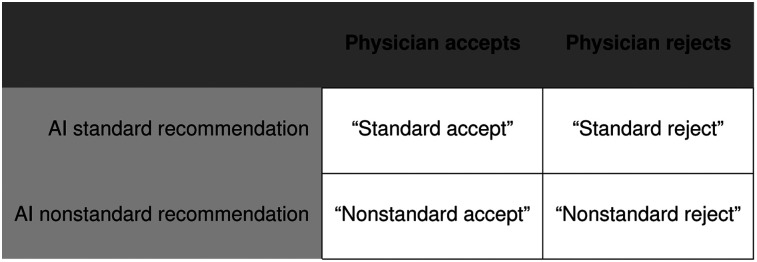
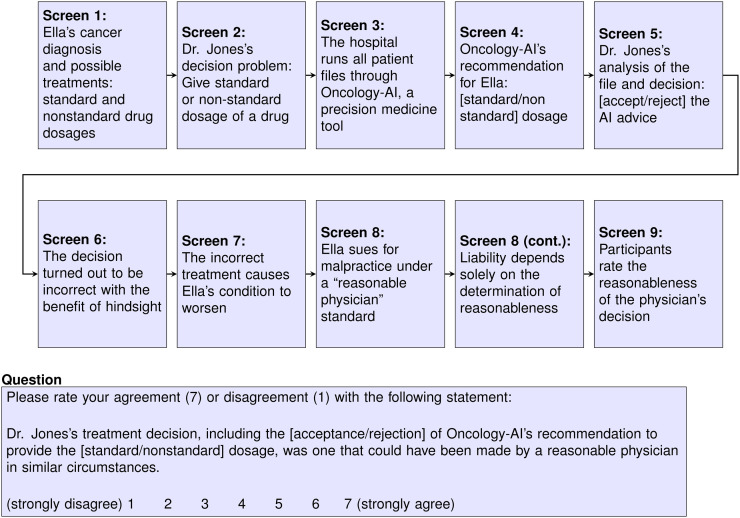
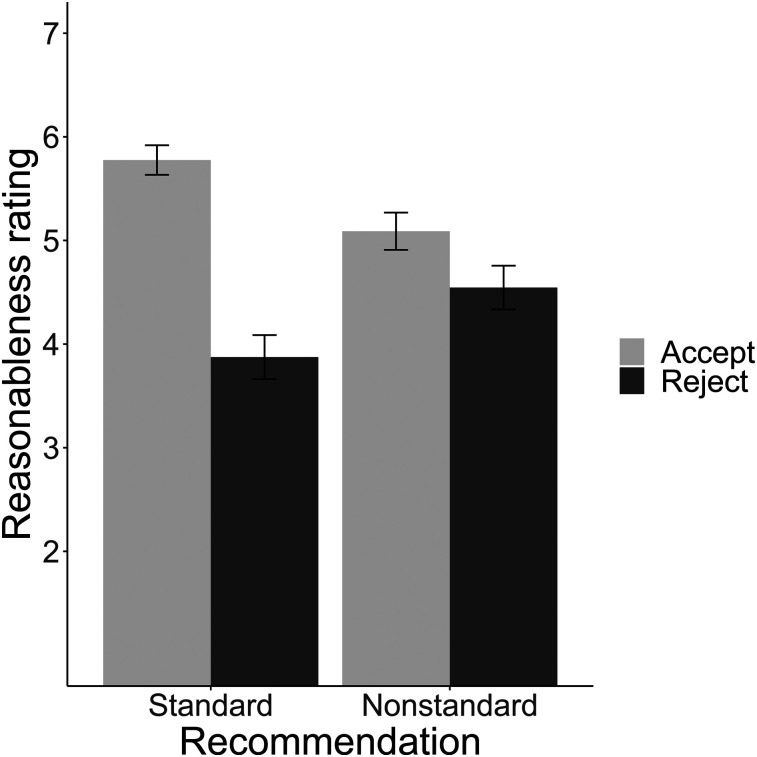
An increasing number of automated and artificial intelligence (AI) systems make medical treatment recommendations, including personalized recommendations, which can deviate from standard care. Legal scholars argue that following such nonstandard treatment recommendations will increase liability in medical malpractice, undermining the use of potentially beneficial medical AI. However, such liability depends in part on lay judgments by jurors: when physicians use AI systems, in which circumstances would jurors hold physicians liable? Methods: To determine potential jurors' judgments of liability, we conducted an online experimental study of a nationally representative sample of 2,000 U.S. adults. Each participant read 1 of 4 scenarios in which an AI system provides a treatment recommendation to a physician. The scenarios varied the AI recommendation (standard or nonstandard care) and the physician's decision (to accept or reject that recommendation). Subsequently, the physician's decision caused harm. Participants then assessed the physician's liability. Results: Our results indicate that physicians who receive advice from an AI system to provide standard care can reduce the risk of liability by accepting, rather than rejecting, that advice, all else being equal. However, when an AI system recommends nonstandard care, there is no similar shielding effect of rejecting that advice and so providing standard care. Conclusion: The tort law system is unlikely to undermine the use of AI precision medicine tools and may even encourage the use of these tools.
Keywords: artificial intelligence; liability; precision medicine.
© 2021 by the Society of Nuclear Medicine and Molecular Imaging.
Figures
References
-
- Price WN, Gerke S, Cohen IG. Potential liability for physicians using artificial intelligence. JAMA. 2019;322:1765–1766. - PubMed
-
- Topol EJ. High-performance medicine: the convergence of human and artificial intelligence. Nat Med. 2019;25:44–56. - PubMed
-
- Avraham R, Schanzenbach M. Medical malpractice. In: Parisi F, ed. Oxford Handbook of Law and Economics. Oxford University Press; 2017.
-
- O’Connell J, Pohl C. How reliable is medical malpractice law? A review of “Medical Malpractice and the American Jury: Confronting the Myths about Jury Incompetence, Deep Pockets, and Outrageous Damage Awards” by Neil Vidmar. J Law Health. 1998;12:359–379. - PubMed
-
- Peters P. The quiet demise of deference to custom: malpractice at the millennium. Wash Lee Law Rev. 2000;57:163–205.
Publication types
MeSH terms
LinkOut - more resources
Full Text Sources
