. 2020 Sep 25;10(1):15728.
doi: 10.1038/s41598-020-72880-0.

The genomes of a monogenic fly: views of primitive sex chromosomes

Affiliations

The genomes of a monogenic fly: views of primitive sex chromosomes

Anne A Andere et al. Sci Rep. .

Abstract

The production of male and female offspring is often determined by the presence of specific sex chromosomes which control sex-specific expression, and sex chromosomes evolve through reduced recombination and specialized gene content. Here we present the genomes of Chrysomya rufifacies, a monogenic blow fly (females produce female or male offspring, exclusively) by separately sequencing and assembling each type of female and the male. The genomes (> 25X coverage) do not appear to have any sex-linked Muller F elements (typical for many Diptera) and exhibit little differentiation between groups supporting the morphological assessments of C. rufifacies homomorphic chromosomes. Males in this species are associated with a unimodal coverage distribution while females exhibit bimodal coverage distributions, suggesting a potential difference in genomic architecture. The presence of the individual-sex draft genomes herein provides new clues regarding the origination and evolution of the diverse sex-determining mechanisms observed within Diptera. Additional genomic analysis of sex chromosomes and sex-determining genes of other blow flies will allow a refined evolutionary understanding of how flies with a typical X/Y heterogametic amphogeny (male and female offspring in similar ratios) sex determination systems evolved into one with a dominant factor that results in single sex progeny in a chromosomally monomorphic system.


Conflict of interest statement

The authors declare no competing interests.

Figures
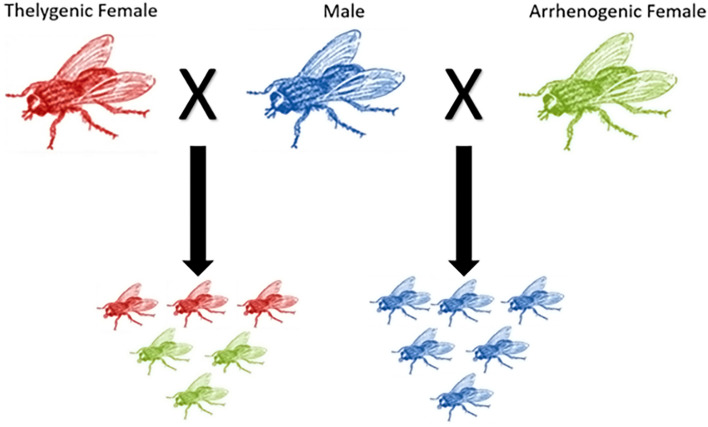
Figure 1
Figure 1
Sex determination of C. rufifacies offspring is determined by the maternal genotype. Thelygenic females produce only female offpsring while arrhenogenic females produce only male offspring. Females in the above figure are represented by the red and green colors, whereas males are blue.
Figure 2
Figure 2
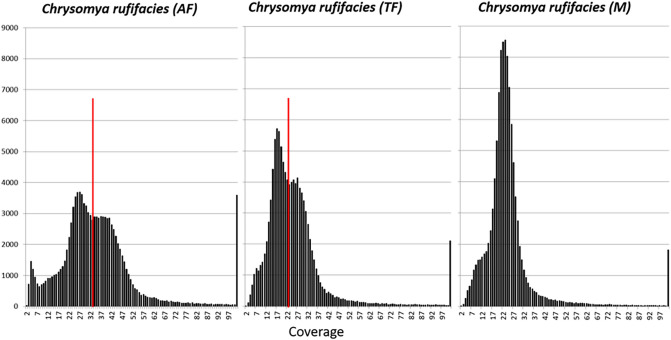
Coverage distributions for the different genomic assemblies with coverage (x-axis) vs. the number of assembled contigs at each coverage. A unimodal distribution is observed in the male genome, while a clear bimodal distribution of the main component of the coverage distribution is observed in females. The different types of females exhibit different ratios of major and minor peak heights.
Figure 3
Figure 3
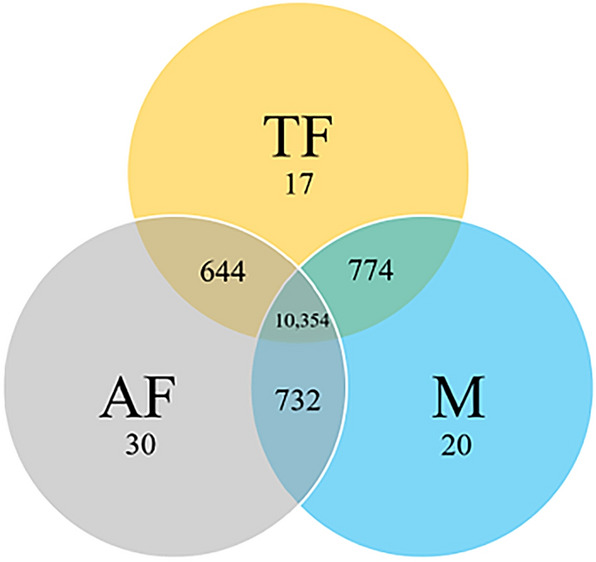
A Venn diagram displaying the number of orthologous clusters of the predicted protein sequences (i) shared among the three sexes, (ii) shared between any two sexes and (iii) those uniquely found in each group. Cluster classification was done according to sequence analysis data, protein similarity comparisons, and phylogenetic relationships.
Figure 4
Figure 4
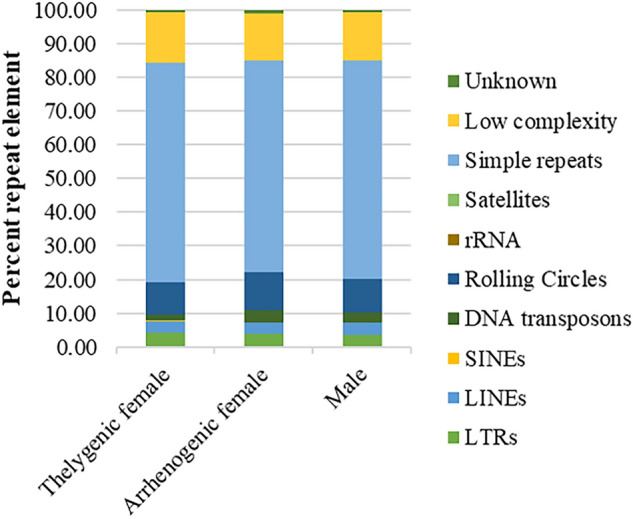
The graph shows the percentage of repeat elements composing the repetitive landscape in each sex type of C. rufifacies. Retrotransposons composed of SINEs, LINEs and LTRs occupied approximately 7% of the total repeatome, while DNA transposons occupied approximately 3% of the repeatome in the male and male producing females and ~ 2% in the female producing females. Satellites and rRNA can barely be seen on the graph as they occupied only 0.07% and 0.05% of the repeatome respectively. Simple repeats were the predominant repetitive element occupying almost 65% of the whole repetitive landscape.

References

    1. Abbott JK, Norden AK, Hansson B. Sex chromosome evolution: historical insights and future perspectives. Proc. Biol. Sci. 2017;284(1854):20162806. - PMC - PubMed
    1. Bachtrog D, et al. Sex determination: why so many ways of doing it? PLoS Biol. 2014;12(7):e1001899. doi: 10.1371/journal.pbio.1001899. - DOI - PMC - PubMed
    1. Barton NH, Charlesworth B. Why sex and recombination? Science. 1998;281(5385):1986–1990. doi: 10.1126/science.281.5385.1986. - DOI - PubMed
    1. Bergero R, Charlesworth D. The evolution of restricted recombination in sex chromosomes. Trends Ecol. Evol. 2009;24(2):94–102. doi: 10.1016/j.tree.2008.09.010. - DOI - PubMed
    1. Kubat Z, et al. Microsatellite accumulation on the Y chromosome in Silene latifolia. Genome. 2008;51(5):350–356. doi: 10.1139/G08-024. - DOI - PubMed

Publication types