. 2020 Sep;9(3):125-137.
doi: 10.1007/s40204-020-00137-0. Epub 2020 Sep 25.

Hydrogel scaffolds with elasticity-mimicking embryonic substrates promote cardiac cellular network formation

Affiliations

Hydrogel scaffolds with elasticity-mimicking embryonic substrates promote cardiac cellular network formation

Matthew Alonzo et al. Prog Biomater. 2020 Sep.

Abstract

Hydrogels are a class of biomaterials used for a wide range of biomedical applications, including as a three-dimensional (3D) scaffold for cell culture that mimics the extracellular matrix (ECM) of native tissues. To understand the role of the ECM in the modulation of cardiac cell function, alginate was used to fabricate crosslinked gels with stiffness values that resembled embryonic (2.66 ± 0.84 kPa), physiologic (8.98 ± 1.29 kPa) and fibrotic (18.27 ± 3.17 kPa) cardiac tissues. The average pore diameter and hydrogel swelling were seen to decrease with increasing substrate stiffness. Cardiomyocytes cultured within soft embryonic gels demonstrated enhanced cell spreading, elongation, and network formation, while a progressive increase in gel stiffness diminished these behaviors. Cell viability decreased with increasing hydrogel stiffness. Furthermore, cells in fibrotic gels showed enhanced protein expression of the characteristic cardiac stress biomarker, Troponin-I, while reduced protein expression of the cardiac gap junction protein, Connexin-43, in comparison to cells within embryonic gels. The results from this study demonstrate the role that 3D substrate stiffness has on cardiac tissue formation and its implications in the development of complex matrix remodeling-based conditions, such as myocardial fibrosis.

Keywords: Alginate; Cardiomyocytes; Cell viability; Elastic modulus; Scaffold stiffness.


Conflict of interest statement

There are no conflicts to declare.

Figures
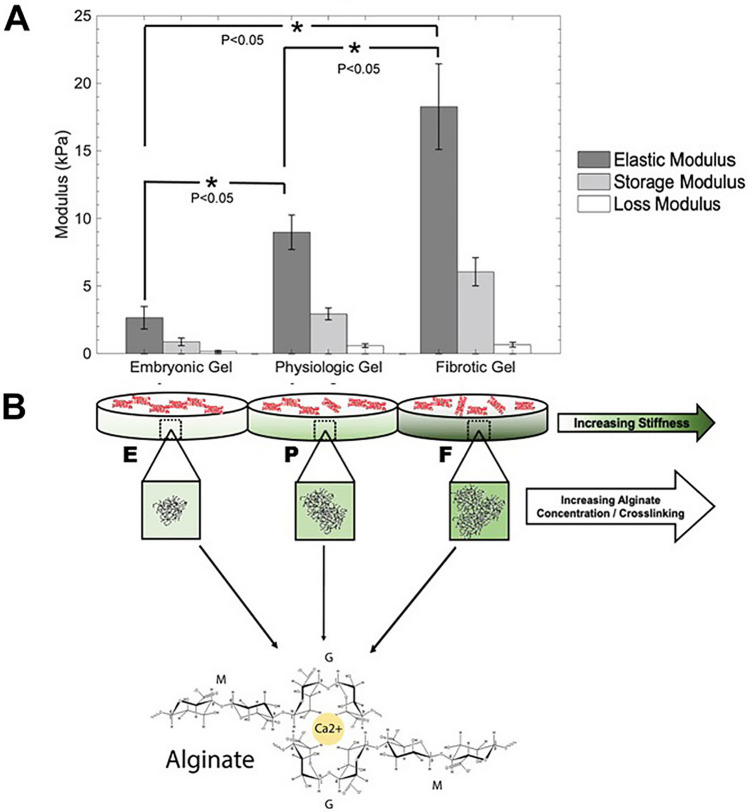
Fig. 1
Fig. 1
Shown in a are the rheological properties of alginate gels, including elastic-, storage- and loss-modulus. In b, a schematic depiction the corresponding gels of increasing mechanical stiffness made by increasing the concentration of both the biopolymer and calcium crosslinking solution is included. p values are all significant. *0.009; **0.008; ***0.034
Fig. 2
Fig. 2
SEM images ac are representatives captured to reveal their ultrastructure. d Shows the average pore size of each gel depicted in ac. e Depicts the swelling behavior of the three different gels in DMEM
Fig. 3
Fig. 3
Shown in a are cells cultured within the 3D gels and on 2D Matrigel controls. The cells were pre-stained with PKH26 (red) to reveal network formation in these cultures. Also, the magnified insets depict the elongated cell morphology within the embryonic gels, which became gradually rounded as the gels were progressively stiffened from the physiologic to the fibrotic gels. Shown in b is the average cellular aspect ratio (width/height) for cells cultured within the gels. The aspect ratio is maximum in the case of cells cultured within the embryonic gels and is close to the value of 1 (implying rounded cells) as the gels were stiffened
Fig. 4
Fig. 4
Shown in a are phase-contrast images of cellular networks cultured within the 3D gels and on 2D Matrigel Controls (Supplementary Fig. 2). It is evident that the average number of cellular networks per unit area is significantly reduced as the gels were progressively stiffened. Shown in b is the average number of cellular networks within all the gels. P values are all significant
Fig. 5
Fig. 5
Cell viability was assessed by performing the live/dead assay on cells within the embryonic, physiologic, and fibrotic scaffolds after 5 days of culture. a, c, e Depict the live cells stained by Calcein AM (green), and b, d, f Represent the dead cells stained by Ethidium homodimer (red) for the embryonic, physiologic and fibrotic scaffolds, respectively. The number of live to dead cells in both the embryonic and physiologic scaffolds was found to be statistically significant (p < 0.05), unlike the fibrotic scaffolds. g Depicts the percentage of live and dead cells for each of the three scaffolds
Fig. 6
Fig. 6
Western blot analysis for cardiac biomarkers Cx-43 and Troponin are displayed between the softest (embryonic) and stiffest (fibrotic) gels in our study. Intercellular Connexin-43 (a) found in gap junctions between neighboring cardiomyocytes is expressed more in softer environments, while cTnI expression increases in stiffer gels (b)

References

    1. Alvarez-Primo F, Anil Kumar S, Manciu FS, Joddar B. Fabrication of surfactant-dispersed HiPco single-walled carbon nanotube-based alginate hydrogel composites as cellular products. Int J Mol Sci. 2019;20:4802. doi: 10.3390/ijms20194802. - DOI - PMC - PubMed
    1. Andersen T, Auk-Emblem P, Dornish M. 3D cell culture in alginate hydrogels. Microarrays. 2015;4:133–161. doi: 10.3390/microarrays4020133. - DOI - PMC - PubMed
    1. Anil Kumar S, Matthew Alonzo M, Allen SC, Abelseth L, Thakur V, Akimoto J, Ito Y, Willerth S, Suggs L, Chattopadhyay M, Joddar B. A visible light-cross-linkable, fibrin–gelatin-based bioprinted construct with human cardiomyocytes and fibroblasts. ACS Biomater Sci Eng. 2019;5:4551–4563. doi: 10.1021/acsbiomaterials.9b00505. - DOI - PMC - PubMed
    1. Anil Kumar S, Allen SC, Tasnim N, Akter T, Shinhye Park S, Kumar A, Chattopadhyay M, Ito Y, Suggs LJ, Joddar B. The applicability of furfuryl-gelatin as a novel bioink for tissue engineering applications. J Biomed Mater Res Part B Appl Biomater. 2019;107(2):314–323. doi: 10.1002/jbm.b.34. - DOI - PMC - PubMed
    1. Annabi N, Mithieux SM, Weiss AS, Dehghani F. Cross-linked open-pore elastic hydrogels based ontropoelastin, elastin and high pressure CO2. Biomaterials. 2010;31:1655–1665. doi: 10.1016/j.biomaterials.2009.11.051. - DOI - PubMed

LinkOut - more resources
