Review
. 2021 Feb:115:103873.
doi: 10.1016/j.dci.2020.103873. Epub 2020 Sep 23.

The immunoglobulins of cartilaginous fishes

Affiliations
Review

The immunoglobulins of cartilaginous fishes

Hanover Matz et al. Dev Comp Immunol. 2021 Feb.

Abstract

Cartilaginous fishes, comprising the chimeras, sharks, skates, and rays, split from the common ancestor with other jawed vertebrates approx. 450 million years ago. Being the oldest extant taxonomic group to possess an immunoglobulin (Ig)-based adaptive immune system, examination of this group has taught us much about the evolution of adaptive immunity, as well as the conserved and taxon-specific characteristics of Igs. Significant progress has been made analyzing sequences from numerous genomic and transcriptomic data sets. These findings have been supported by additional functional studies characterizing the Igs and humoral response of sharks and their relatives. This review will summarize what we have learned about the genomic organization, protein structure, and in vivo function of these Ig isotypes in cartilaginous fishes and highlight the areas where our knowledge is still lacking.

Keywords: Antibody; B cells; Cartilaginous fish; IgM; IgNAR; Memory; Shark.


Figures

Figure 1:
Figure 1:
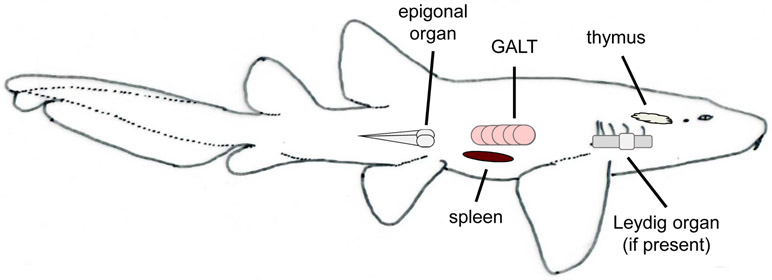
The major immunological organs of cartilaginous fishes and their relative positions.
Figure 2:
Figure 2:
Schematic showing the different Ig gene arrangements in mammals and sharks. Mammalian Igs are found in a translocon arrangement, with multiple V segments, D segments, and J segments arranged upstream of the C regions for all the different Ig isotypes. In contrast, cartilaginous fish Igs are found in a cluster configuration, where a single V segment, two or more D segments, a J segment, and the C regions for a single isotype are present in each cluster, and multiple clusters are present for each isotype. C regions are shown in grey, the segments that make up the variable region are colored by isotype.
Figure 3:
Figure 3:
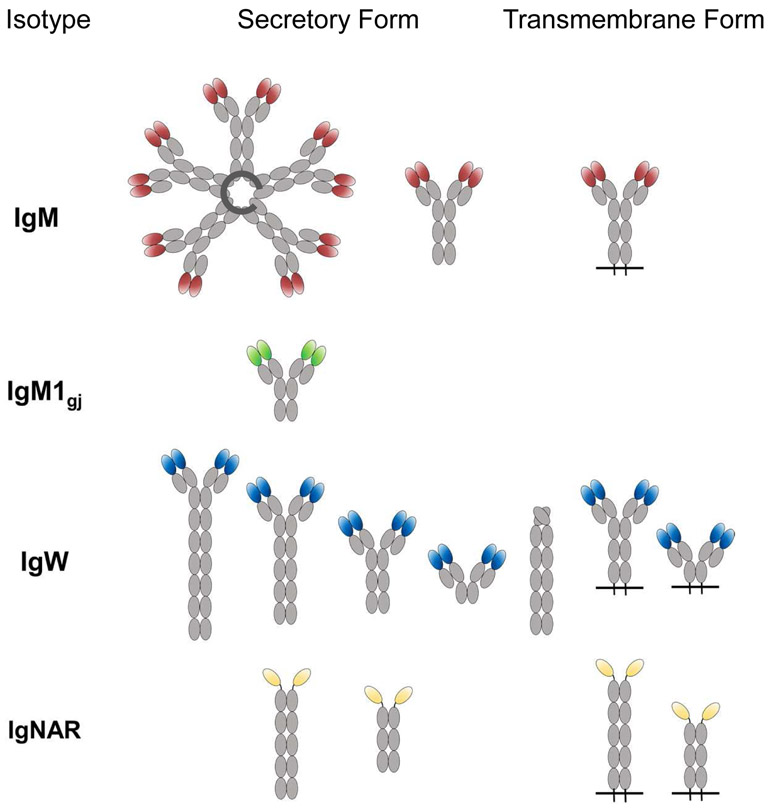
Illustration of the transmembrane and secretory immunoglobulin isoforms found in cartilaginous fishes to date. Constant domains are shown in grey while the variable domains of each are colored by isotype. Secreted IgM pentamers are stabilized by joining (J) chain.
Figure 4:
Figure 4:
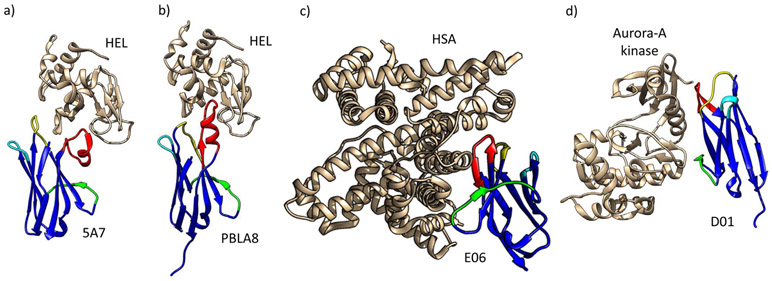
Structural analyses show that VNARs (blue) can complex their target antigens (gold) using a range of different binding modalities. The VNAR CDR1 is shown in yellow, CDR3 in red, HV2 in green, and HV4 in cyan in all panels. As can be seen in (a) the type I VNAR 5A7 contacts HEL via CDR1 and a folded CDR3 that is constrained by disulfide bonding to the FR2 and FR4 (PDB 1T6V) while (b) the type II VNAR PBLA8 contacts hen egg lysozyme (HEL) via CDR1 and an extended CDR3 loop projecting deep into HELs enzymatic cleft (PDB 2I25). In contrast, (c) the type IV/IIb VNAR E06 binds its target human serum albumin (HSA) through CDR3 and HV2 (PDB 4HGK), and (d) the synthetic VNAR D01 contacts Aurora-A kinase via CDR1, CDR3, and HV2 (PDB 5L8L). From Matz and Dooley, 2018.
Figure 5:
Figure 5:
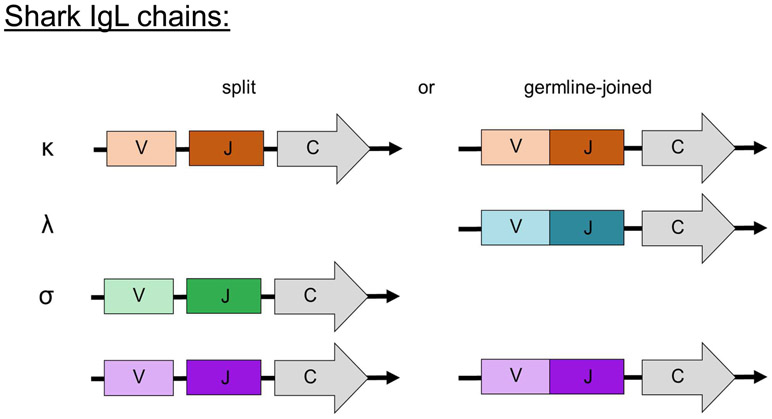
Like IgH chains, cartilaginous fish IgL chains can be found in both split and germline-joined configurations. Notably, the λ chains of all species examined to date are all germline-joined and σ are split, while the other isotypes are present in varying ratios of spit and joined in different species.

References

    1. Anderson MK, Shamblott MJ, Litman RT, Litman GW, 1995. Generation of immunoglobulin light chain gene diversity in Raja erinacea is not associated with somatic rearrangement, an exception to a central paradigm of B cell immunity. J. Exp. Med 182, 109–119. - PMC - PubMed
    1. Anderson MK, Strong SJ, Litman RT, Luer CA, Amemiya CT, Rast JP, Litman GW, 1999. A long form of the skate IgX gene exhibits a striking resemblance to the new shark IgW and IgNARC genes. Immunogenetics 49, 56–67. - PubMed
    1. Berstein R, Schluter SF, Shen S, Marchalonis JJ, 1996. A new high molecular weight immunoglobulin class from the carcharhine shark: implications for the properties of the primordial immunoglobulin. Proceedings of the National Academy of Sciences 93, 3289–3293. - PMC - PubMed
    1. Castro CD, Ohta Y, Dooley H, Flajnik MF, 2013. Noncoordinate expression of J-chain and B limp-1 define nurse shark plasma cell populations during ontogeny. European journal of immunology 43, 3061–3075. - PMC - PubMed
    1. Chen K, Xu W, Wilson M, He B, Miller NW, Bengten E, Edholm E-S, Santini PA, Rath P, Chiu A, 2009. Immunoglobulin D enhances immune surveillance by activating antimicrobial, proinflammatory and B cell-stimulating programs in basophils. Nature immunology 10, 889. - PMC - PubMed

Publication types