


Structural brain correlates of dementia in Huntington's disease
- PMID: 32979842
- PMCID: PMC7519361
- DOI: 10.1016/j.nicl.2020.102415
Structural brain correlates of dementia in Huntington's disease
Abstract
Background: Huntington's disease (HD) is a fatal genetic neurodegenerative disorder with no effective treatment currently available. Progressive basal ganglia and whole-brain atrophy and concurrent cognitive deterioration are prototypical aspects of HD. However, the specific patterns of brain atrophy underlying cognitive impairment of different severity in HD are poorly understood. The aim of this study was to investigate the specific structural brain correlates of major cognitive deficits in HD and to explore its association with neuropsychological indicators.
Participants: Thirty-five symptomatic early-to-mild HD patients and 15 healthy controls (HC) with available T1-MRI imaging were included in this study.
Methods: In this cross-sectional study, HD patients were classified as patients with (HD-Dem) and without (HD-ND) major cognitive impairment in the range of dementia. This classification was based on previously validated PD-CRS cutoff scores for HD. Differences in brain atrophy across groups were studied by means of grey-matter volume voxel-based morphometry (GMV-VBM) and cortical thickness (Cth). Voxelwise and vertexwise general linear models were used to assess the group comparisons, controlling for the effects of age, sex, education, CAG repeat length and severity of motor symptoms. Clusters surviving p < 0.05 and family-wise error (FWE) correction were considered statistically significant. In order to characterize the impact on cognitive performance of the observed brain differences across groups, GMV and Cth values in the set of significant regions were computed and correlated with specific neuropsychological tests.
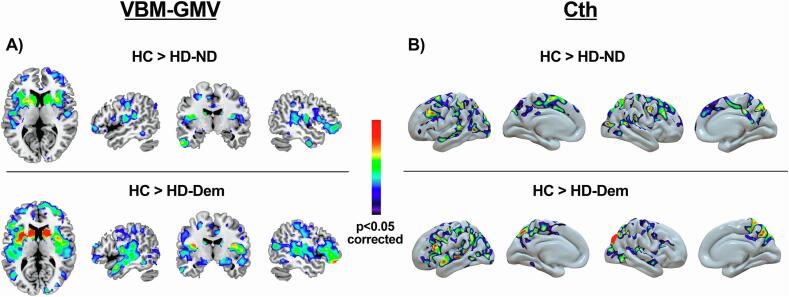
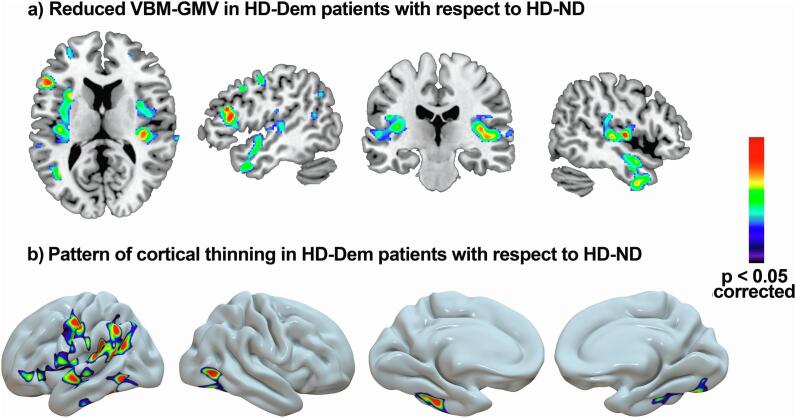
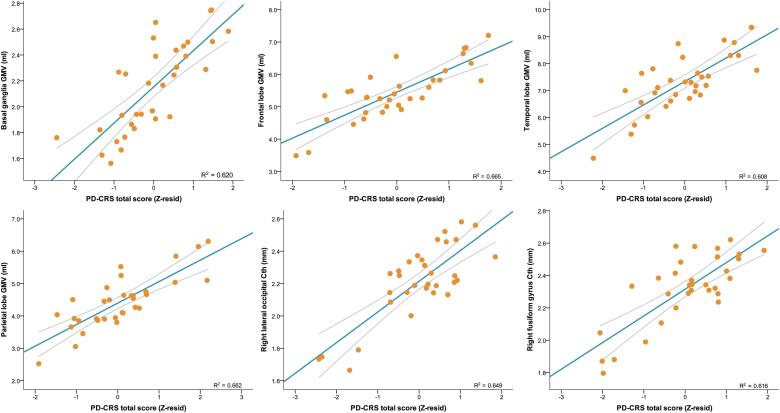
Results: All groups had similar sociodemographic profiles, and the HD groups did not significantly differ in terms of CAG repeat length. Compared to HC, both HD groups exhibited significant atrophy in multiple subcortical and parietal brain regions. However, compared to HC and HD-ND groups, HD-Dem patients showed a more prominent pattern of reduced GMV and cortical thinning. Importantly, this thinning was restricted to regions of the parietal-temporal and occipital cortices. Furthermore, these brain alterations were further associated with poorer cognitive performance in tasks assessing frontal-executive and attention domains as well as memory, language and constructional abilities.
Conclusions: Major cognitive impairment in the range of dementia in HD is associated with brain and cognitive alterations exceeding the prototypical frontal-executive deficits commonly recognized in HD. The observed posterior-cortical damage identified by MRI and its association with memory, language, and visuoconstructive dysfunction suggest a strong involvement of extra-striatal atrophy in the onset of severe cognitive dysfunction in HD patients. Critically, major cognitive impairment in this sample was not associated with CAG repeat length, age or education. This finding could support a possible involvement of additional neuropathological mechanisms aggravating cognitive deterioration in HD.
Keywords: Dementia; Huntington’s disease; Mild cognitive impairment; Movement disorders; Neuropsychology.
Copyright © 2020 The Author(s). Published by Elsevier Inc. All rights reserved.
Conflict of interest statement
The authors declare that they have no known competing financial interests or personal relationships that could have appeared to influence the work reported in this paper.
Figures
References
-
- Walker F.O. Huntington's disease. Lancet. 2007;369(9557):218–228. - PubMed
-
- Ross C.A., Aylward E.H., Wild E.J., Langbehn D.R., Long J.D., Warner J.H., Scahill R.I., Leavitt B.R., Stout J.C., Paulsen J.S., Reilmann R., Unschuld P.G., Wexler A., Margolis R.L., Tabrizi S.J. Huntington disease: natural history, biomarkers and prospects for therapeutics. Nature reviews. Neurology. 2014;10(4):204–216. - PubMed
-
- Peavy G.M., Jacobson M.W., Goldstein J.L., Hamilton J.M., Kane A., Gamst A.C., Lessig S.L., Lee J.C., Corey-Bloom J. Cognitive and functional decline in Huntington's disease: dementia criteria revisited. Movement disorders : official journal of the Movement Disorder Society. 2010;25(9):1163–1169. - PMC - PubMed
Publication types
MeSH terms
LinkOut - more resources
Full Text Sources
Medical
