. 2020 Sep:223:327-336.
doi: 10.1016/j.schres.2020.08.022. Epub 2020 Sep 24.

Sleep spindle activity in childhood onset schizophrenia: Diminished and associated with clinical symptoms

Affiliations

Sleep spindle activity in childhood onset schizophrenia: Diminished and associated with clinical symptoms

Andjela Markovic et al. Schizophr Res. 2020 Sep.

Abstract

Neuroimaging studies of childhood onset schizophrenia (COS), a rare yet severe form of schizophrenia with an onset before the age of 13 years, have shown continuity with adult onset schizophrenia. Previous research in adult patients has shown reduced sleep spindle activity, transient oscillations in the sleep electroencephalogram (EEG) generated through thalamocortical loops. The current study examines sleep spindle activity in patients with COS. Seventeen children and adolescents with COS (16 years ±6.6) underwent overnight sleep EEG recordings. Sleep spindle activity was compared between patients with COS and age and gender matched controls and correlated with clinical symptom severity. We found pronounced deficits in sleep spindle amplitude, duration, density and frequency in patients with COS (effect size = 0.61 to 1.96; dependent on metric and EEG derivation). Non-rapid eye movement (NREM) sleep EEG power and coherence in the sigma band (11-16 Hz) corresponding to spindle activity were also markedly diminished in patients with COS as compared to controls. Furthermore, the degree of deficit in power and coherence of spindles was strongly associated with clinician rated hallucinations and positive symptoms over widespread cortical regions. Our finding of diminished spindle activity and its association with hallucinations likely reflect dysfunction of the thalamocortical circuits in children and adolescents with COS. Given the relative ease of sleep EEG recordings in vulnerable populations, this study highlights the potential of such recordings to characterize brain function in schizophrenia.

Trial registration: ClinicalTrials.gov NCT00049738.

Keywords: Adolescent; Biomarker; Schizophrenia; Sleep; Spindle.


Conflict of interest statement

Declaration of competing interest The authors have no conflict of interest to declare.

Figures
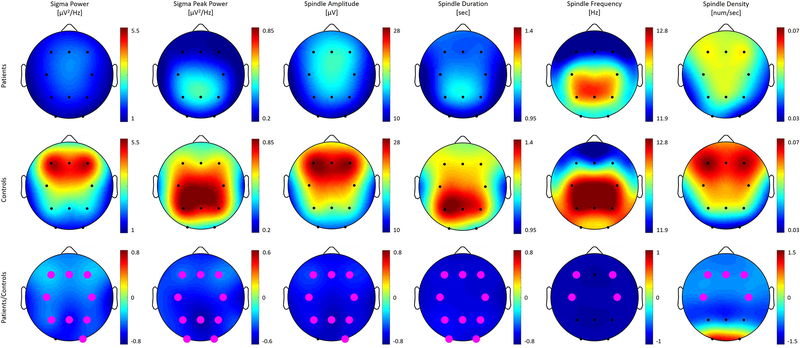
Figure 1:
Figure 1:
Topographic distribution across derivations for all metrics of spindle activity, i.e. non-rapid eye movement (NREM) sigma power, NREM sigma peak power, spindle amplitude, duration, frequency and density. The first and the second row depict power values averaged for patients and controls separately and plotted on the same scale. The third row shows the ratio of average power for patients divided by control with statistically significant electrodes in magenta. Note that these plots are on a different scale with negative values (in cool colors) representing decreased power in patients and positive values (in warm colors) indicating enhanced power in patients as compared to controls. We observed significant decreases in patients across the brain for all metrics shown.
Figure 2:
Figure 2:
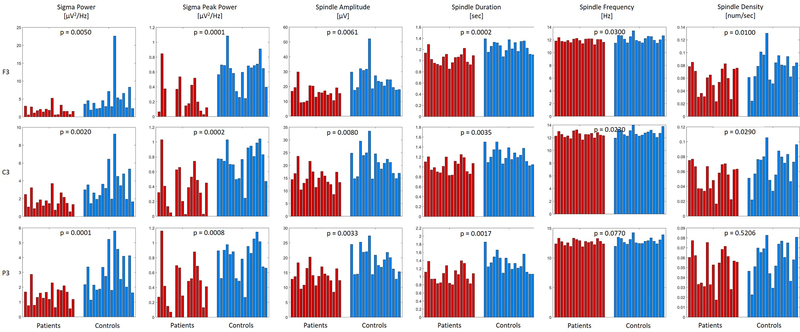
Individual values for spindle metrics in patients (shown in red) and controls (shown in blue) for three derivations over the left hemisphere (Frontal = F3, Central = C3, and Parietal = P3). The p-values of the bootstrap statistic between patients and controls are shown at the top of every chart. The columns are ordered such that the patients correspond to the age and gender matched control (e.g., the first column in the patient and control group are age and gender matched).
Figure 3:
Figure 3:
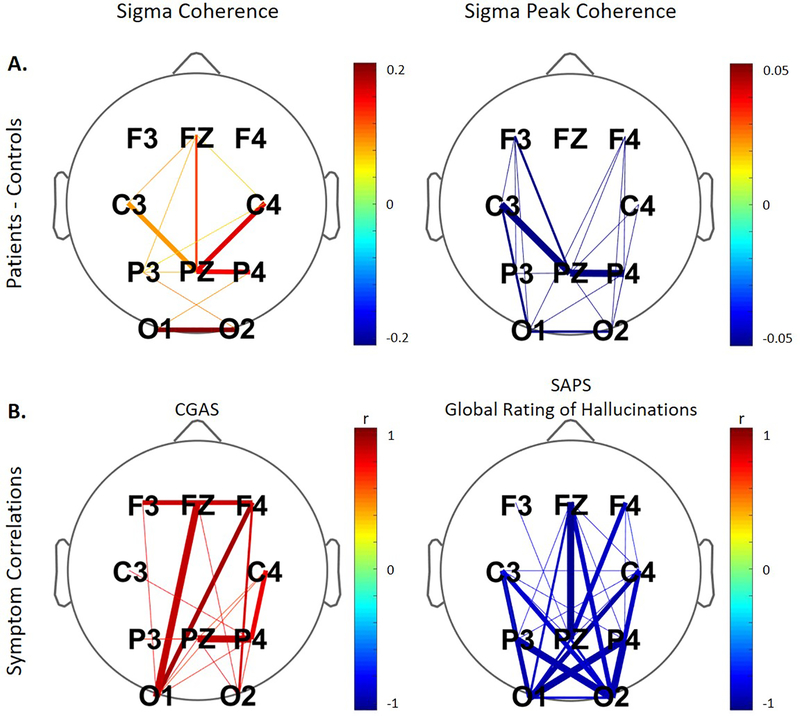
A. Connections significantly different between patients and controls for non-rapid eye movement (NREM) sigma coherence and NREM sigma peak coherence. Negative values (in cool colors) represent decreased coherence in patients and positive values (in warm colors) indicating enhanced coherence in patients as compared to controls. B. Significant correlations between coherence and clinical ratings for the patient group. The color corresponds to the direction of correlation with warm tones for positive and cool tones for negative correlations. The line thickness reflects the four levels of significance (p < 0.05; p < 0.01; p < 0.005; p < 0.001) with increasing thickness for higher significance in all plots. Non-significant connections are not depicted. We note that for global ratings of hallucinations from the Assessment of Positive Symptoms (SAPS) larger values indicate more impairment, while on the Children’s Global Assessment Scale (CGAS), smaller numbers correspond to greater impairment.
Figure 4:
Figure 4:
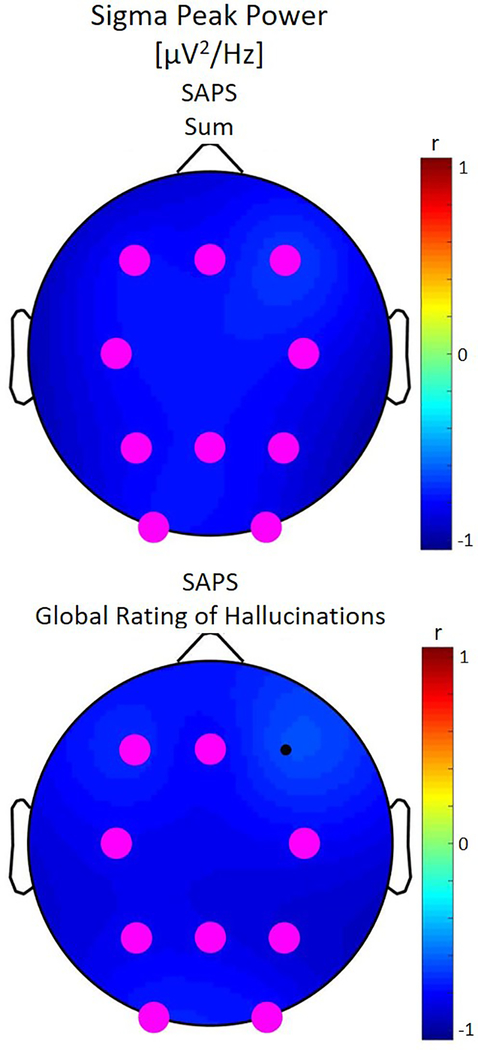
Correlations between non-rapid eye movement (NREM) sigma peak power and clinical ratings for the patient group. The color corresponds to the direction of correlation with cool tones for negative correlations. Statistically significant electrodes are depicted in magenta. We note that for global ratings of hallucinations and the sum from the Assessment of Positive Symptoms (SAPS) larger values indicate more impairment. Lower sigma peak power was significantly associated with more severe hallucinations and positive symptoms across the brain.

References

    1. Addington AM, Rapoport JL, 2009. The genetics of childhood-onset schizophrenia: When madness strikes the prepubescent. Curr. Psychiatry Rep. 11, 156–161. 10.1007/s11920-009-0024-y - DOI - PMC - PubMed
    1. American Psychiatric Association, 2013. Diagnostic and Statistical Manual of Mental Disorder. American Psychiatric Association, Washington, DC.
    1. Asarnow RF, Forsyth JK, 2013. Genetics of Childhood-onset Schizophrenia. Child Adolesc. Psychiatr. Clin 22, 675–687. 10.1016/j.chc.2013.06.004 - DOI - PMC - PubMed
    1. Bendat JS, Piersol AG, 2010. Random Data: Analysis and Measurement Procedures, Wiley Series in Probability and Statistics. John Wiley & Sons, Inc, Hoboken, NJ, USA: 10.1002/9781118032428 - DOI
    1. Bleuler E, 1911. Dementia Praecox or the Group of Schizophrenias. International Universities Press, New York.

Publication types

Associated data