Review
. 2020:28:102435.
doi: 10.1016/j.nicl.2020.102435. Epub 2020 Sep 14.

What do we know about pre- and postoperative plasticity in patients with glioma? A review of neuroimaging and intraoperative mapping studies

Affiliations
Review

What do we know about pre- and postoperative plasticity in patients with glioma? A review of neuroimaging and intraoperative mapping studies

Elisa Cargnelutti et al. Neuroimage Clin. 2020.

Abstract

Brain plasticity potential is a central theme in neuro-oncology and is currently receiving increased attention. Advances in treatment have prolonged life expectancy in neuro-oncological patients and the long-term preservation of their quality of life is, therefore, a new challenge. To this end, a better understanding of brain plasticity mechanisms is vital as it can help prevent permanent deficits following neurosurgery. Indeed, reorganization processes can be fundamental to prevent or recover neurological and cognitive deficits by reallocating brain functions outside the lesioned areas. According to more recent studies in the literature, brain reorganization taking place following neurosurgery is associated with good neurofunctioning at follow-up. Interestingly, in the last few years, the number of reports on plasticity has notably increased. Aim of the current review was to provide a comprehensive overview of pre- and postoperative neuroplasticity patterns. Within this framework, we aimed to shed light on some tricky issues, including i) involvement of the contralateral healthy hemisphere, ii) role and potential changes of white matter and connectivity patterns, and iii) reorganization in low- versus high-grade gliomas. We finally discussed the practical implications of these aspects and role of additional potentially relevant factors to be explored. Final purpose was to provide a guideline helpful in promoting increase in the extent of tumor resection while preserving the patients' neurological and cognitive functioning.

Keywords: Contralesional hemisphere; Glioma; Postoperative plasticity; Preoperative plasticity; White matter and connectivity.


Conflict of interest statement

The authors declare that they have no known competing financial interests or personal relationships that could have appeared to influence the work reported in this paper.

Figures
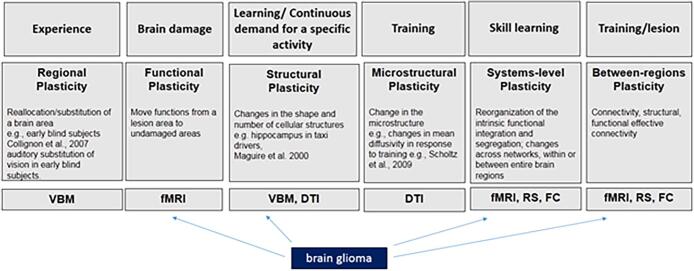
Fig. 1
Fig. 1
Examples of plasticity causes (first level), types and examples (second level), and approaches of analyses (third level) used for studying re-shaping. The type of neuroplasticity associated with brain glioma is indicated. Note. DTI = diffusion tensor imaging; FC = task-based functional connectivity; fMRI = functional magnetic resonance imaging; RS = resting-state connectivity; VBM = voxel-based morphometry.
Fig. 2
Fig. 2
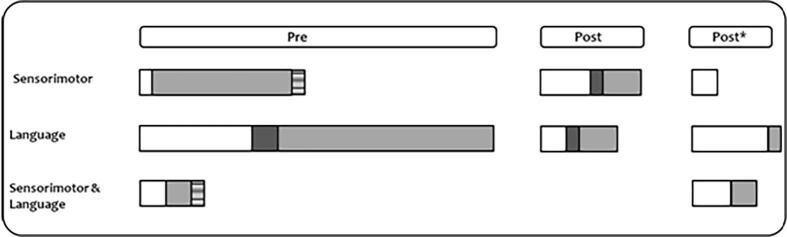
Techniques adopted in the selected studies to assess plasticity at each time point. Overview of the number of studies adopting different approaches to provide evidence of plasticity in pre- and postoperative phases, the latter either at follow-up or at subsequent surgery/tumor regrowth (marked with *). Numbers in brackets refer to tested patients. Results are reported based on the assessed function/network: sensorimotor network (in violet), language (light blue), both (green) or neither (pink). Note. DTI = diffusion tensor imaging; fMRI = functional magnetic resonance imaging; MEG = magnetoencephalography; IOM = intraoperative mapping; sMRI = structural magnetic resonance imaging; TMS = transcranial magnetic stimulation. (For interpretation of the references to color in this figure legend, the reader is referred to the web version of this article.)
Fig. 3
Fig. 3
Assessed tumor grading at each time point. Graphical representation of the proportion of studies addressing plasticity in the motor system, language system, or both, preoperatively, postoperatively at follow-up, and postoperatively at tumor regrowth/subsequent surgery (marked with *). Studies are classified according to the tumor grade of tested patients: LGG (white), HGG (dark gray), both (light gray) or not specified (mixed color).
Fig. 4
Fig. 4
Exemplificative case of postoperative plasticity. Exemplificative illustration of postoperative plasticity (tested in our laboratory by fMRI, unpublished image), showing the change in functional activation on a language task ( i.e., object naming) between the pre- and postoperative phases in a patient harboring an LGG in the left frontal lobe. In a) preoperative > postoperative activation; in b), postoperative > preoperative activation. Color bars indicate t-values.

References

    1. Almairac F., Duffau H., Herbet G. Contralesional macrostructural plasticity of the insular cortex in patients with glioma: a VBM study. Neurology. 2018;91:e1902–e1908. doi: 10.1212/WNL.0000000000006517. - DOI - PubMed
    1. Anglade C., Thiel A., Ansaldo A.I. The complementary role of the cerebral hemispheres in recovery from aphasia after stroke: a critical review of literature. Brain Inj. 2014;28:138–145. doi: 10.3109/02699052.2013.859734. - DOI - PubMed
    1. Antonsson M., Jakola A., Longoni F., Carstam L., Hartelius L., Thordstein M., Tisell M. Post-surgical effects on language in patients with presumed low-grade glioma. Acta Neurol. Scand. 2018;137:469–480. doi: 10.1111/ane.12887. - DOI - PubMed
    1. Baciu M., Le Bas J.F., Segebarth C., Benabid A.L. Presurgical fMRI evaluation of cerebral reorganization and motor deficit in patients with tumors and vascular malformations. Eur. J. Radiol. 2003;46:139–146. doi: 10.1016/s0720-048x(02)00083-9. - DOI - PubMed
    1. Bartolomeo P. Spatially biased decisions: towards a dynamic interactive model of visual neglect. In: Tracy J.I., Hampstead B., Sathian K., editors. Plasticity of Cognition in Neurologic Disorders. Oxford University Press; 2014.