. 2020 Dec;66(6):1191-1203.
doi: 10.1007/s00294-020-01109-4. Epub 2020 Sep 26.

Functional analysis of Cti6 core domain responsible for recruitment of epigenetic regulators Sin3, Cyc8 and Tup1

Affiliations

Functional analysis of Cti6 core domain responsible for recruitment of epigenetic regulators Sin3, Cyc8 and Tup1

Rasha Aref et al. Curr Genet. 2020 Dec.

Abstract

Mapping of effective protein domains is a demanding stride to disclose the functional relationship between regulatory complexes. Domain analysis of protein interactions is requisite for understanding the pleiotropic responses of the respective partners. Cti6 is a multifunctional regulator for which we could show recruitment of co-repressors Sin3, Cyc8 and Tup1. However, the responsible core domain tethering Cti6 to these co-repressors is poorly understood. Here, we report the pivotal domain of Cti6 that is indispensable for co-repressor recruitment. We substantiated that amino acids 450-506 of Cti6 bind PAH2 of Sin3. To analyse this Cti6-Sin3 Interaction Domain (CSID) in more detail, selected amino acids within CSID were replaced by alanine. It is revealed that hydrophobic amino acids V467, L481 and L491 L492 L493 are important for Cti6-Sin3 binding. In addition to PAH2 of Sin3, CSID also binds to tetratricopeptide repeats (TPR) of Cyc8. Indeed, we could demonstrate Cti6 recruitment to promoters of genes, such as RNR3 and SMF3, containing iron-responsive elements (IRE). Importantly, Sin3 is also recruited to these promoters but only in the presence of functional Cti6. Our findings provide novel insights toward the critical interaction domain in the co-regulator Cti6, which is a component of regulatory complexes that are closely related to chromatin architecture and the epigenetic status of genes that are regulated by pleiotropic co-repressors.

Keywords: Corepressor Sin3; Cti6; Histone deacetylase Rpd3; Protein–protein interaction.


Conflict of interest statement

The authors have no conflict of interest to declare.

Figures
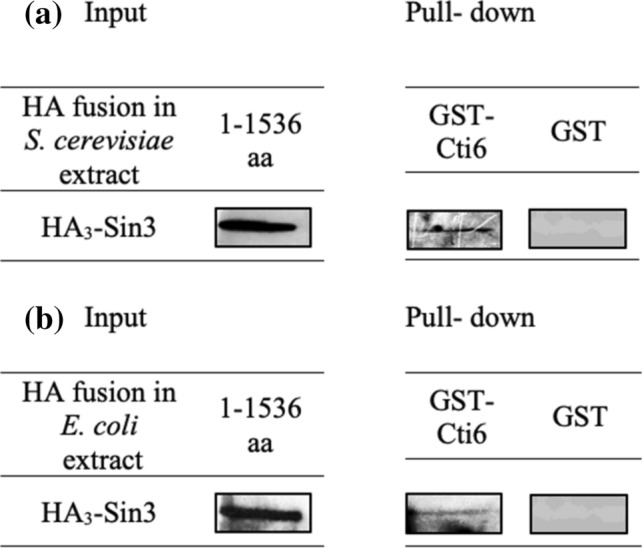
Fig. 1
Fig. 1
In vitro interaction of Cti6 with Sin3 shown by affinity chromatography. a Full length of Cti6 was fused with GST, immobilized on GSH Sepharose and incubated with protein extract from yeast transformants containing full-length HA3-Sin3 synthesized by S. cerevisiae (strain C13-ABY.S86, plasmid pCW117). b Bacterially synthesized HA3-Sin3 (E.coli strain BL21, plasmid pSW11) was incubated with GST-Cti6 (full-length fusion protein) bound to GSH Sepharose. GST-Cti6 fusion is encoded by plasmid pRAR3 (aa 1–506), GST vector was used as a negative control. Extracts containing 75 µg of total protein were analyzed for the input control. To achieve comparable amounts of HA-Sin3 for the interaction assay, total protein was adjusted accordingly
Fig. 2
Fig. 2
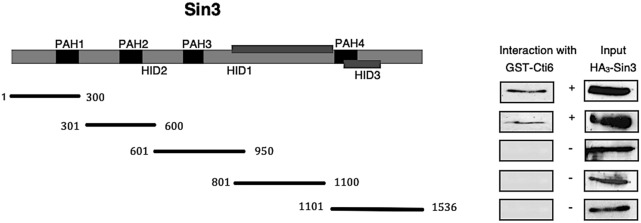
Mapping of Sin3 domains interacting with Cti6. GST-Cti6 fusion plasmid pRAR3 was used to synthesize full length of Cti6. The following expression plasmids representing individual PAH domains were used for synthesis of HA-tagged Sin3 length variants in S. cerevisiae: pCW83 (aa 1–300), pYJ91 (aa 301–600), pYJ90 (aa 601–950), pYJ89 (aa 801–1100) and pMP20 (aa 1101–1536). For input controls (shown in the right panel of the figure), 20% of protein used for the interaction assay was analyzed. PAH1-4: paired amphipathic helices 1–4
Fig. 3
Fig. 3
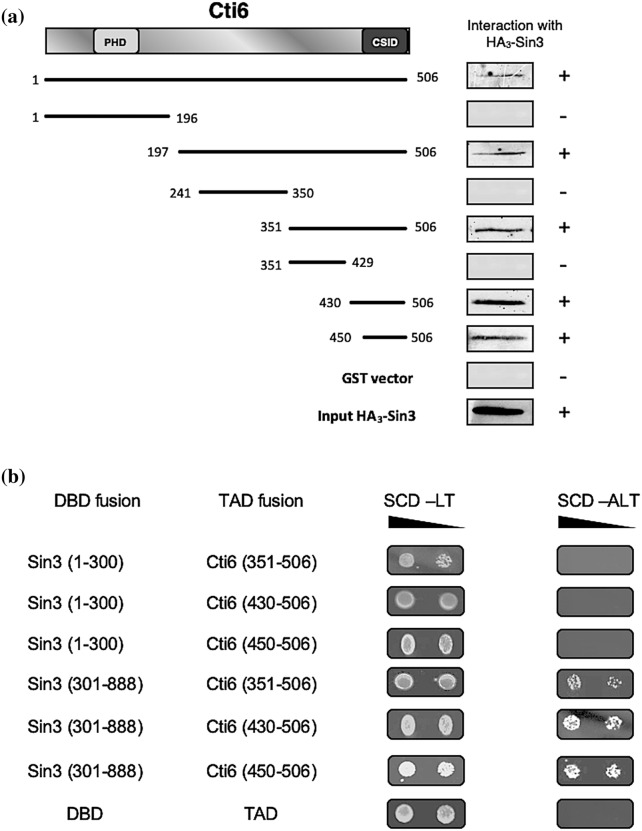
a Mapping of the Cti6 domain responsible for interaction with Sin3. Length variants of Cti6 were fused with GST, immobilized on GSH Sepharose and incubated with full-length HA3-Sin3 in total protein extract, synthesized by S. cerevisiae (Strain C13-ABY.S86, plasmid pCW117). GST-Cti6 fusions are encoded by plasmids pRAR3 (aa 1–506), pRAR10 (aa 1–196), pRAR11 (aa 197–506), pRAR14 (aa 241–350), pRAR15 (aa 351–506), pRAR30 (aa 351–429), pRAR31 (aa 430–506) and pRAR47 (aa 450–506). GST vector was used as a negative control. Input control is shown at the bottom of the figure (20% of protein used for the interaction assay). CSID: Cti6-Sin3 interaction domain; PHD: plant homeodomain. b Interaction of Sin3 domains with various Cti6 domains shown by two-hybrid assay. Plasmids pWJ6 (aa 1–300) and pJW50 (aa 301–888) encoding the Gal4 DNA-binding domain (DBD) fused with Sin3 domains PAH1 and PAH2, respectively, were transformed into strain PJ69-4A, containing a GAL2-ADE2 fusion (selection marker: TRP1). Correspondingly, various plasmids encoding fusions of Gal4 transcriptional-activation domain (TAD) with Cti6 were co-transformed (selection marker: LEU2): pRAR20 (Cti6, aa 351–506), pRAR37 (Cti6, aa 430–506), pRAR49 (Cti6, aa 450–506). As a negative control, empty pGBD-C1 and pGAD-C1 vectors were used. Growth in the absence of adenine is possible when a functional Gal4 activator is reconstituted by Cti6-Sin3 interaction in vivo. Selection plates (SCD-LT, absence of leucine and tryptophan; SCD-ALT, absence of leucine, tryptophan and adenine) were incubated for 48 h
Fig. 4
Fig. 4
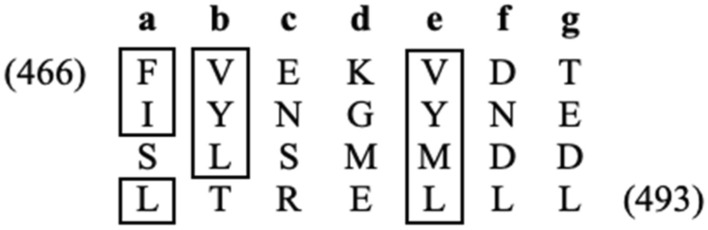
Amphipathic pattern of hydrophobic amino acids within CSID. Amino acids 466–493 of Cti6 are displayed as a heptad repeat (ag). Hydrophobic residues at positions a, b and e are boxed
Fig. 5
Fig. 5
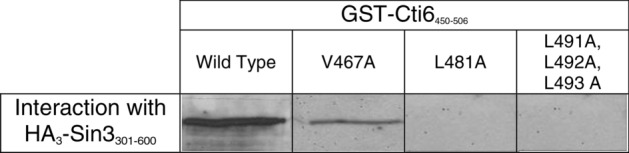
In vitro interaction of GST-Cti6 mutant variants and HA3-Sin3 (PAH2). GST-Cti6450-506 comprising CSID wild type and missense variants (plasmids pRAR47, pRAR50, pRAR51 and pRAR52) were comparatively analyzed for interaction with HA-tagged Sin3301-600 (PAH2) expressed in S. cerevisiae (plasmid pYJ91)
Fig. 6
Fig. 6
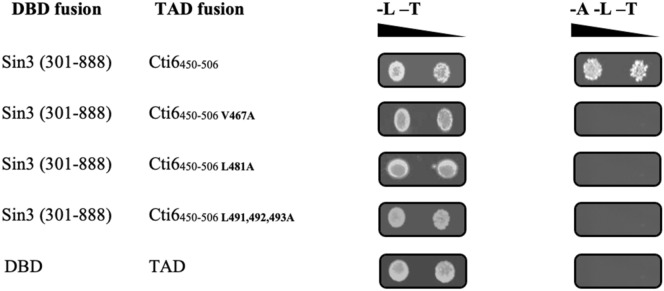
Mutational analysis of Cti6-Sin3 interaction using two hybrid analyses. The Gal4 DNA-binding domain (DBD) was fused with a Sin3 fragment comprising PAH2 to give plasmid pJW50 (aa 301–888). Correspondingly, Gal4 transcriptional-activation domain (TAD) was fused with Cti6450-506 wild-type and mutant variants to give pRAR49 (wild type), pRAR65 (V467A), pRAR66 (L481A) and pRAR67 (L491, 492, 493A). As a negative control, empty vectors pGAD-C1 and pGBD-C1 were used. DBD and TAD pairs of fusion plasmids (selection markers: TRP1 and LEU2, respectively) were co-transformed into strain PJ69-4A, containing a GAL2-ADE2 fusion that allows growth in the absence of adenine when a functional Gal4 activator is reconstituted. Selection plates (-L -T and -L -T -A; absence of leucine, tryptophan and adenine) were incubated for 48 h. Sequence of the mutagenized Cti6 domain (residues 466–493): FVEKVDTIYNGYNESLSMMDDLTRELLLW. Amino acids that were replaced by alanine are underlined
Fig. 7
Fig. 7
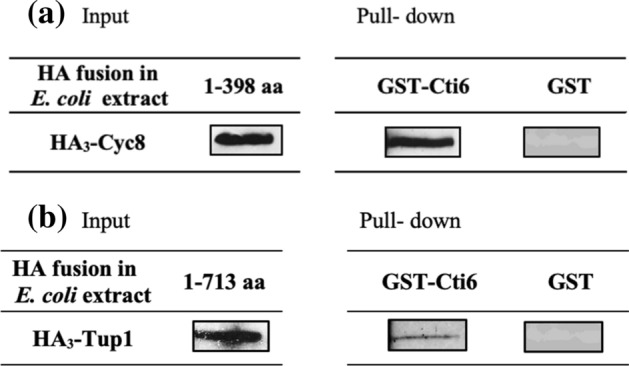
In vitro interaction of Cti6 with Cyc8 and Tup1 individually shown by affinity chromatography. a Full length of Cti6 was fused with GST, immobilized on GSH Sepharose and incubated with protein extract from E. coli (Strain BL21) containing HA3-Cyc8 (plasmid pFK77; 10 TPR motifs). b Bacterially synthesized HA-Tup1 (E. coli strain BL21, plasmid pRAR110) was incubated with GST-Cti6 (full-length fusion protein) bound to GSH Sepharose. GST-Cti6 fusion is encoded by plasmid pRAR3 (aa 1–506), GST vector was used as a negative control. Extracts containing 75 µg of total protein were analyzed for the input control. To achieve comparable amounts of HA-Cyc8 and HA-Tup1 for the interaction assay, total protein was adjusted accordingly
Fig. 8
Fig. 8
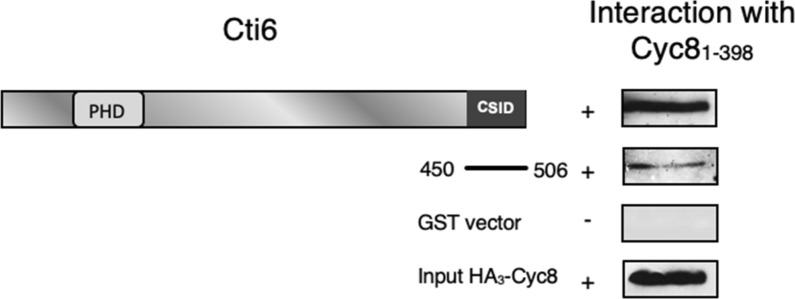
In vitro interaction between length variant GST-Cti6450-506 and TPR domains of Cyc8. Length variant GST-Cti6450–506 was immobilized on GSH Sepharose and incubated with protein extract from E. coli (Strain BL21), containing HA3-Cyc8 (plasmid pFK77; 10 TPR motifs). GST-Cti6 fusions are encoded by plasmids pRAR3 (aa 1–506) and pRAR47 (aa 450–506), respectively. GST vector was used as a negative control. Input control is shown at the bottom of the figure (20% of protein used for the interaction assay)
Fig. 9
Fig. 9
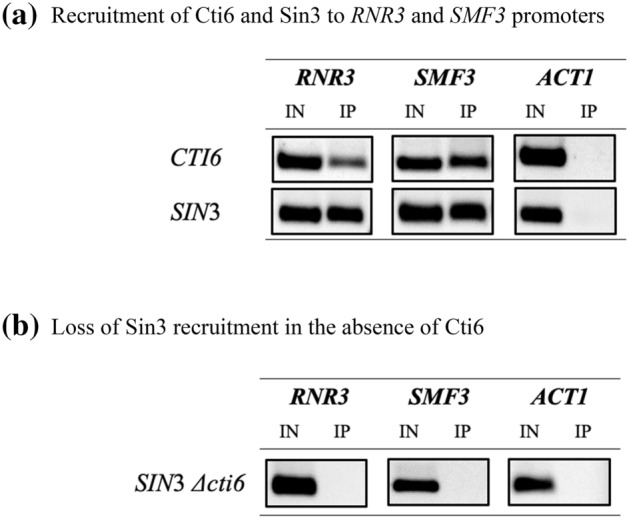
Sin3 recruitment to IRE-containing promoters. Cti6-dependent recruitment of Sin3 co-repressor to IRE-containing promoter regions of RNR3 and SMF3 shown by chromatin immunoprecipitation. Strains RAY1 (contains a His-tagged variant of CTI6 at its natural chromosomal position), RAY3 (isogenic cti6 deletion mutant) and FKY11 (contains a His-tagged variant of Sin3 at its natural chromosomal position) were cultivated to the exponential growth phase under repression (+ 100 µM Fe +). After shearing of chromatin, binding to His-Tag Dynabeads® and elution, promoter fragments were analyzed by end-point PCR (a) recruitment of Cti6 and Sin3 to RNR3 and SMF3 promoters (b) loss of Sin3 recruitment in the absence of Cti6, using specific primers for RNR3, SMF3 and ACT1 (negative control). PCR products were obtained after 29 amplification cycles and then separated by electrophoresis on a 2% agarose gel. IN input control of total chromatin fragments, IP analysis of samples obtained by affinity purification
Fig. 10
Fig. 10
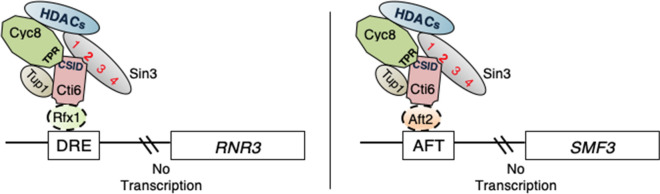
A schematic representation of two hypothetical models of Sin3 dependent Cti6 recruitment. RNR3 and SMF3 are iron-regulated structural genes. Under repression (+ 100 µM Fe +), Anchoring of Cti6 on the DRE region of RNR3 and AFT of SMF3 promoters occurs. This may be implemented via Cti6 recruitment by Rfx1 and Aft2 (in dashed oval shape as speculative scenario), respectively. Then, Cti6 recruits Sin3 co-repressor through the interaction between PAH2 and CSID which triggers a conformational reorganization, bringing HDACs into action preventing transcription of the respective genes. The existence of Cyc8 and Tup1 should be considered through CSID/TPR and Cti6/Tup1 interaction. DRE, damage-responsive elements; AFT, activator of Fe transcription; CSID, Cti6-Sin3 interaction domain; TPR, tetratricopeptide repeat. Numbers 1, 2, 3 and 4 within the Sin3 oval indicate paired amphipathic helices PAH1, 2, 3 and 4

References

    1. Adams GE, Chandru A, Cowley SM. Co-repressor, Co-activator and general transcription factor: the many faces of the Sin3 Histone Deacetylase (HDAC) Complex. Biochem J. 2018;475:3921–3932. doi: 10.1042/BCJ20170314. - DOI - PMC - PubMed
    1. Bing L, Joseph R. Ssn6-Tup1 regulates RNR3 by positioning nucleosomes and affecting the chromatin structure at the upstream repression sequence. J Biol Chem. 2001;276:33788–33797. doi: 10.1074/jbc.M104220200. - DOI - PubMed
    1. Blaiseau PL, Lesuisse E, Camadro JM. Aft2p, a novel iron-regulated transcription activator that modulates, with Aft1p, intracellular iron use and resistance to oxidative stress in yeast. J Biol Chem. 2001;276:34221–34226. doi: 10.1074/jbc.M104987200. - DOI - PubMed
    1. Cairns BR. The logic of chromatin architecture and remodelling at promoters. Nature. 2009;461:193–198. doi: 10.1038/nature08450. - DOI - PubMed
    1. Carrozza MJ, Florens L, Swanson SK, Shia WJ, Anderson S, Yates J, Washburn MP, Workman JL. Stable incorporation of sequence specific repressors Ash1 and Ume6 into the Rpd3L complex. Biochim Biophys Acta. 2005;1731:77–87. doi: 10.1016/j.bbaexp.2005.09.005. - DOI - PubMed

MeSH terms

LinkOut - more resources