


Dietary Gracilaria persica mediated the growth performance, fillet colouration, and immune response of Persian sturgeon (Acipenser persicus)
- PMID: 32981978
- PMCID: PMC7502242
- DOI: 10.1016/j.aquaculture.2020.735950
Dietary Gracilaria persica mediated the growth performance, fillet colouration, and immune response of Persian sturgeon (Acipenser persicus)
Abstract
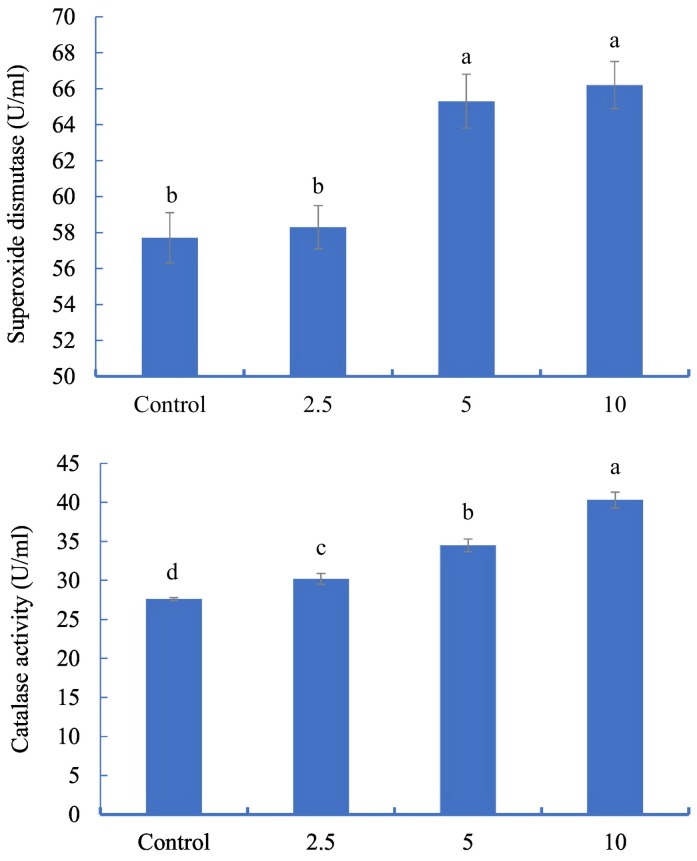
Algal seaweeds have abundant amounts of active substances and can be used as pharmaceuticals and biomedicals in aquafeeds. In this context, the powder of red macroalgae Gracilaria persica was included in the diets of Persian sturgeon at the rate of 0, 2.5, 5, and 10 g/kg to investigate its role on the growth rate, fillet colouration, haemato-biochemical indices, serum, and skin mucus immunity. The weight gain, SGR, and FCR displayed no significant changes in fish fed varying levels of G. persica (P > 0.05). The level of total carotenoids was significantly higher in the blood and fillet of fish fed 5 and 10 g G. persica/kg diet (P < 0.05). Dietary G. persica significantly altered RBCs, WBCs, and HCT at 5, and 10 g/kg, whereas the Hb was increased in fish fed 5 g/kg (P < 0.05). The blood total protein and albumin were significantly increased in fish fed 5 and 10 g/kg (P < 0.05). No significant alterations were observed on ALT, AST, ALP, and glucose levels of fish fed varying levels of G. persica (P > 0.05). Serum Ig, lysozyme, superoxide dismutase, catalase, and respiratory burst activities were increased in fish fed 5, and 10 g/kg than fish fed 0 and 2.5 g/kg diet (P < 0.05). The level of total protein and lysozyme activity in the skin mucus were significantly higher in the blood and fillet of fish fed 5, and 10 g G. persica/kg diet than fish fed 0 and 2.5 g/kg (P < 0.05). Based on the obtained results, G. persica can be used as a feasible feed additive in the diets of Persian sturgeon at 5-10 g/kg diet.
Keywords: Coloration; Gracilaria persica; Growth; Immunity; Persian sturgeon.
© 2020 Elsevier B.V. All rights reserved.
Conflict of interest statement
The authors declare that they have no conflict of interest.
Figures
References
-
- Abdel-Latif H.M.R., Abdel-Tawwab M., Dawood M.A.O., Menanteau-Ledouble S., El-Matbouli M. Benefits of dietary butyric acid, sodium butyrate, and their protected forms in Aquafeeds: a review. Rev. Fish. Sci. Aquac. 2020:1–28. doi: 10.1080/23308249.2020.1758899. - DOI
-
- Adegbeye M.J., Elghandour M.M.M.Y., Monroy J.C., Abegunde T.O., Salem A.Z.M., Barbabosa-Pliego A., Faniyi T.O. Potential influence of Yucca extract as feed additive on greenhouse gases emission for a cleaner livestock and aquaculture farming – a review. J. Clean. Prod. 2019;239
-
- Adel M., Dawood M.A.O., Shafiei S., Sakhaie F., Shekarabi S.P.H. Dietary Polygonum minus extract ameliorated the growth performance, humoral immune parameters, immune-related gene expression and resistance against Yersinia ruckeri in rainbow trout (Oncorhynchus mykiss) Aquaculture. 2020;519
-
- Ahmadifar E., Yousefi M., Karimi M., Fadaei Raieni R., Dadar M., Yilmaz S., Dawood M.A.O., Abdel-Latif H.M.R. Benefits of dietary polyphenols and polyphenol-rich additives to aquatic animal health: an overview. Rev. Fish. Sci. Aquac. 2020:1–34. doi: 10.1080/23308249.2020.1818689. - DOI
-
- Al-Deriny S.H., Dawood M.A.O., Elbialy Z.I., El-Tras W.F., Mohamed R.A. Selenium nanoparticles and spirulina alleviate growth performance, hemato-biochemical, immune-related genes, and heat shock protein in Nile tilapia (Oreochromis niloticus) Biol. Trace Elem. Res. 2020 doi: 10.1007/s12011-020-02096-w. - DOI - PubMed
LinkOut - more resources
Full Text Sources
Other Literature Sources