Review
. 2020 Sep 15:14:95-105.
doi: 10.2147/BTT.S265767. eCollection 2020.

Nucleic Acid Therapy for β-Thalassemia

Affiliations
Review

Nucleic Acid Therapy for β-Thalassemia

Annette d'Arqom. Biologics. .

Abstract

β-thalassemia is caused by mutations in the β-globin gene which diminishes or abolishes β-globin chain production. This reduction causes an imbalance of the α/β-globin chain ratio and contributes to the pathogenesis of the disease. Several approaches to reduce the imbalance of the α/β ratio using several nucleic acid-based technologies such as RNAi, lentiviral mediated gene therapy, splice switching oligonucleotides (SSOs) and gene editing technology have been investigated extensively. These approaches aim to reduce excess free α-globin, either by reducing the α-globin chain, restoring β-globin expression and reactivating γ-globin expression, leading a reduced disease severity, treatment necessity, treatment interval, and disease complications, thus, increasing the life quality of the patients and alleviating economic burden. Therefore, nucleic acid-based therapy might become a potential targeted therapy for β-thalassemia.

Keywords: RNAi; gene editing; good health and well-being; splice switching oligonucleotides; targeted therapy.


Conflict of interest statement

The author reports no conflicts of interest related to this work.

Figures
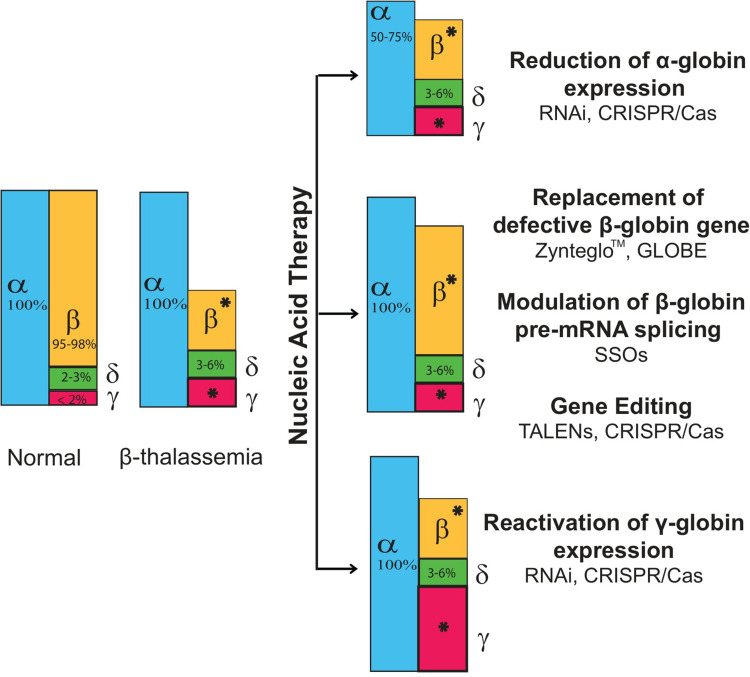
Figure 1
Figure 1
Nucleic acid-based targeted therapy for β-thalassemia Pathophysiology of β-thalassemia involves reducing or abolishing the β-globin chain, causing an excess of free α-globin. Therefore, three strategies can be employed to reduce the imbalance of α/β globin ratio: reducing α-globin expression, restoring β-globin expression and reactivating γ-globin. Several technologies can be used to achieve the aim, such as RNA interference (RNAi) to degrade the α-globin mRNA or to inhibit BCL11A to reactivate γ-globin production. Delivery of a normal β-globin gene to replace a defective gene is possible using the lentiviral vector. Moreover, modulating β-globin pre-mRNA splicing by splice switching oligonucleotides (SSOs) might reduce the possibilities of β-globin overexpression. Gene editing technologies such as Zinc Finger Nucleases (ZFNs), Transcription activator-like effector nucleases (TALENs) and Clustered Regularly Interspaced Short Palindromic Repeats and CRISPR-associated protein (CRISPR/Cas) has the ability to restore β-globin expression by correcting the mutation, to reduce α-globin expression by deleting specific α-globin enhancers, such as MCS-R2 and to induce HbF production by disrupting BCL11A, MYB or KLF1 genes. *Level of β-globin and γ-globin varies with the type of mutation. Notes: Adapted from Fucharoen.8
Figure 2
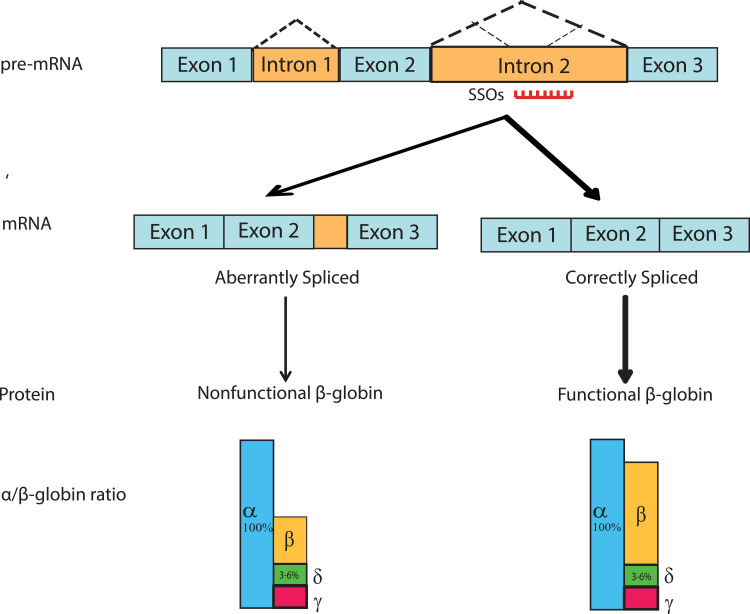
Figure 2
Mechanism of splice switching oligonucleotides (SSOs) Mutation in the intron region may activate aberrant splice sites leading to retaining the intron fragment in the mature mRNA and translated to a nonfunctional β-globin chain. SSOs targeted to the aberrant splicing elements block spliceosome to recognize the pseudo-exon and restore correct splicing which is translated to fully functional β-globin protein. Even though 100% of correct splicing cannot be achieved, the correctly spliced β-globin balances the α/β globin ratio, reduces the excess α-globin and increases the HbA level, thus alleviating the disease pathology. Notes: Adapted from Svasti et al.33 Copyright (2009) National Academy of Sciences.

References

    1. Cao A, Galanello R. Beta-thalassemia. Genet Med. 2010;12(2):61–76. doi: 10.1097/GIM.0b013e3181cd68ed - DOI - PubMed
    1. Cao A, Kan YW. The prevention of Thalassemia. Cold Spring Harb Perspect Med. 2013;3(2):a011775. doi: 10.1101/cshperspect.a011775 - DOI - PMC - PubMed
    1. Rivella S. Ineffective erythropoiesis and Thalassemias. Curr Opin Hematol. 2009;16(3):187–194. doi: 10.1097/MOH.0b013e32832990a4 - DOI - PMC - PubMed
    1. Nienhuis AW, Nathan DG. Pathophysiology and clinical manifestations of the β-thalassemias. Cold Spring Harb Perspect Med. 2012;2:12. doi: 10.1101/cshperspect.a011726 - DOI - PMC - PubMed
    1. Riewpaiboon A, Nuchprayoon I, Torcharus K, et al. Economic burden of Beta-thalassemia/Hb E and Beta-thalassemia major in Thai children. BMC Res Notes. 2010;3(1):29. doi: 10.1186/1756-0500-3-29 - DOI - PMC - PubMed