


Cost-Effectiveness Analysis of Colorectal Cancer Screening: A Systematic Review
- PMID: 32982508
- PMCID: PMC7490076
- DOI: 10.2147/RMHP.S262171
Cost-Effectiveness Analysis of Colorectal Cancer Screening: A Systematic Review
Abstract
Introduction: Colorectal cancer (CRC) is a significant health problem with an increasing incidence worldwide. Screening is one of the ways, in which cases and deaths of CRC can be prevented. The objective of this systematic review was to evaluate the cost-effectiveness of the different CRC screening techniques and to specify the efficient technique from a cost-effectiveness perspective.
Methods: The economic studies of CRC screening in general populations (average risk), aged 50 years and above were reviewed. Two reviewers independently reviewed the titles, abstracts, and full-texts of the studies in five databases: Cochrane, Embase, Scopus, Web of Science and PubMed. The disagreements between reviewers were resolved through the authors' consensus. The main outcome measures in this systematic review were the incremental cost-effectiveness ratio (ICER) of screening versus no-screening and then in comparison with other screening techniques. The ICER is defined by the difference in cost between two possible interventions, divided by the difference in their effect.
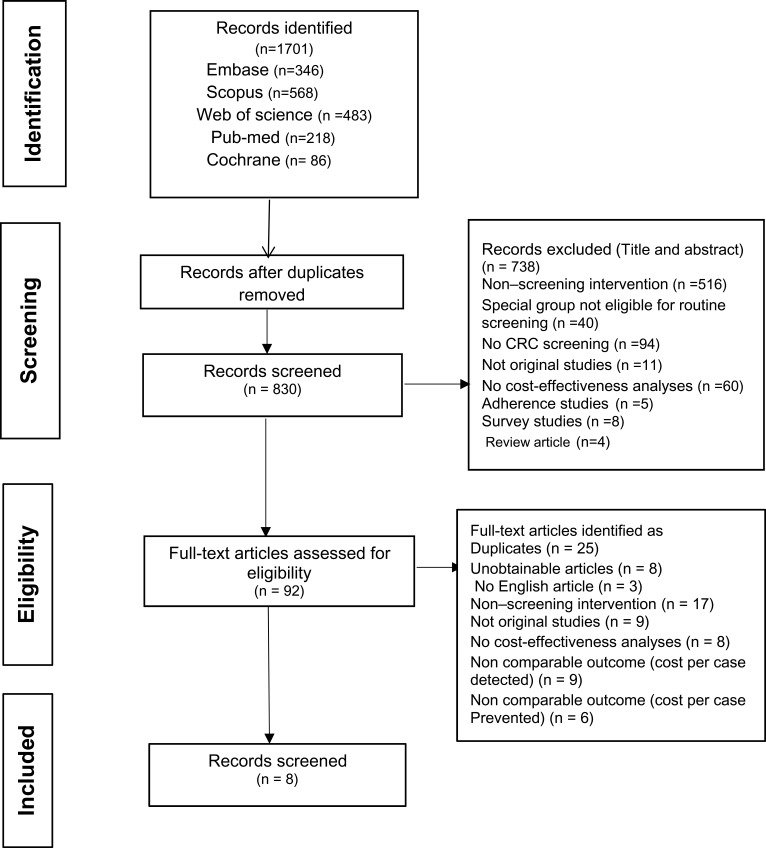
Results: Eight studies were identified and retained for the final analysis. In this study, when screening techniques were compared to no-screening, all CRC screening techniques showed to be cost-effective. The lowest ICER calculated was $PPP -16265/quality-adjusted life-year (QALY) (the negative ICERs were between purchasing power parity in US dollar ($PPP) -16265/QALY to $PPP -1988/QALY, whereas the positive ICERs were between $PPP 1257/QALY to $PPP 55987/QALY). For studies comparing various screening techniques, there was great heterogeneity in terms of the structures of the analyses, leading to diverse conclusions about their incremental cost-effectiveness.
Conclusion: All CRC screening techniques were cost-effective, compared with the no-screening methods. The cost-effectiveness of the various screening techniques mainly was dependent on the context-specific parameters and highly affected by the framework of the cost-effectiveness analysis. In order to make the studies comparable, it is important to adopt a reference-based methodology for economic evaluation studies.
Keywords: colorectal cancer; economic evaluation; incremental cost-effectiveness ratio; screening techniques.
© 2020 Khalili et al.
Conflict of interest statement
The authors report no conflicts of interest in this work.
Figures
References
-
- Albreht T, Conroy F, Dalmas M, et al. European Guide for Quality National Cancer Control Programmes. Ljubljana, Slovenia: National Institute of Public Health; 2015.
-
- European Council. Council recommendation of 2 December 2003 on cancer screening (2003/878/EC). Off J Eur Union. 2003;327.
Publication types
LinkOut - more resources
Full Text Sources
