MAP4 as a New Candidate in Cardiovascular Disease
- PMID: 32982783
- PMCID: PMC7479186
- DOI: 10.3389/fphys.2020.01044
MAP4 as a New Candidate in Cardiovascular Disease
Abstract
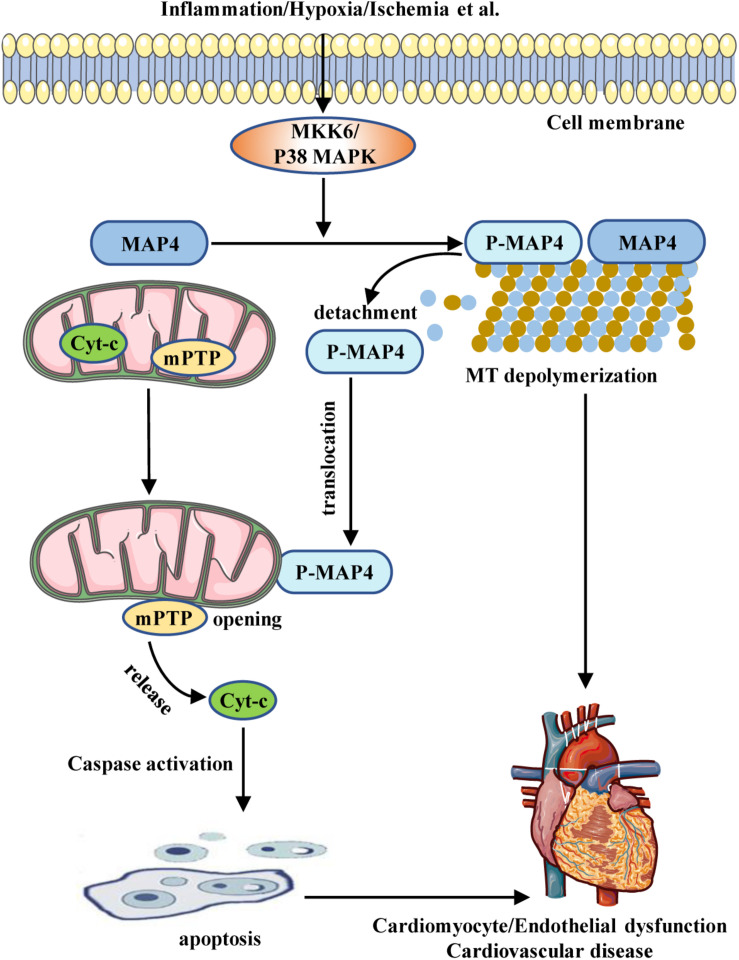
Microtubule and mitochondrial dysfunction have been implicated in the pathogenesis of cardiovascular diseases (CVDs), including cardiac hypertrophy, fibrosis, heart failure, and hypoxic/ischemic related heart dysfunction. Microtubule dynamics instability leads to disrupted cell homeostasis and cell shape, decreased cell survival, and aberrant cell division and cell cycle, while mitochondrial dysfunction contributes to abnormal metabolism and calcium flux, increased cell death, oxidative stress, and inflammation, both of which causing cell and tissue dysfunction followed by CVDs. A cytosolic skeleton protein, microtubule-associated protein 4 (MAP4), belonging to the family of microtubule-associated proteins (MAPs), is widely expressed in non-neural cells and possesses an important role in microtubule dynamics. Increased MAP4 phosphorylation results in microtubule instability. In addition, MAP4 also expresses in mitochondria and reveals a crucial role in maintaining mitochondrial homeostasis. Phosphorylated MAP4 promotes mitochondrial apoptosis, followed by cardiac injury. The aim of the present review is to highlight the novel role of MAP4 as a potential candidate in multiple cardiovascular pathologies.
Keywords: cardiovascular disease; microtubule; microtubule-associated protein 4; microtubule-associated proteins; mitochondria.
Copyright © 2020 Li, Zhang, Lei, Huang and Hu.
Figures
Similar articles
-
Microtubule associated protein 4 phosphorylation leads to pathological cardiac remodeling in mice.EBioMedicine. 2018 Nov;37:221-235. doi: 10.1016/j.ebiom.2018.10.017. Epub 2018 Oct 13. EBioMedicine. 2018. PMID: 30327268 Free PMC article.
-
Cardiac proteomics reveals the potential mechanism of microtubule associated protein 4 phosphorylation-induced mitochondrial dysfunction.Burns Trauma. 2019 Mar 11;7:8. doi: 10.1186/s41038-019-0146-3. eCollection 2019. Burns Trauma. 2019. PMID: 30906793 Free PMC article.
-
Basis for MAP4 dephosphorylation-related microtubule network densification in pressure overload cardiac hypertrophy.J Biol Chem. 2010 Dec 3;285(49):38125-40. doi: 10.1074/jbc.M110.148650. Epub 2010 Oct 2. J Biol Chem. 2010. PMID: 20889984 Free PMC article.
-
A Mitochondrial Approach to Cardiovascular Risk and Disease.Curr Pharm Des. 2019;25(29):3175-3194. doi: 10.2174/1389203720666190830163735. Curr Pharm Des. 2019. PMID: 31470786 Review.
-
Mitochondrial quality control in cardiac cells: Mechanisms and role in cardiac cell injury and disease.J Cell Physiol. 2019 Jun;234(6):8122-8133. doi: 10.1002/jcp.27597. Epub 2018 Nov 11. J Cell Physiol. 2019. PMID: 30417391 Free PMC article. Review.
Cited by
-
Switching in the expression pattern of actin isoforms marks the onset of contractility and distinct mechanodynamic behavior during cardiomyocyte differentiation.Physiol Rep. 2022 Feb;10(3):e15171. doi: 10.14814/phy2.15171. Physiol Rep. 2022. PMID: 35166060 Free PMC article.
-
miR-103-3p Regulates the Differentiation and Autophagy of Myoblasts by Targeting MAP4.Int J Mol Sci. 2023 Feb 18;24(4):4130. doi: 10.3390/ijms24044130. Int J Mol Sci. 2023. PMID: 36835542 Free PMC article.
-
ARIH1 Inhibition Promotes Microtubule Stability and Sensitizes Breast Cancer Cells to Microtubule-Stabilizing Agents.Cancers (Basel). 2025 Feb 25;17(5):782. doi: 10.3390/cancers17050782. Cancers (Basel). 2025. PMID: 40075632 Free PMC article.
-
Microtubule lattice spacing governs cohesive envelope formation of tau family proteins.Nat Chem Biol. 2022 Nov;18(11):1224-1235. doi: 10.1038/s41589-022-01096-2. Epub 2022 Aug 22. Nat Chem Biol. 2022. PMID: 35996000 Free PMC article.
-
Protein interaction networks in the vasculature prioritize genes and pathways underlying coronary artery disease.Commun Biol. 2024 Jan 12;7(1):87. doi: 10.1038/s42003-023-05705-1. Commun Biol. 2024. PMID: 38216744 Free PMC article.
References
-
- Aizawa H., Emori Y., Murofushi H., Kawasaki H., Sakai H., Suzuki K. (1990). Molecular cloning of a ubiquitously distributed microtubule-associated protein with Mr 190,000. J. Biol. Chem. 265 13849–13855. - PubMed
Publication types
LinkOut - more resources
Full Text Sources
Other Literature Sources
