


Picking up a Fight: Fine Tuning Mitochondrial Innate Immune Defenses Against RNA Viruses
- PMID: 32983015
- PMCID: PMC7487669
- DOI: 10.3389/fmicb.2020.01990
Picking up a Fight: Fine Tuning Mitochondrial Innate Immune Defenses Against RNA Viruses
Abstract
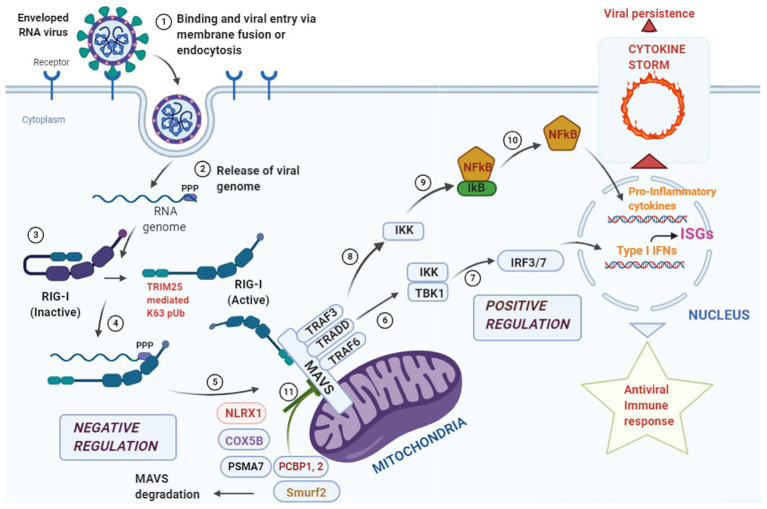
As the world faces the challenge of the COVID-19 pandemic, it has become an urgent need of the hour to understand how our immune system sense and respond to RNA viruses that are often life-threatening. While most vaccine strategies for these viruses are developed around a programmed antibody response, relatively less attention is paid to our innate immune defenses that can determine the outcome of a viral infection via the production of antiviral cytokines like Type I Interferons. However, it is becoming increasingly evident that the "cytokine storm" induced by aberrant activation of the innate immune response against a viral pathogen may sometimes offer replicative advantage to the virus thus promoting disease pathogenesis. Thus, it is important to fine tune the responses of the innate immune network that can be achieved via a deeper insight into the candidate molecules involved. Several pattern recognition receptors (PRRs) like the Toll like receptors (TLRs), NOD-like receptors (NLRs), and the retinoic acid inducible gene-I (RIG-I) like receptors (RLRs) recognize cytosolic RNA viruses and mount an antiviral immune response. RLRs recognize invasive viral RNA produced during infection and mediate the induction of Type I Interferons via the mitochondrial antiviral signaling (MAVS) molecule. It is an intriguing fact that the mitochondrion, one of the cell's most vital organelle, has evolved to be a central hub in this antiviral defense. However, cytokine responses and interferon signaling via MAVS signalosome at the mitochondria must be tightly regulated to prevent overactivation of the immune responses. This review focuses on our current understanding of the innate immune sensing of the host mitochondria by the RLR-MAVS signalosome and its specificity against some of the emerging/re-emerging RNA viruses like Ebola, Zika, Influenza A virus (IAV), and severe acute respiratory syndrome-coronavirus (SARS-CoV) that may expand our understanding for novel pharmaceutical development.
Keywords: RNA virus; cytokine storm; innate immunity; mitochondria; mitochondrial antiviral signaling; retinoic acid inducible gene-I.
Copyright © 2020 Dutta, Das and Mukherjee.
Figures
References
-
- Allen I. C., Moore C. B., Schneider M., Lei Y., Davis B. K., Scull A., et al. (2012). NLRX1 protein attenuates inflammatory responses to virus infection by interfering with the RIG-I-MAVS signaling pathway and TRAF6 ubiquitin ligase. Immunity 34, 854–865. 10.1016/j.immuni.2011.03.026.NLRX1, PMID: - DOI - PMC - PubMed
-
- Biacchesi S., LeBerre M., Lamoureux A., Louise Y., Lauret E., Boudinot P., et al. (2009). Mitochondrial antiviral signaling protein plays a major role in induction of the fish innate immune response against RNA and DNA viruses. J. Virol. 83, 7815–7827. 10.1128/JVI.00404-09, PMID: - DOI - PMC - PubMed
Publication types
LinkOut - more resources
Full Text Sources
Research Materials
Miscellaneous
