. 2020 Aug 26:11:2029.
doi: 10.3389/fmicb.2020.02029. eCollection 2020.

Species-Level Analysis of Human Gut Microbiota With Metataxonomics

Affiliations

Species-Level Analysis of Human Gut Microbiota With Metataxonomics

Jing Yang et al. Front Microbiol. .

Abstract

The current understanding of human gut microbial community is mainly limited to taxonomic features at the genus level. Here, we examined the human gut microbial community at the species level by metataxonomics. To achieve this purpose, a high-throughput approach involving operational phylogenetic unit analysis of the near full-length 16S ribosomal RNA (rRNA) gene sequence was used. A total of 1,235 species-level phylotypes (SLPs) were classified in the feces of 120 Chinese healthy individuals, including 461 previously classified species, 358 potentially new species, and 416 potentially new taxa, which were categorized into low, medium, and high prevalent bacteria groups based on their prevalence. Each individual harbored 186 ± 51 SLPs on average. There was no universal bacterial species shared by all the individuals. However, 90 ± 19 of 116 SLPs were shared in the high prevalent bacteria group. Thirty-two out of thirty-eight species in the high prevalent bacteria group detected in this study were also found in at least one previous study on human gut microbiota based on either culture-dependent or culture-independent approaches. Through compositional analysis, a hierarchical clustering of the prevalence and relative abundance of the 1,235 SLPs revealed two types of gut microbial communities, which were dominated by Prevotella copri and Bacteroides vulgatus, respectively. The type dominated by P. copri was more prevalent in northern China, while the B. vulgatus-dominant type was more prevalent in southern China. Therefore, P- and B-type gut microbial communities in China were proposed. It was found that 166 out of 461 known bacterial species have been previously reported as potential pathogens, and the individuals sampled for this study harbored 20 of these potential pathogenic species on average. The top two most abundant and prevalent potential pathogenic species were Klebsiella pneumoniae and Bacteroides fragilis.

Keywords: gut microbiota; metataxonomics; potential pathogenic species; resident bacteria; species-level phylotypes.


Figures

FIGURE 1
FIGURE 1
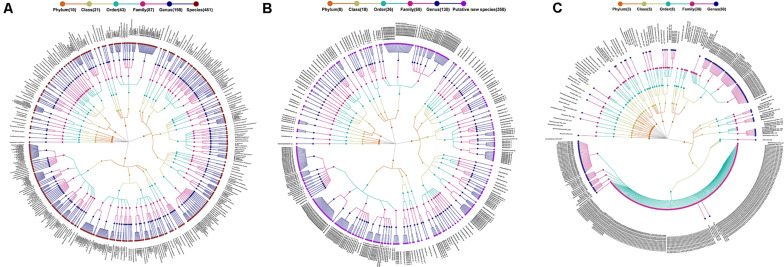
Taxonomic profiles of 1,235 species-level phylotypes (SLPs) in the gut microbial community of humans. A taxonomic tree of (A) 461 known species, (B) 368 potentially new species, and (C) 416 potentially higher taxa. *Each dot represents a SLP. The descending hierarchical levels are expressed from the inner to the outer rings. The total number of SPLs at different hierarchical levels is displayed in brackets.
FIGURE 2
FIGURE 2
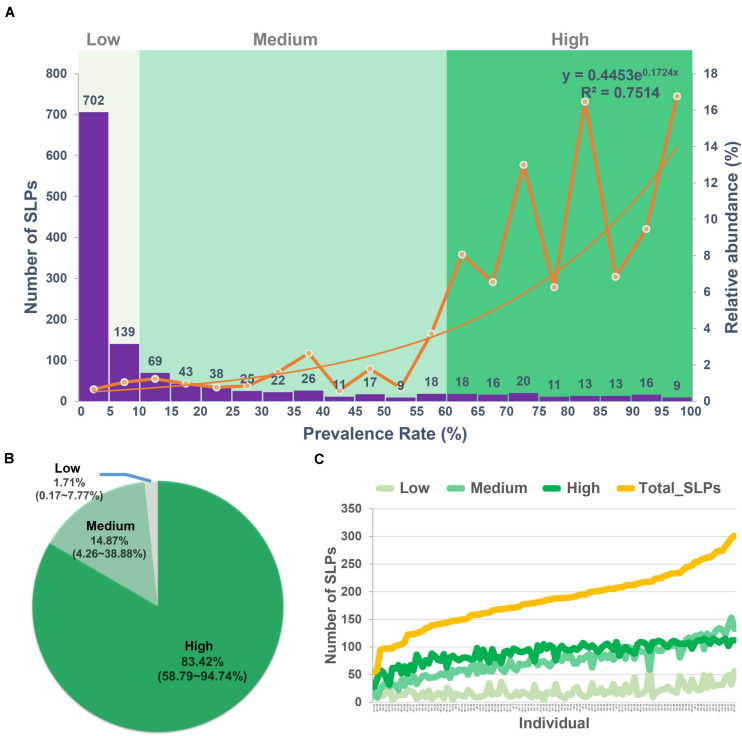
Low, medium, and high prevalent bacteria groups. (A) The numbers (left axis) and the relative abundance (right axis) of the species-level phylotypes (SLPs) in individuals with the 5% interval. According to the prevalence of the 1,235 SLPs, they were classified into the low (<10%), medium (10–60%), and high prevalent (>60%) bacteria groups. (B) The relative abundance of the low, medium, and high prevalent bacteria groups in each cohort. (C) The total number of SLPs and SLPs in low, medium, and high prevalent bacteria groups in each individual. The low, medium, and high prevalent bacteria groups are shown in different colors.
FIGURE 3
FIGURE 3
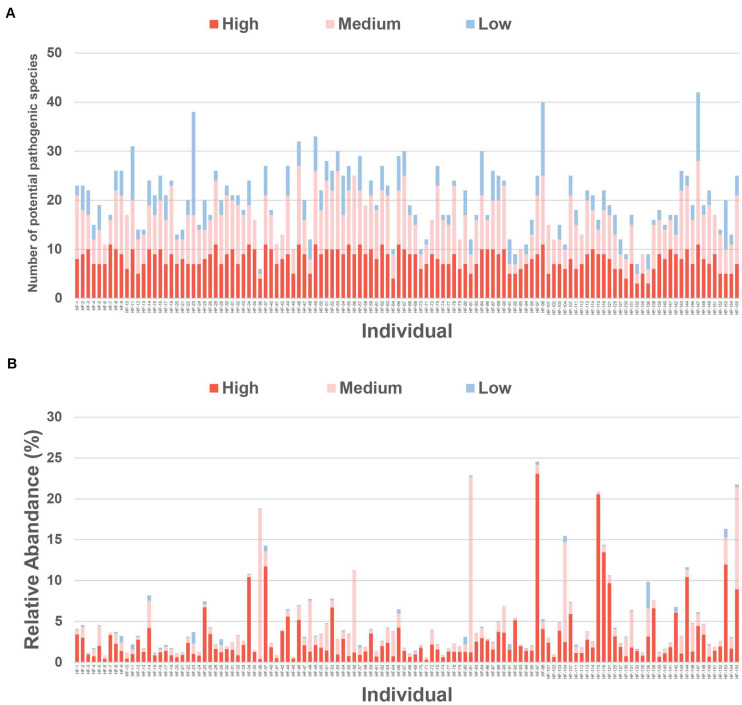
Relative abundance of potential pathogenic species in individuals. (A) The number of potential pathogenic species in low, medium, and high prevalent bacteria groups in individuals. (B) The relative abundance of potential pathogenic species in low, medium, and high prevalent bacteria groups in individuals. *The potential pathogenic species in low, medium, and high prevalent bacteria groups are shown in different colors.
FIGURE 4
FIGURE 4
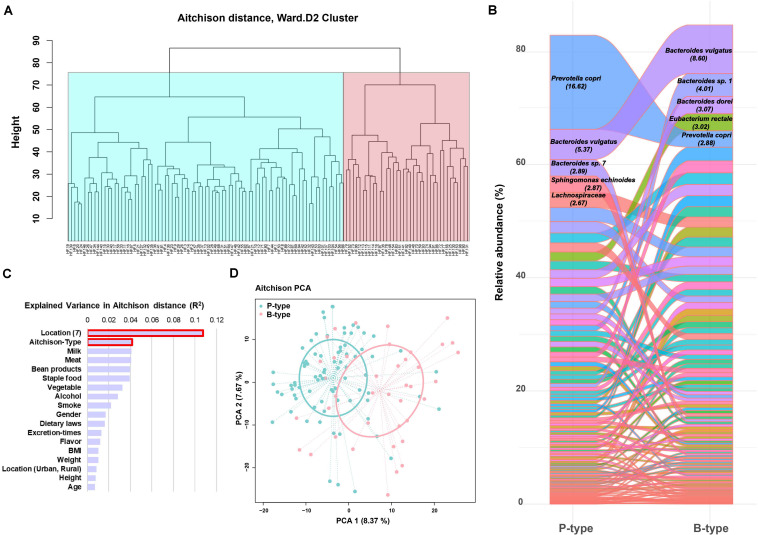
Species-level phylotype (SLP) typing of the gut microbial community in humans. (A) Hierarchical clustering of 120 individuals based on Aitchison distance analysis. (B) The relative abundance of all the 116 SLPs between the two SLP types. The abundance of the dominant species is shown. (C) Multivariate association analysis of the major influencing factors. (D) The principal component analysis (PCA) blot of proportionality data. SLPs in the three types were ordered from the highest to the lowest according to their abundance. Each SLP is represented by a single color.
FIGURE 5
FIGURE 5
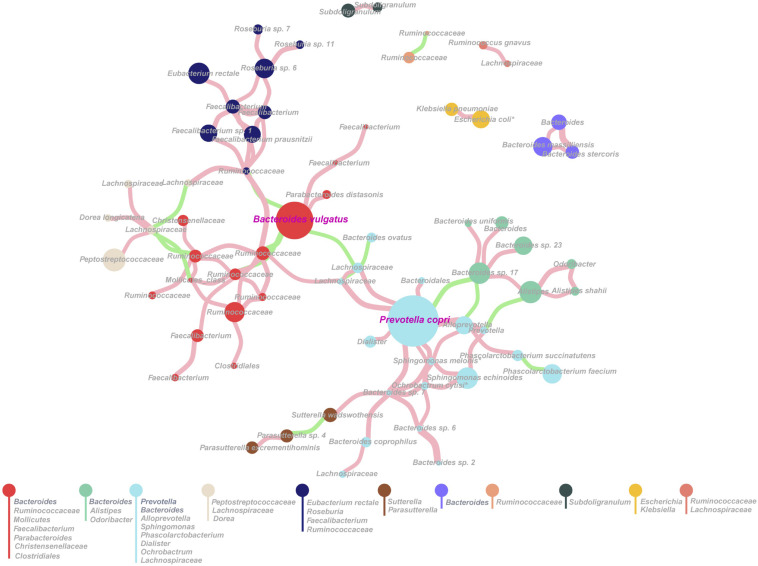
Proportional abundant species-level phylotypes (SLPs) based on proportionality analysis. Each node represents one SLP, whose abundance is directly proportional to the size of the node. Eleven modules were obtained, and each module is represented by a different color. The genus of each module is listed. An edge was drawn between SLPs if they showed a proportionality metrics (ρ) ≥0.3. A pink edge represents the proportionality between SLPs taxa, whereas a green edge indicates inverse proportionality.

References

    1. Aitchison J., Barceloó-Vidal C., Martián-Fernaíndez J. A., Pawlowsky-Glahn V. (2000). Logratio analysis and compositional distance. Math. Geol. 32 271–275.
    1. Almeida A., Mitchell A. L., Boland M., Forster S. C., Gloor G. B., Tarkowska A., et al. (2019). A new genomic blueprint of the human gut microbiota. Nature 568 499–504. 10.1038/s41586-019-0965-1 - DOI - PMC - PubMed
    1. Arumugam M., Raes J., Pelletier E., Le Paslier D., Yamada T., Mende D. R., et al. (2011). Enterotypes of the human gut microbiome. Nature 473 174–180. 10.1038/nature09944 - DOI - PMC - PubMed
    1. Bai X., Lu S., Yang J., Jin D., Pu J., Díaz Moyá S., et al. (2018). Precise fecal microbiome of the herbivorous tibetan antelope inhabiting high-altitude alpine plateau. Front. Microbiol. 9:2321. 10.3389/fmicb.2018.02321 - DOI - PMC - PubMed
    1. Bokulich N. A., Subramanian S., Faith J. J., Gevers D., Gordon J. I., Knight R., et al. (2013). Quality-filtering vastly improves diversity estimates from Illumina amplicon sequencing. Nat. Methods 10 57–59. 10.1038/nmeth.2276 - DOI - PMC - PubMed

LinkOut - more resources