. 2020 Aug 21:11:1881.
doi: 10.3389/fimmu.2020.01881. eCollection 2020.

Single Nucleotide Polymorphism in KIR2DL1 Is Associated With HLA-C Expression in Global Populations

Affiliations

Single Nucleotide Polymorphism in KIR2DL1 Is Associated With HLA-C Expression in Global Populations

Luciana de Brito Vargas et al. Front Immunol. .

Abstract

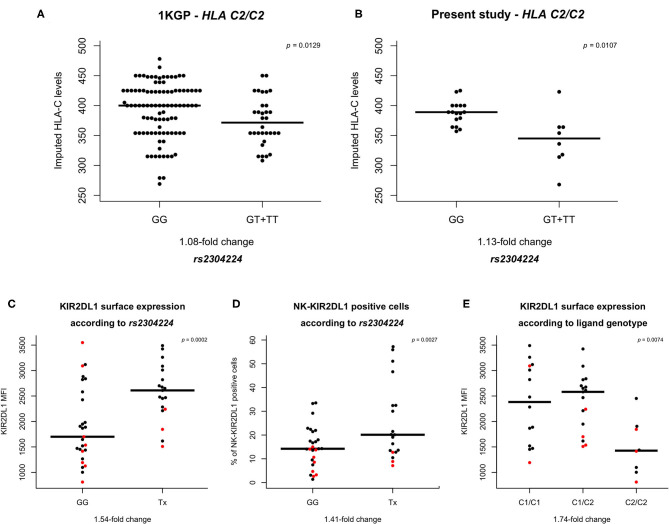
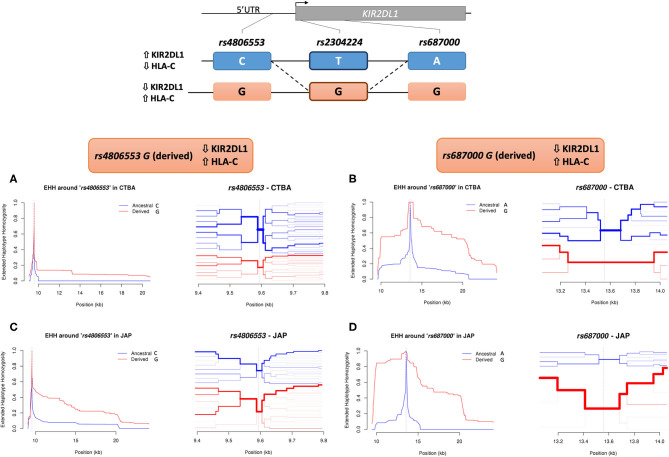
Regulation of NK cell activity is mediated through killer-cell immunoglobulin-like receptors (KIR) ability to recognize human leukocyte antigen (HLA) class I molecules as ligands. Interaction of KIR and HLA is implicated in viral infections, autoimmunity, and reproduction and there is growing evidence of the coevolution of these two independently segregating gene families. By leveraging KIR and HLA-C data from 1000 Genomes consortium we observed that the KIR2DL1 variant rs2304224*T is associated with lower expression of HLA-C in individuals carrying the ligand HLA-C2 (p = 0.0059). Using flow cytometry, we demonstrated that this variant is also associated with higher expression of KIR2DL1 on the NK cell surface (p = 0.0002). Next, we applied next generation sequencing to analyze KIR2DL1 sequence variation in 109 Euro and 75 Japanese descendants. Analyzing the extended haplotype homozygosity, we show signals of positive selection for rs4806553*G and rs687000*G, which are in linkage disequilibrium with rs2304224*T. Our results suggest that lower expression of HLA-C2 ligands might be compensated for higher expression of the receptor KIR2DL1 and bring new insights into the coevolution of KIR and HLA.

Keywords: KIR; NK cells; coevolution; expression; linkage disequilibrium; natural selection; population genetics.


Figures

Figure 1
Figure 1
HLA-C and KIR2DL1 expression are associated with genetic variants. (A,B) rs2304224 in KIR2DL1 marks in silico HLA-C surface expression (28) in two different cohorts. The presence of allele rs2304224*T marks lower HLA-C expression in (A) 130 C2/C2 homozygotes out of 955 individuals from 1000 genomes consortium and (B) 25 C2/C2 homozygotes out of 308 Euro-Brazilians from Curitiba (present study). (C) Higher KIR2DL1 surface expression and (D) increased presence on NK cells are also associated with the variant rs2304224*T (p = 0.0002 and p = 0.0027, respectively). (E) HLA-C genotype is associated to KIR2DL1 surface expression (p = 0.0074). There is no difference in expression, however, between homozygotes C1/C1 and heterozygotes C1/C2 (p = 0.44). Homozygosity for C2/C2, on the other hand, is associated with lower KIR2DL1 surface expression than in C1/C1 (p = 0.0031) and C1/C2 (p = 0.0016). Each dot in the graphs represents one individual. Red dots indicate hemizygosity for KIR2DL1. Median values are shown in horizontal lines and statistical significance is indicated in the top right corners of each plot.
Figure 2
Figure 2
Extended haplotype homozygosity (EHH) in KIR2DL1. The extended homozygosity analysis is based on the premise that advantageous alleles increase in frequency at a higher pace than the local recombination rate breaks down the haplotypes in which these alleles are located. Therefore, alleles marking regions with elevated extended homozygosity are possibly under recent positive selection. Here we identify extended haplotypes surrounding KIR2DL1 variants rs4806553 and rs687000. The possible haplotypes of rs4806553 and rs687000 in relation to rs2304224 are represented at the top of the image. The continuous line represents the most common configuration between two variants, and the dashed line represent less frequent configurations. On the left of each haplotype, arrows indicate higher or lower expression of KIR2DL1 and HLA-C, as associated with rs2304224 alleles G or T. A representation of the genomic organization of KIR2DL1 with the indicated location of the three variants is represented above. (A) EHH graph of decay in homozygosity (left) and furcation plot (right) for rs4806553 in Euro-Brazilians. The graph shows little to no difference between ancestral rs4806553*C (blue) and derived rs4806553*G (red) alleles in Euro-Brazilians. (C) EHH graph of decay in homozygosity (left) and furcation plot (right) for rs4806553 in Japanese. In Japanese, elevated homozygosity is associated with derived allele rs4806553*G (red). (B) EHH graph of decay in homozygosity (left) and furcation plot (right) for rs687000 in Brazilians with European ancestry and (D) Brazilians with Japanese ancestry. Elevated homozygosity associated with derived allele rs687000*G (red) is consistent with the selective sweep model, in which recent positive selection sweeps the diversity on nearby loci. Vertical dotted lines indicate the position of the core SNP. The thickness of each branch in the furcation plot is determined by haplotype frequency.

References

    1. Kiessling R, Klein E, Pross H, Wigzell H. “Natural” killer cells in the mouse. II. Cytotoxic cells with specificity for mouse moloney leukemia cells. Characteristics of the killer cell. Eur J Immunol. (1975) 5:117–21. 10.1002/eji.1830050209 - DOI - PubMed
    1. Waggoner SN, Reighard SD, Gyurova IE, Cranert SA, Mahl SE, Karmele EP, et al. . Roles of natural killer cells in antiviral immunity. Curr Opin Virol. (2016) 16:15–23. 10.1016/j.coviro.2015.10.008 - DOI - PMC - PubMed
    1. Ciccone E, Pende D, Viale O, Di Donate C, Tripodi G, Orengo AM, et al. . Evidence of a natural killer (NK) cell repertoire for (allo) antigen recognition: definition of five distinct NK-determined allospecificities in humans. J Exp Med. (1992) 175:709–18. 10.1084/jem.175.3.709 - DOI - PMC - PubMed
    1. van der Slik AR, Koeleman BPC, Verduijn W, Bruining GJ, Roep BO, Giphart MJ. KIR in type 1 diabetes: disparate distribution of activating and inhibitory natural killer cell receptors in patients versus HLA-matched control subjects. Diabetes. (2003) 52:2639–42. 10.2337/diabetes.52.10.2639 - DOI - PubMed
    1. Augusto DG, Lobo-Alves SC, Melo MF, Pereira NF, Petzl-Erler ML. Activating KIR and HLA Bw4 ligands are associated to decreased susceptibility to pemphigus foliaceus, an autoimmune blistering skin disease. PLoS ONE. (2012) 7:e39991. 10.1371/journal.pone.0039991 - DOI - PMC - PubMed

Publication types