


Impact of Sex and Smoking on the Efficacy of EGFR-TKIs in Terms of Overall Survival in Non-small-Cell Lung Cancer: A Meta-Analysis
- PMID: 32984005
- PMCID: PMC7477328
- DOI: 10.3389/fonc.2020.01531
Impact of Sex and Smoking on the Efficacy of EGFR-TKIs in Terms of Overall Survival in Non-small-Cell Lung Cancer: A Meta-Analysis
Abstract
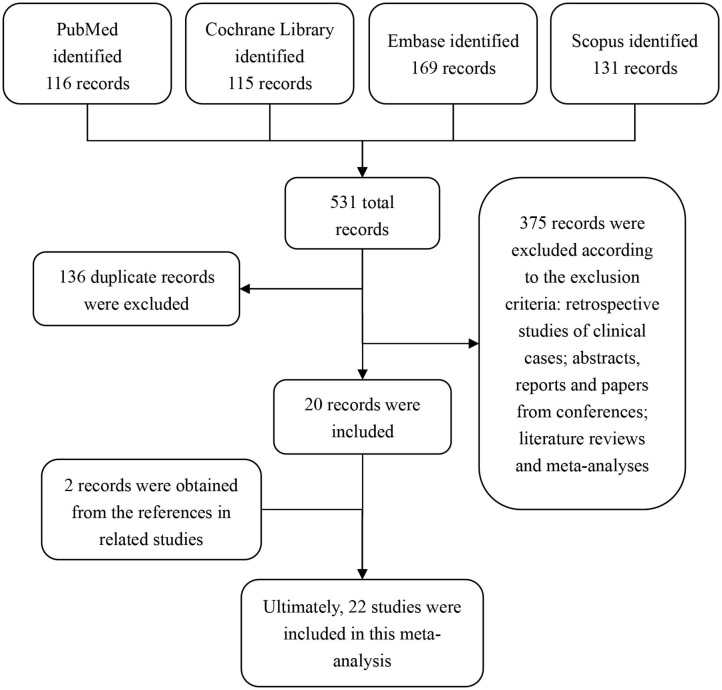
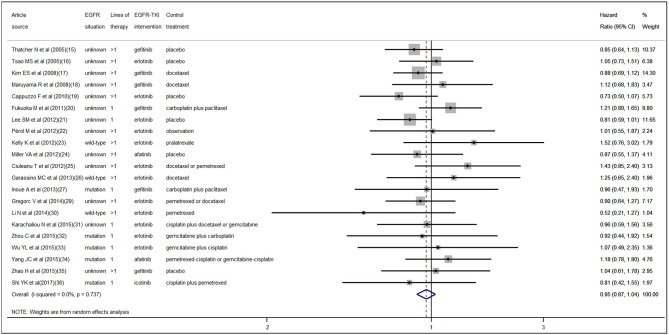
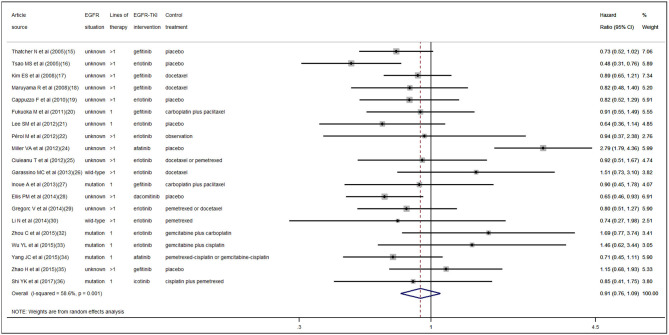
Background: To comprehensively understand the impact of sex and smoking on the efficacy of epidermal growth factor receptor-tyrosine kinase inhibitor (EGFR-TKI) therapy in terms of overall survival (OS) in non-small-cell lung cancer (NSCLC). Methods: PubMed, Cochrane Library, Embase, and Scopus were searched from inception to March 17, 2019. OS was analyzed based on hazard ratios (HRs) and 95% confidence intervals (CIs) and estimated using the random effects model. Results: Our meta-analysis included 22 studies involving 11,874 patients. In the primary analysis, we found no statistically significant efficacy difference for EGFR-TKI intervention between females and males (pooled HR 0.95, 95% CI 0.87-1.04, P = 0.30) and no obvious efficacy difference between never smokers and ever smokers (pooled HR 0.91, 95% CI 0.76-1.09, P = 0.31). In the subgroup analysis of placebo control treatment, we found that female NSCLC patients who received EGFR-TKI therapy had a longer OS than male patients (pooled HR 0.86, 95% CI 0.75-1.00, P = 0.04), while smoking status showed no significant effect on the efficacy of EGFR-TKI treatment in terms of the OS of NSCLC patients in all subgroup analyses. Conclusion: The efficacy of EGFR-TKI therapy for NSCLC patients is independent of smoking status but dependent on sex, and females have a longer OS than males.
Keywords: epidermal growth factor receptor-tyrosine kinase inhibitor; meta-analysis; non-small-cell lung cancer; overall survival; sex.
Copyright © 2020 Xiao, Zhou, He and Chen.
Figures
References
Publication types
LinkOut - more resources
Full Text Sources
Research Materials
Miscellaneous
