


Fragility of a multilayer network of intranational supply chains
- PMID: 32984501
- PMCID: PMC7509503
- DOI: 10.1007/s41109-020-00310-1
Fragility of a multilayer network of intranational supply chains
Abstract
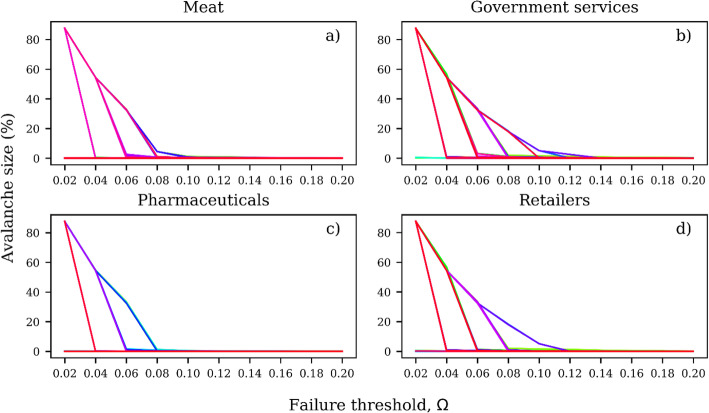
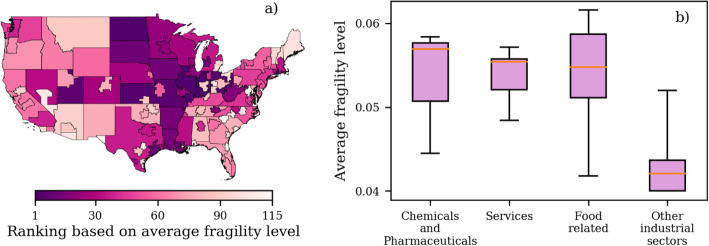
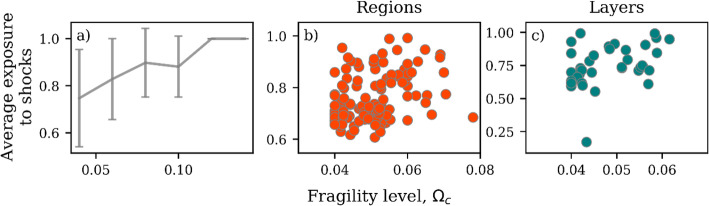
Supply chains enable the flow of goods and services within economic systems. When mapped for the entire economy and geographic locations of a country, supply chains form a spatial web of interactions among suppliers and buyers. One way to characterize supply chains is through multiregional input-output linkages. Using a multiregional input-output dataset, we build the multilayer network of supply chains in the United States. Together with a network cascade model, the multilayer network is used to explore the propagation of economic shocks along intranational supply chains. We find that the effect of economic shocks, measured using the avalanche size or total number of collapsed nodes, varies widely depending on the geographic location and economic sector of origin of a shock. The response of the supply chains to shocks reveals a threshold-like behavior. Below a certain failure or fragility level, the avalanche size increases relatively quickly for any node in the network. Based on this result, we find that the most fragile regions tend to be located in the central United States, which are regions that tend to specialize in food production and manufacturing. The most fragile layers are chemical and pharmaceutical products, services and food-related products, which are all sectors that have been disrupted by the Coronavirus Disease 2019 (COVID-19) pandemic in the United States. The fragility risk, measured by the intersection of the fragility level of a node and its exposure to shocks, varies across regions and sectors. This suggests that interventions aiming to make the supply-chain network more robust to shocks are likely needed at multiple levels of network aggregation.
Keywords: COVID-19; Cascading failure; Diffusion; Economic networks; Multiplex; Multiregional input-output; Shock.
© The Author(s) 2020.
Conflict of interest statement
Competing interestsThe authors declare that they have no competing interests.
Figures
References
-
- Acemoglu D, Akcigit U, Kerr W. Networks and the macroeconomy: an empirical exploration. NBER Macroecon Annu. 2016;30(1):273–335. doi: 10.1086/685961. - DOI
-
- Acemoglu D, Carvalho VM, Ozdaglar A, Tahbaz-Salehi A. The network origins of aggregate fluctuations. Econometrica. 2012;80(5):1977–2016. doi: 10.3982/ECTA9623. - DOI
-
- Acemoglu D, Ozdaglar A, Tahbaz-Salehi A. The Oxford handbook of the economics of networks. 2016. Networks, shocks, and systemic risk.
-
- Acharya VV, Richardson M. Causes of the financial crisis. Crit Rev. 2009;21(2–3):195–210. doi: 10.1080/08913810902952903. - DOI
-
- Akpan N (2020) These underlying conditions make coronavirus more severe, and they’re surprisingly common. Natl Geogr. https://www.nationalgeographic.com/science/2020/03/these-underlyingcondi.... Accessed 30 Mar 2020.
LinkOut - more resources
Full Text Sources
Other Literature Sources