


Association of trimethylamine N-Oxide with cardiovascular and all-cause mortality in hemodialysis patients
- PMID: 32985309
- PMCID: PMC7534338
- DOI: 10.1080/0886022X.2020.1822868
Association of trimethylamine N-Oxide with cardiovascular and all-cause mortality in hemodialysis patients
Abstract
Background: Trimethylamine-N-Oxide (TMAO) is a proatherogenic and prothrombotic metabolite. Our study examined the association of plasma TMAO level with cardiovascular and all-cause mortality in hemodialysis (HD) patients.
Methods: Patients who were at least 18 years-old and received HD for at least 6 months were enrolled within 6 months. Patients with coronary heart disease, congestive heart failure, arrhythmia, or stroke within 3 months before study onset were excluded. The primary endpoints were cardiovascular and all-cause death, and the secondary endpoint was cerebrovascular death.
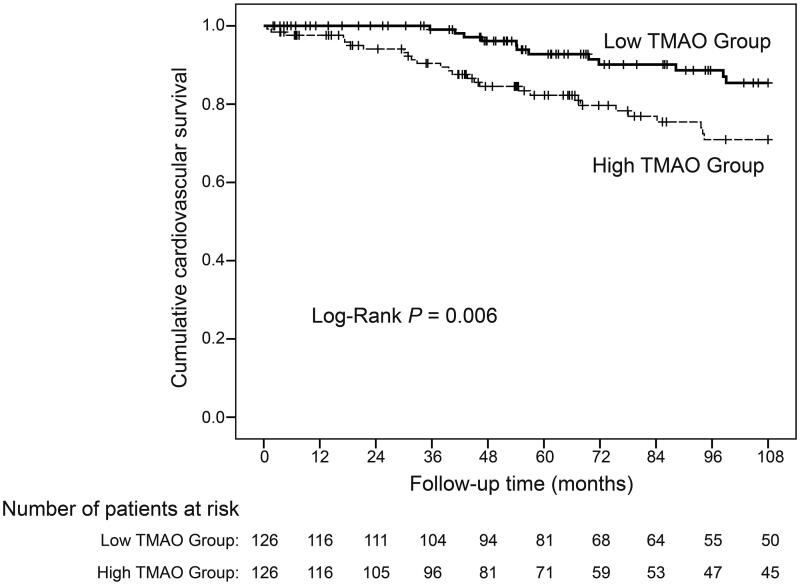
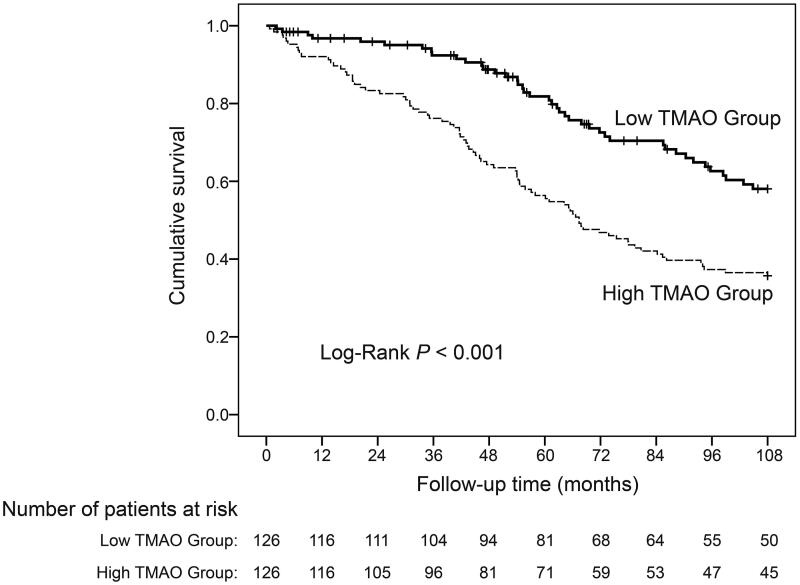
Results: We recruited 252 patients and divided them into a high-TMAO group (>4.73 μg/mL) and a low-TMAO group (≤4.73 μg/mL). The median follow-up time was 73.4 months (interquartile range: 42.9, 108). A total of 123 patients died, 39 from cardiovascular disease, 19 from cerebrovascular disease, and 65 from other causes. Kaplan-Meier analysis indicated that the high-TMAO group had a greater incidence of cardiovascular death (Log-Rank: p = 0.006) and all-cause death (Log-Rank: p < 0.001). Cox regression analysis showed that high TMAO level was significantly associated with cardiovascular and all-cause mortality. After adjustment for confounding, this association remained significant for cardiovascular mortality (TMAO as a continuous variable: HR: 1.18, 95%CI: 1.07, 1.294, p < 0.001; TMAO as a dichotomous variable: HR: 3.44, 95%CI: 1.68, 7.08, p < 0.001) and all-cause mortality (TMAO as a continuous variable: HR: 1.14, 95%CI: 1.08, 1.21, p < 0.001; TMAO as a dichotomous variable: HR: 2.54, 95%CI: 1.71, 3.76, p < 0.001).
Conclusions: High plasma TMAO level is significantly and independently associated with cardiovascular and all-cause mortality in HD patients.
Keywords: Uremic toxins; all-cause mortality; cardiovascular mortality; hemodialysis; trimethylamine N-oxide.
Conflict of interest statement
The results presented in this paper have not been published previously in whole or part, except an abstract of this manuscript was presented earlier in ASN’s Kidney Week 2019 in Washington, DC (NO. 3236604).
Figures
References
-
- United States Renal Data System . 2018 USRDS annual data report: Epidemiology of kidney disease in the United States. Bethesda (MD): National Institutes of Health, National Institute of Diabetes and Digestive and Kidney Diseases; 2018.
-
- Himmelfarb J, Ikizler TA.. Hemodialysis. N Engl J Med. 2010;363(19):1833–1845. - PubMed
-
- Longenecker JC, Coresh J, Powe NR, et al. Traditional cardiovascular disease risk factors in dialysis patients compared with the general population: the CHOICE Study. J Am Soc Nephrol. 2002;13(7):1918–1927. - PubMed
-
- Tomlinson JAP, Wheeler DC.. The role of trimethylamine N-oxide as a mediator of cardiovascular complications in chronic kidney disease. Kidney Int. 2017;92(4):809–815. - PubMed
MeSH terms
Substances
LinkOut - more resources
Full Text Sources
Other Literature Sources
Medical
