. 2020 Sep 28;10(1):15859.
doi: 10.1038/s41598-020-72816-8.

Effect of very low-protein diets supplemented with branched-chain amino acids on energy balance, plasma metabolomics and fecal microbiome of pigs

Affiliations

Effect of very low-protein diets supplemented with branched-chain amino acids on energy balance, plasma metabolomics and fecal microbiome of pigs

Shelby Spring et al. Sci Rep. .

Abstract

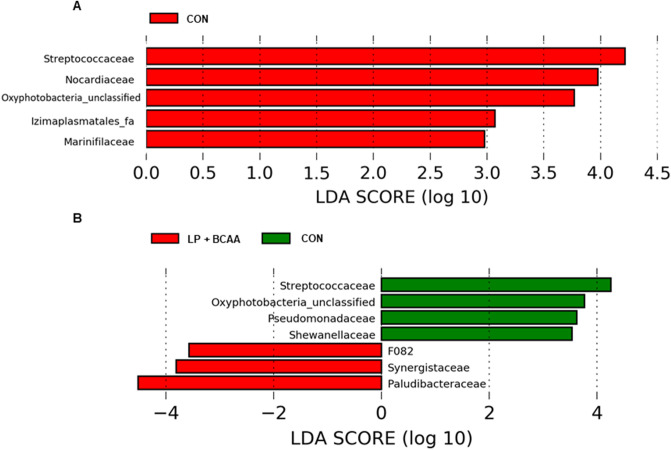
Feeding pigs with very-low protein (VLP) diets while supplemented with limiting amino acids (AA) results in decreased growth. The objective of this study was to determine if supplementing VLP diets with branched-chain AA (BCAA) would reverse the negative effects of these diets on growth and whether this is associated with alterations in energy balance, blood metabolomics and fecal microbiota composition. Twenty-four nursery pigs were weight-matched, individually housed and allotted into following treatments (n = 8/group): control (CON), low protein (LP) and LP supplemented with BCAA (LP + BCAA) for 4 weeks. Relative to CON, pigs fed with LP had lower feed intake (FI) and body weight (BW) throughout the study, but those fed with LP + BCAA improved overall FI computed for 4 weeks, tended to increase the overall average daily gain, delayed the FI and BW depression for ~ 2 weeks and had transiently higher energy expenditure. Feeding pigs with LP + BCAA impacted the phenylalanine and protein metabolism and fatty acids synthesis pathways. Compared to CON, the LP + BCAA group had higher abundance of Paludibacteraceae and Synergistaceae and reduced populations of Streptococcaceae, Oxyphotobacteria_unclassified, Pseudomonadaceae and Shewanellaceae in their feces. Thus, supplementing VLP diets with BCAA temporarily annuls the adverse effects of these diets on growth, which is linked with alterations in energy balance and metabolic and gut microbiome profile.


Conflict of interest statement

The authors declare no competing interests.

Figures
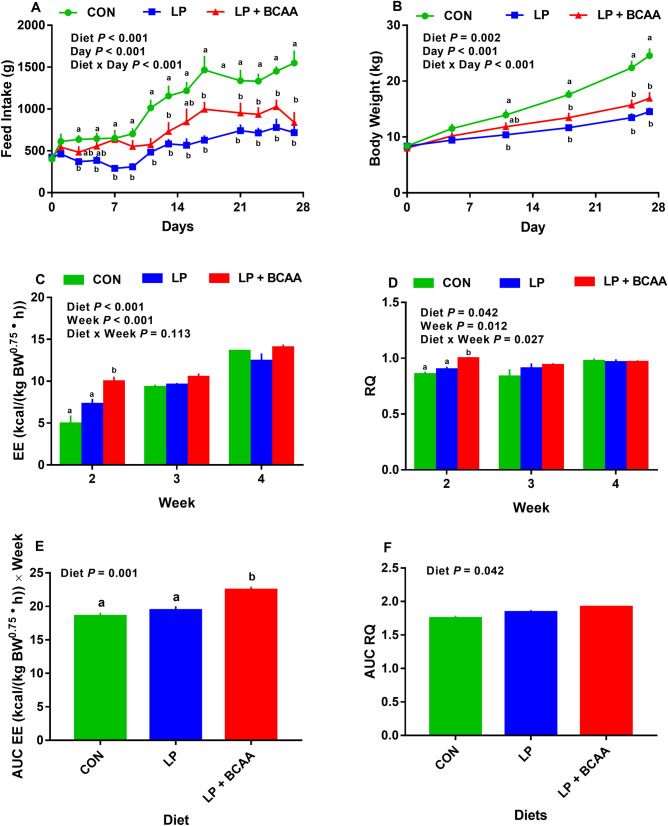
Figure 1
Figure 1
Effect of very low protein diets supplemented with branched-chain amino acids on energy balance. (A) feed intake, (B) body weight, (C) mean energy expenditure (EE), (D) mean respiratory quotient (RQ), (E) area under curve (AUC) for EE, and (F) AUC for RQ. CON, control diet; LP, low protein diet; LP + BCAA, low protein diet supplemented with branched-chain amino acids. Among groups, values with different superscripts are different (P ≤ 0.05). The values are means ± standard errors of means, n = 8.
Figure 2
Figure 2
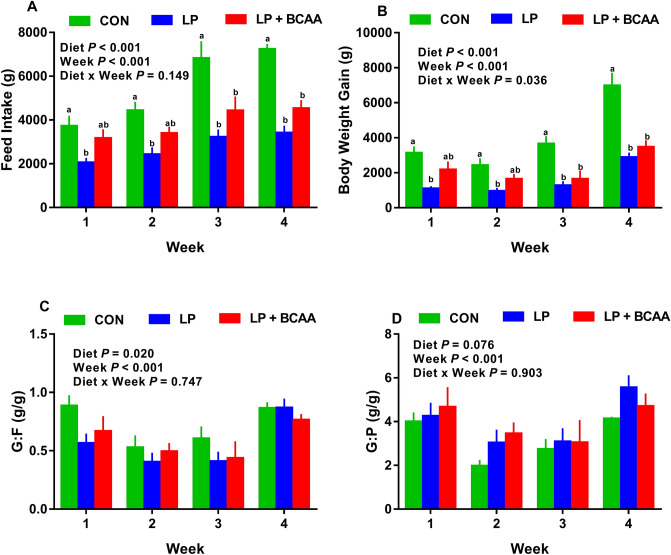
Effect of very low protein diets supplemented with branched-chain amino acids on weekly feed intake, body weight gain and feed and protein efficiency ratio. (A) cumulative feed intake, (B) body weight gain, (C) gain to feed ratio (G:F), and (D) gain to protein ratio (G:P). CON, control diet; LP, low protein diet; LP + BCAA, low protein diet supplemented with branched-chain amino acids. Among groups, values with different superscripts are different (P ≤ 0.05). The values are means ± standard errors of means, n = 8.
Figure 3
Figure 3
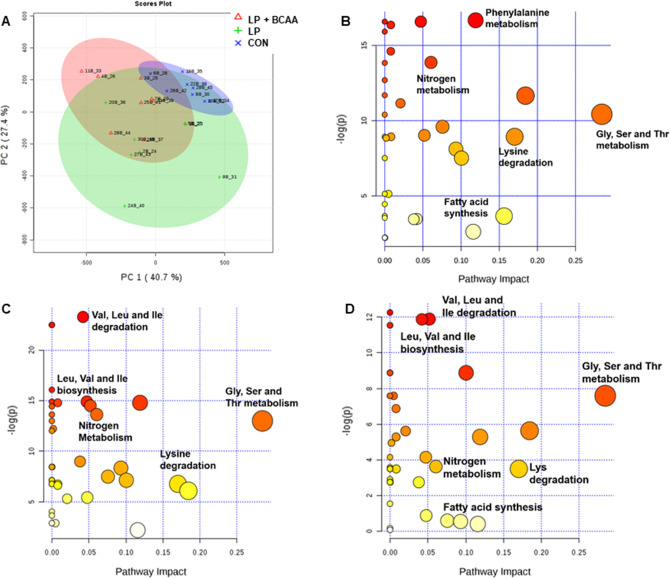
Principal component analysis (PCA) score plots and the pathway analysis map of plasma metabolites in pigs fed with very low protein diets supplemented with branched-chain amino acids. (A) PCA score plot for plasma metabolites. Individual pigs are shown as nodes, (B, C, D) the map of pathway analysis for the plasma. Each circle is obtained from topology analysis representing a metabolic pathway with the scores. The x-axis denotes the pathway impact and the y-axis represents the pathway enrichment. The size of each circle is based on its impact value while the color of each circle is based on its P value. Larger size circles have higher pathway impact, while darker color circles are indicative of more significant changes of metabolites and pathway enrichment. CON, control diet; LP, low protein diet; LP + BCAA, low protein diet supplemented with branched-chain amino acids. (B) CON vs. LP + BCAA, (C) CON vs. LP, (D) LP vs. LP + BCAA. n = 8.
Figure 4
Figure 4
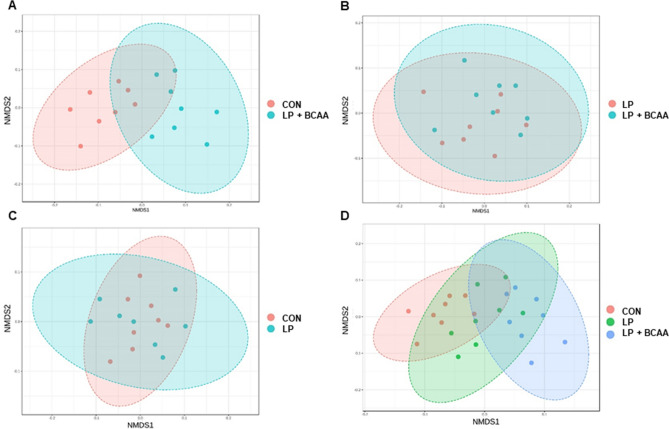
Beta diversity of the fecal bacterial community in pigs fed with very low protein diets supplemented with branched-chain amino acids. Non-metric multidimensional scaling (NMDS) of fecal microbiota for (A) CON vs. LP + BCAA, (B) LP vs. LP + BCAA, (C) CON vs. LP, (D) CON vs. LP vs. LP + BCAA. Pigs are grouped based on their dietary treatments, i.e. CON, control diet; LP, low protein diet; LP + BCAA, low protein diet supplemented with branched-chain amino acids. Each node represents an individual pig. Differences were considered significant at P < 0.05. The Permutational Multivariate Analysis of Variance (PERMANOVA) P values for CON vs. LP + BCAA, LP vs. LP + BCAA, CON vs. LP and CON vs. LP vs. LP + BCAA were < 0.004, < 0.197, 0.178 and < 0.016 respectively. n = 8.
Figure 5
Figure 5
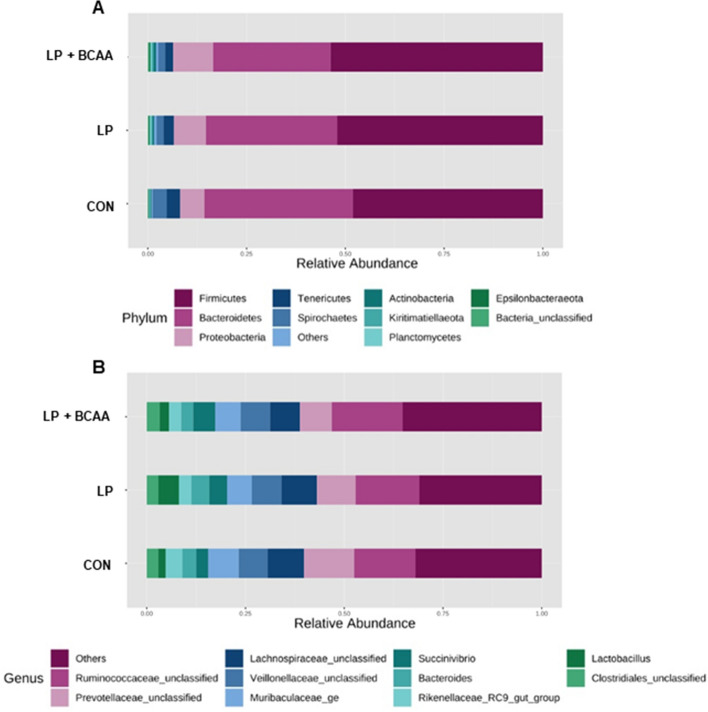
The effect of very low protein diets supplemented with branched-chain amino acids on fecal bacterial community at phylum and genus levels. (A) The relative abundance of bacterial community composition at phylum level in fecal samples of pigs fed with very low protein diets supplemented with branched-chain amino acids. Only the top 10 phyla are depicted for clarity. (B) The relative abundance of bacterial community composition at genus level in fecal samples of pigs fed with very low protein diets supplemented with branched-chain amino acids. Only the top 10 genera are depicted for clarity. CON, control diet; LP, low protein diet; LP + BCAA, low protein diet supplemented with branched-chain amino acids. n = 8.
Figure 6
Figure 6
Effect of very low protein diets supplemented with branched-chain amino acids on fecal microbiota composition at family level using linear discriminant analysis (LDA) with effect size measurements (LEfSe). (A) CON, control diet vs. LP, low protein diet. (B) CON vs. LP + BCAA, low protein diet supplemented with branched-chain amino acids. No differences in LDA analysis were seen for LP vs. LP + BCAA. n = 8.

References

    1. Campbell JM, Crenshaw JD, Polo J. The biological stress of early weaned piglets. J. Anim. Sci. Biotechnol. 2013;4:19. doi: 10.1186/2049-1891-4-19. - DOI - PMC - PubMed
    1. Ball RO, Aherne FX. Influence of dietary nutrient density, level of feed intake and weaning age on young pigs. II. Apparent nutrient digestibility and incidence and severity of diarrhea. Can. J. Anim. Sci. 1987;67:1105–1115.
    1. Yue LY, Qiao SY. Effects of low-protein diets supplemented with crystalline amino acids on performance and intestinal development in piglets over the first 2 weeks after weaning. Livest. Sci. 2008;115:144–152.
    1. Opapeju FO, Krause DO, Payne RL, Rademacher M, Nyachoti CM. Effect of dietary protein level on growth performance, indicators of enteric health, and gastrointestinal microbial ecology of weaned pigs induced with postweaning colibacillosis. J Anim Sci. 2009;87:2635–2643. - PubMed
    1. Manjarin R, et al. Effect of amino acids supply in reduced crude protein diets on performance, efficiency of mammary uptake, and transporter gene expression in lactating sows. J. Anim. Sci. 2012;90:3088–3100. - PubMed

Publication types