


Misperception of Visual Verticality in Patients with Primary Headache Disorders: A Systematic Review with Meta-Analysis
- PMID: 32987639
- PMCID: PMC7598580
- DOI: 10.3390/brainsci10100664
Misperception of Visual Verticality in Patients with Primary Headache Disorders: A Systematic Review with Meta-Analysis
Abstract
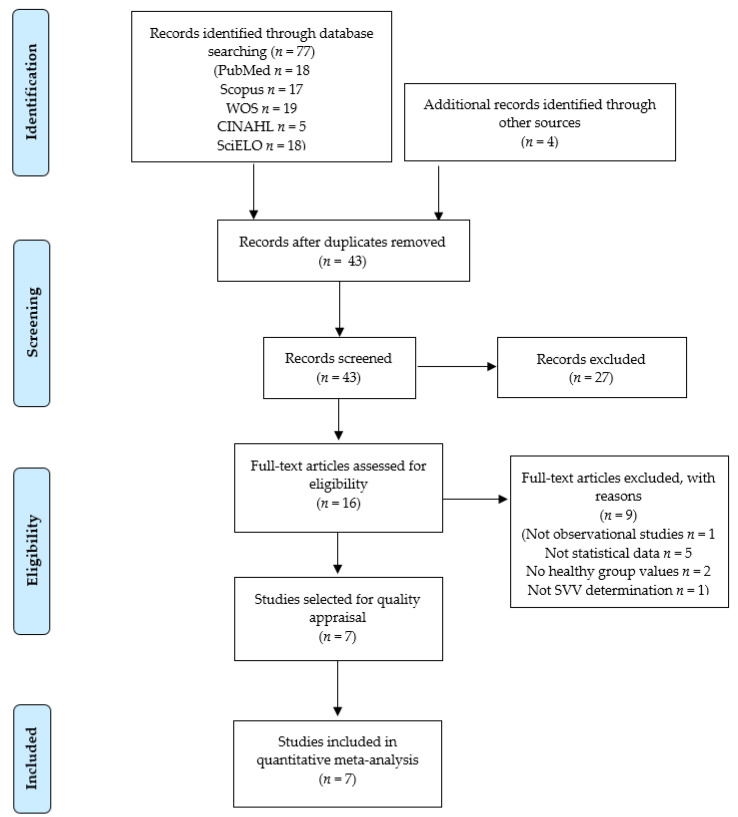
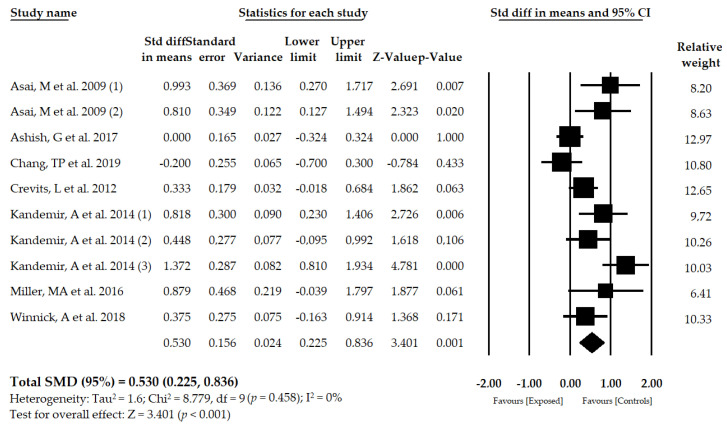
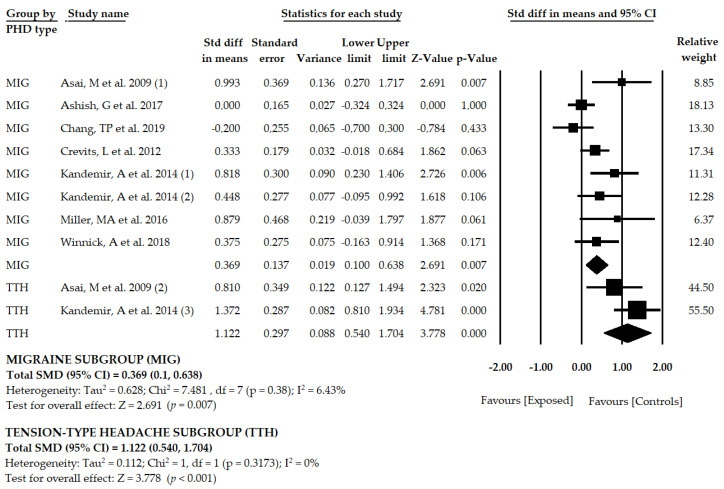
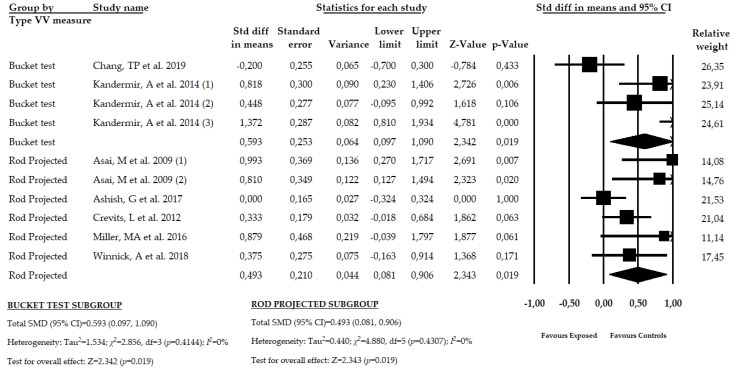
Migraine and tension-type headache (TTH) are the two most prevalent primary headache disorders (PHDs) that may involve visual and vestibular impairments, neck pain, and postural unsteadiness. The perception of visual verticality (VV) has been studied in patients diagnosed with PHD to assess balance disorders showing varying findings. Our study aimed to assess the VV perception in patients diagnosed with PHD in comparison to healthy controls. A systematic review with meta-analysis was carried out in PubMed MEDLINE, Scopus, WOS, CINAHL, and SciELO. The Cohen standardized mean difference (SMD) was used to estimate the differences between exposed and healthy controls. Seven studies with 816 participants were included. The quality of included studies, according to the Newcastle-Ottawa Scale (NOS), was moderate (mean score of 5.2). Patients diagnosed with PHD showed a moderate misperception of VV as assessed with the subjective visual vertical (SVV) test (SMD = 0.530; 95% CI = 0.225, 0.836; p < 0.001). Specifically, a misperception of the SVV was found in patients with migraine (SMD = 0.369; 95% CI = 0.1, 0.638; p = 0.007) and with TTH (SMD = 1.122; 95% CI = 0.540, 1.704; p < 0.001). This review shows a misperception of VV in patients with migraine and TTH when assessed with the SVV test, being higher in patients with TTH, although the THH sample size was low.
Keywords: migraine; perception of visual verticality; primary headache disorders; sensory integration; subjective visual vertical; tension-type headache.
Conflict of interest statement
The authors declare no conflict of interest.
Figures

Similar articles
-
Misperception of Visual Vertical in Peripheral Vestibular Disorders. A Systematic Review With Meta-Analysis.Laryngoscope. 2021 May;131(5):1110-1121. doi: 10.1002/lary.29124. Epub 2020 Sep 23. Laryngoscope. 2021. PMID: 32965689
-
Visual Verticality Perception in Spinal Diseases: A Systematic Review and Meta-Analysis.J Clin Med. 2020 Jun 3;9(6):1725. doi: 10.3390/jcm9061725. J Clin Med. 2020. PMID: 32503240 Free PMC article. Review.
-
Misperception of the subjective visual vertical in neurological patients with or without stroke: A meta-analysis.NeuroRehabilitation. 2019;44(3):379-388. doi: 10.3233/NRE-182642. NeuroRehabilitation. 2019. PMID: 31227659
-
New Mobile Device to Measure Verticality Perception: Results in Young Subjects with Headaches.Diagnostics (Basel). 2020 Oct 7;10(10):796. doi: 10.3390/diagnostics10100796. Diagnostics (Basel). 2020. PMID: 33036468 Free PMC article.
-
Pericranial Total Tenderness Score in Patients with Tension-type Headache and Migraine. A Systematic Review and Meta-analysis.Pain Physician. 2021 Dec;24(8):E1177-E1189. Pain Physician. 2021. PMID: 34793636
Cited by
-
Care Gaps and Recommendations in Vestibular Migraine: An Expert Panel Summit.Front Neurol. 2022 Jan 3;12:812678. doi: 10.3389/fneur.2021.812678. eCollection 2021. Front Neurol. 2022. PMID: 35046886 Free PMC article. Review.
-
Clinical Features, Video Head Impulse Test, and Subjective Visual Vertical of Acute and Symptom-Free Phases in Patients with Definite Vestibular Migraine.Biomedicines. 2025 Mar 30;13(4):825. doi: 10.3390/biomedicines13040825. Biomedicines. 2025. PMID: 40299426 Free PMC article.
-
Evaluation of Subjective Visual Vertical (SVV) and Ocular Movements in Patients with Primary headache -An Analytical Cross-sectional Study.Indian J Otolaryngol Head Neck Surg. 2025 Jan;77(1):334-341. doi: 10.1007/s12070-024-05182-w. Epub 2024 Nov 2. Indian J Otolaryngol Head Neck Surg. 2025. PMID: 40066408 No abstract available.
-
What visuospatial perception has taught us about the pathophysiology of vestibular migraine.Curr Opin Neurol. 2024 Feb 1;37(1):32-39. doi: 10.1097/WCO.0000000000001232. Epub 2023 Nov 29. Curr Opin Neurol. 2024. PMID: 38018799 Free PMC article. Review.
References
-
- Stovner L.J., Nichols E., Steiner T.J., Abd-Allah F., Abdelalim A., Al-Raddadi R.M., Ansha M.G., Barac A., Bensenor I.M., Doan L.P., et al. Global, regional, and national burden of migraine and tension-type headache, 1990–2016: A systematic analysis for the Global Burden of Disease Study 2016. Lancet Neurol. 2018;17:954–976. doi: 10.1016/S1474-4422(18)30322-3. - DOI - PMC - PubMed
-
- Vos T., Abajobir A.A., Abbafati C., Abbas K.M., Abate K.H., Abd-Allah F., Abdulle A.M., Abebo T.A., Abera S.F., Aboyans V., et al. Global, regional, and national incidence, prevalence, and years lived with disability for 328 diseases and injuries for 195 countries, 1990–2016: A systematic analysis for the Global Burden of Disease Study 2016. Lancet. 2017;390:1211–1259. doi: 10.1016/S0140-6736(17)32154-2. - DOI - PMC - PubMed
Publication types
LinkOut - more resources
Full Text Sources
