Review
. 2020 Sep 24;21(19):7022.
doi: 10.3390/ijms21197022.

Exosome Composition and Seminal Plasma Proteome: A Promising Source of Biomarkers of Male Infertility

Affiliations
Review

Exosome Composition and Seminal Plasma Proteome: A Promising Source of Biomarkers of Male Infertility

Luz Candenas et al. Int J Mol Sci. .

Abstract

Infertility has become a global health issue, with approximately 50% of infertility cases generated by disorders in male reproduction. Spermatozoa are conveyed towards female genital tracts in a safe surrounding provided by the seminal plasma. Interestingly, this dynamically changing medium is a rich source of proteins, essential not only for sperm transport, but also for its protection and maturation. Most of the seminal proteins are acquired by spermatozoa in transit through exosomes (epididymosomes and prostasomes). The high number of seminal proteins, the increasing knowledge of their origins and biological functions and their differential expression in the case of azoospermia, asthenozoospermia, oligozoospermia and teratozoospermia or other conditions of male infertility have allowed the identification of a wide variety of biomarker candidates and their involvement in biological pathways, thus to strongly suggest that the proteomic landscape of seminal plasma may be a potential indicator of sperm dysfunction. This review summarizes the current knowledge in seminal plasma proteomics and its potentiality as a diagnostic tool in different degrees of male infertility.

Keywords: biomarkers; infertility; seminal exosomes; seminal plasma; seminal proteins; sperm.


Conflict of interest statement

The authors declare no conflict of interest.

Figures
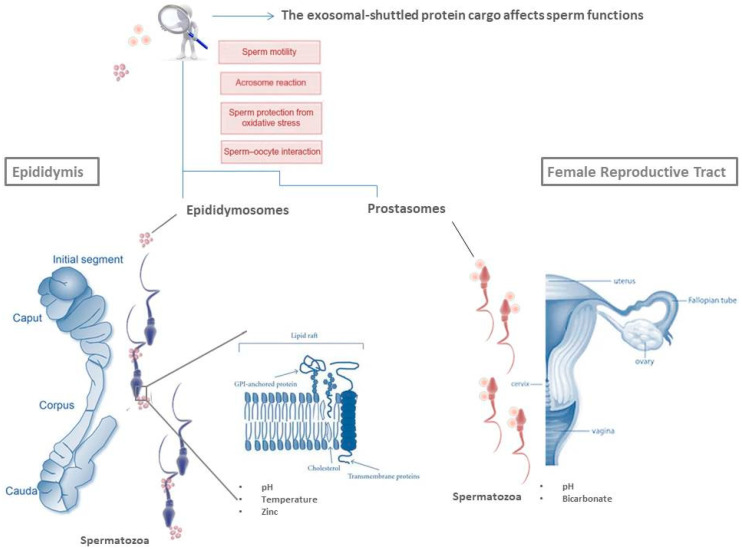
Figure 1
Figure 1
The fate of spermatozoa (SPZ) beyond testis. During their transit along the epididymis, SPZ receive proteins carried by epididymosomes. The GPI-anchor-mediated docking is a way of epididymosomal delivery cargo from lipid rafts of epididymosomes to lipid rafts of SPZ. Other conditions, such as pH, temperature and zinc concentration surely influence vesicle fusion. During ejaculation, SPZ encounter another subset of exosomes: the prostasomes. The recruitment of prostasomes by SPZ requires the presence of bicarbonate and an environment with a favorable pH. Proteins shuttled via exosomes are involved in important sperm functions such as sperm motility, prevention of premature acrosome reaction, protection of SPZ from oxidative stress and sperm–oocyte interaction.

References

    1. Sendler E., Johnson G.D., Mao S., Goodrich R.J., Diamond M.P., Hauser R., Krawetz S.A. Stability, delivery and functions of human sperm RNAs at fertilization. Nucleic Acids Res. 2013;41:4104–4117. doi: 10.1093/nar/gkt132. - DOI - PMC - PubMed
    1. Rodriguez-Martinez H., Kvist U., Ernerudh J., Sanz L., Calvete J.J. Seminal plasma proteins: What role do they play? Am. J. Reprod. Immunol. 2011;66:11–22. doi: 10.1111/j.1600-0897.2011.01033.x. - DOI - PubMed
    1. Samanta L., Parida R., Dias T.R., Agarwal A. The enigmatic seminal plasma: A proteomics insight from ejaculation to fertilization. Reprod. Biol. Endocrinol. 2018;16:41. doi: 10.1186/s12958-018-0358-6. - DOI - PMC - PubMed
    1. Lilja H., Oldbring J., Rannevik G., Laurell C.B. Seminal vesicle-secreted proteins and their reactions during gelation and liquefaction of human semen. J. Clin. Investig. 1987;80:281–285. doi: 10.1172/JCI113070. - DOI - PMC - PubMed
    1. Aalberts M., Stout T.A., Stoorvogel W. Prostasomes: Extracellular vesicles from the prostate. Reproduction. 2014;147:R1–R14. doi: 10.1530/REP-13-0358. - DOI - PubMed
