. 2020 Sep 25;51(1):124.
doi: 10.1186/s13567-020-00842-5.

Epidemiology of age-dependent prevalence of Bovine Herpes Virus Type 1 (BoHV-1) in dairy herds with and without vaccination

Affiliations

Epidemiology of age-dependent prevalence of Bovine Herpes Virus Type 1 (BoHV-1) in dairy herds with and without vaccination

Jonas Brock et al. Vet Res. .

Abstract

Many studies report age as a risk factor for BoHV-1 infection or seropositivity. However, it is unclear whether this pattern reflects true epidemiological causation or is a consequence of study design and other issues. Here, we seek to understand the age-related dynamics of BoHV-1 seroprevalence in seasonal calving Irish dairy herds and provide decision support for the design and implementation of effective BoHV-1 testing strategies. We analysed seroprevalence data from dairy herds taken during two Irish seroprevalence surveys conducted between 2010 and 2017. Age-dependent seroprevalence profiles were constructed for herds that were seropositive and unvaccinated. Some of these profiles revealed a sudden increase in seroprevalence between adjacent age-cohorts, from absent or low to close to 100% of seropositive animals. By coupling the outcome of our data analysis with simulation output of an individual-based model at the herd scale, we have shown that these sudden increases are related to extensive virus circulation within a herd for a limited time, which may then subsequently remain latent over the following years. BoHV-1 outbreaks in dairy cattle herds affect animals independent of age and lead to almost 100% seroconversion in all age groups, or at least in all animals within a single epidemiological unit. In the absence of circulating infection, there is a year-on-year increase in the age-cohort at which seroprevalence changes from low to high. The findings of this study inform recommendations regarding testing regimes in the context of contingency planning or an eradication programme in seasonal calving dairy herds.

Keywords: Ireland; dairy; infection dynamics; infectious Bovine Rhinotracheitis (IBR); seasonal calving; serosurveillance.


Conflict of interest statement

The authors declare that they have no competing interests.

Figures
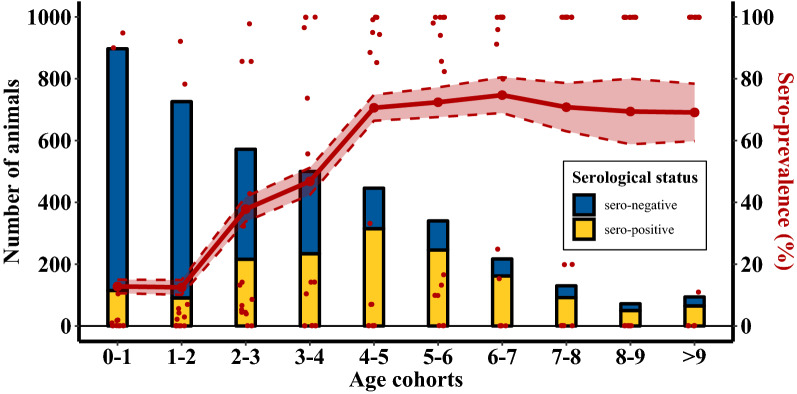
Figure 1
Figure 1
Animal-level seroprevalence in 15 unvaccinated seropositive dairy herds (Dataset A), by age cohort. Per age cohort the dataset is shown as the absolute number of seropositive/negative cattle (yellow/blue bar chart, left y-axis); and as a proportion of seropositive animals (red line, right axis, with its 95% confidence interval). Red dots (right axis) refer to herd-level seroprevalence for each herd, again by age-cohort. (Note: Across the early and late age-cohorts the individual herds’ prevalence values (red dots) tend to dichotomies between zero and 100%).
Figure 2
Figure 2
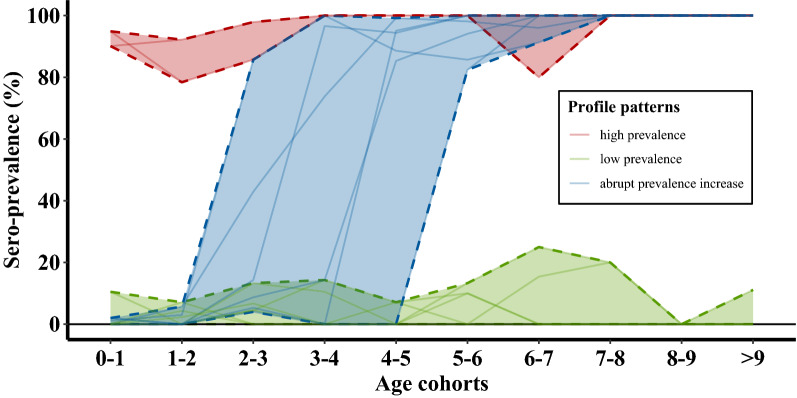
Individual age-dependent seroprevalence profiles of 15 unvaccinated seropositive dairy herds (Dataset A as in Figure 1). Each line represents the age-dependent data from a single herd. Three qualitatively different profile categories are identified: [1] herds with a high seroprevalence throughout all age cohorts (red), [2] herds with one abrupt increase in seroprevalence between consecutive age cohorts (blue), and [3] herds with a low prevalence across all age cohorts. Solid lines represent individual herds, while dashed lines indicate maximum/minimum envelopes per category.
Figure 3
Figure 3
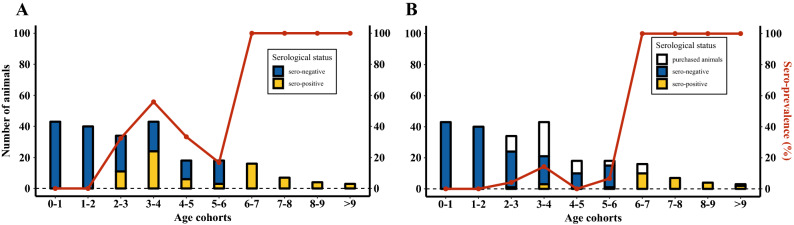
Serological profile of a single unvaccinated herd before (A) and after (B) exclusion of purchased animals. Correction for movement events reveals the category of seroprevalence profiles reflecting the history of BoHV-1 circulation in this herd. Note: Nevertheless, this herd was excluded from further analysis due to the high number of in-moves.
Figure 4
Figure 4
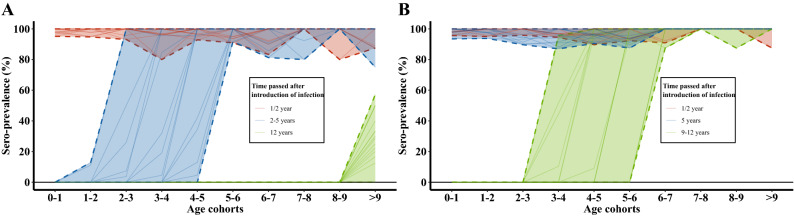
Model output of the age-dependent seroprevalence profiles of 15 simulated cattle herds at three subsequent time points after a single introduction of BoHV-1 infection (line colours). Solid lines represent individual herds, while dashed lines indicate the maximum/minimum envelopes per time point. A Output scenario A—no reactivation: the 15 seroprevalence profiles are reported at 0.5 years (red); at a random time point between 2 and 5 years (blue); and at 12 years (green) after the initial seeding of infection. B Output scenario B—reactivation of a latent animal was forced 4.5 years after the initial seeding of infection, leading to an additional round of primary infection: the 15 seroprevalence profiles are reported at 0.5 years (red); at 5 years (blue); and at a random time point between 9 and 12 years (green) after the initial seeding of infection. Note: In (b) Blue lines, i.e. 5 years post introduction, equal 0.5 years after reactivation occurred; and green equals time points selected at random between 4.5 and 7.5 years after the reactivation event.
Figure 5
Figure 5
Stacked area graphs representing the age-dependent seroprevalence profile over a five year period in a single vaccinated dairy herd. The herd was serologically sampled in (A) 2010, (B) 2011, (C) 2013 and (D) 2015. In this herd, vaccination started in 2012. The left y-axis (the number of animals) refers to the smoothed histograms (seropositive, seronegative) and the right y-axis (seroprevalence) to the coloured line. The lines represent age-dependent seroprevalence profiles, which were coloured according to the epidemiological stages as outlined in Figure 2.
Figure 6
Figure 6
Conceptual model for the spread and temporal development of BoHV-1 seroconversions in an unvaccinated dairy herd over the course of 10 years. A successful reactivation event occurred 5 years after initial virus introduction. In each of the plots, the black line represents apparent seroprevalence of a theoretical herd whereas pink represents seroconversions attributable to the initial outbreak and blue to the subsequent reactivation event. A Age-dependent seroprevalence profile half a year after initial virus introduction; B seroprevalence profile 4.5 years after virus introduction; C seroprevalence profile 5.5 years after virus introduction i.e. half year after reactivation event. D Seroprevalence profile 10 years after initial virus introduction and 5 years after the reactivation event.

References

    1. Ackermann M, Engels M. Pro and contra IBR-eradication. Vet Microbiol. 2006;113:293–302. doi: 10.1016/j.vetmic.2005.11.043. - DOI - PubMed
    1. Muylkens B, Thiry J, Kirten P, Schynts F, Thiry E. Bovine herpesvirus 1 infection and infectious bovine rhinotracheitis. Vet Res. 2007;38:181–209. doi: 10.1051/vetres:2006059. - DOI - PubMed
    1. Graham D. Bovine herpes virus-1 (BoHV-1) in cattle-a review with emphasis on reproductive impacts and the emergence of infection in Ireland and the United Kingdom. Ir Vet J. 2013;66:1. doi: 10.1186/2046-0481-66-15. - DOI - PMC - PubMed
    1. Nettleton P, Russell G. Update on infectious bovine rhinotracheitis. Pract. 2017;39:255–272. doi: 10.1136/inp.j2226. - DOI
    1. Nandi S, Kumar M, Manohar M, Chauhan R. Bovine herpes virus infections in cattle. Anim Health Res Rev. 2009;10:85–98. doi: 10.1017/S1466252309990028. - DOI - PubMed